




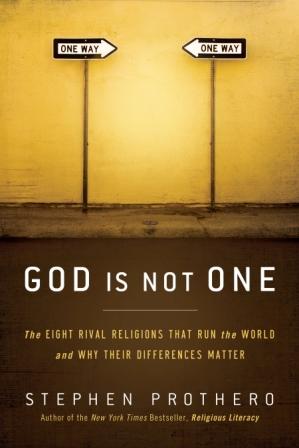
 Yesterday I began reading Stephen Prothero‘s new book, God Is Not One: The Eight Rival Religions that Run the World–And Why Their Differences Matter. It’s a follow-up to Prothero’s best-selling Religious Literacy: What Every American Needs to Know–And Doesn’t.
In God Is Not One, Prothero works to help us with our basic ignorance of eight of the world’s major religions. He does this in a very clean and engaging journalistic style. There’s history here, but also human drama and contemporary analysis. He also aims to avoid stereotypes and flat, one-dimensional depictions–no easy task given the scope of the book.
But one of the things I appreciate already is Prothero’s rejection of the current mantra among so many in the world: “All religions basically worship the same God.” Prothero uses his introduction to basically demolish that idea as far as I’m concerned. The book is worth the introduction for its able deconstruction of that myth. As an example, here’s a great analogy from a subsection in the introduction (“Sports and Salvation”) where Prothero illustrates that not all religions have the same goal of salvation, a common misconception most of us have:
Which of the following–baseball, basketball, tennis, or golf–is best at scoring runs? The answer of course is baseball, because runs is a term foreign to basketball, tennis, and golf alike. Different sports have different goals: basketball players shoot baskets; tennis players win points; golfers sink puts. So if you ask which sport is best at scoring runs, you have privileged baseball from the start. To criticize a basketball team for failing to score runs is not to besmirch them. It is simply to misunderstand the game of basketball. So here is another problem with the pretend pluralism of the perennial philosophy sort: just as hitting home runs is the monopoly of one sport, salvation is the monopoly of one religion. If you see sin as the human predicament and salvation as the solution, then it makes sense to come to Christ. But that will not settle as much as you might think, because the real question is not which religion is best at carrying us into the end zone of salvation but which of the many religious goals on offer we should be seeking. Should we be trudging toward the end zone of salvation, or tyring to reach the finish line of social harmony? Should our goal be reincarnation? Or escape from the vicious cycle of life, death, and rebirth? (p. 22)
The sports analogy is helpful because it reminds us that not every religious system has the same end in mind. They work to accomplish different things in the world and in the lives of the adherents.
But Prothero’s suggestion that choosing a religion simply depends on what goal we have in mind would seem to miss his own point. If we take the truth claims of each religion  seriously, we must recognize that some goals are penultimate at best (social harmony, for example), while others are ultimate and therefore overwhelmingly significant (rebirth or eternal life, for example). And we might realize that there is a religion that claims to do each in its proper place, that is, provide salvation through rebirth manifest in social harmony at least among its adherents. When we think in those terms, we’re really only left with one option: Jesus. God doesn’t come a la carte.
Prothero writes without that kind of interest. He attempts to write as a religion scholar possessing something of the “objective detachment” of his guild. He doesn’t pretend to have had no experience with religion, and with a Christian upbringing in particular. But in his assumption of academic standards for his fields, he manages to raise very big questions in very interesting ways without very helpful answers or guidance. That’s left to pastors and blog writers, I suppose :-).
At any rate, I’m three chapters in (Introduction, Islam, and Christianity) and already I think this is a book well worth buying and reading. As I said earlier, I think the introduction alone is worth the purchase price of the book. So far, he’s given a good overview of Islam, though each religion is a topic so vast an introduction to the religion could command an entire book itself. Props to Prothero for attempting such an ambitious undertaking.
Below are the chapters and religions covered. The sub-titles give you Prothero’s short-hand for the religion’s main goal.
Introduction
Islam: The Way of Submission
Christianity: The Way of Salvation
Confucianism: The Way of Propriety
Hinduism: The Way of Devotion
Buddhism: The Way of Awakening
Yoruba Religion: the Way of Connection
Judaism: The Way of Exile and Return
Daoism: The Way of Flourishing
A Brief Coda on Atheism: The Way of Religion
Lord willing, I hope to interact with God Is Not One as I read. Would really welcome your thoughts.
Related Posts: