



In recent years, the church has suffered numerous reports of catastrophic moral failure by some of its most talented and visible leaders. But it isn’t only famous, highly regarded pastors who falter.
It happens to all sorts of pastors from churches large, small, and midsize. They hail from every nation and every branch of Christendom. Their sins violate all sorts of biblical standards—and not just the most obvious ones of abuse of power and sexual sin; some leave the faith, dishonor authorities, take their own lives, break vows, misuse funds, plagiarize, covet, and more.
Why are so many pastors failing in these ways? Is moral failure among pastors really as much of an epidemic as it seems? How can we have confidence in our leaders amid all the bad news?
As we consider these questions, we’ll discuss here four potential explanations that have been offered. Two of these, while having some merit, I believe fail to get at the heart of the matter; the other two, I think, come closer to helping us understand the real issues affecting how and why pastors fail, and the church’s role in that process.
Explanation #1: Pastors don’t fail in great numbers. The press and social media foster the illusion of a problem.
It’s tempting to blame the press for publicizing the problem. The argument goes like this: Most pastors are faithful and honorable, and problems are overreported since the press loves scandals, especially if they involve leaders. Rising antipathy toward the church also makes signs of hypocrisy appealing to editors. Further, the argument goes, our current fascination with victims prompts publication of abuse allegations that sometimes prove false. And social media spreads uncertain allegations even if they never appear in the traditional press.
There is a measure of truth in these points, and exposing corruption and oppression from any quarter has long been an essential part of the press’s vocation. But even so, too many pastors do fail both morally and spiritually. And church leaders aren’t the only ones whose failings are broadcast far and wide; we also hear about those of politicians, athletes, business leaders, and entertainers. The church cannot complain of preferential mistreatment.
The fact is, we do have a real problem. Yes, most pastors are godly men, but I’ve known several who took their own lives, three who were caught in adultery, one or two who were bullies, one who misappropriated funds, and several liars. We cannot blame the press if church leaders violate the norms they proclaim to uphold.
The church should never accept such moral failure in our leaders—yet we should anticipate it. The Bible clearly and openly recounts the sins of Abraham, Moses, David, Solomon, Peter, and many others, thus preparing us to deal with straying leaders. Some may be restored to their positions even after a failure, as those on this list were; others will not. Similarly, Paul instructs Timothy, Titus, and the Ephesian elders to expect godless opposition from within. Therefore, while we never tolerate moral failure, we can acknowledge and investigate it.
The church should never accept such moral failure in our leaders—yet we should anticipate it.
It’s difficult to track the whole career of any group, pastors included, but some statistics from one group I’m associated with help clarify. Of the 80 members on the board and council of this organization from 2005 to 2022, all but five or six are still faithfully engaged in ministry or honorably retired. Of the men who aren’t, one is now dechurched; a few saw their calls end, apparently for failure in fulfilling duties, or were dismissed for abuse of power; an additional situation is ongoing at this writing.
Other prominent pastors have been criticized or accused of errors in leadership or pressured to resign; yet, when no formal charges or investigations take place, allegations are difficult to assess. Sometimes charges are false, malicious, or misguided. Moreover, if charged with “mistakes in judgment,” every leader might plead guilty.
It’s also hard to answer the question “Was this pastor fundamentally faithful throughout his ministry?” A pastor can be both faithful and imperfect. Pastors face bitter accusations for giving ineffective pastoral counsel, for failing to complete planned projects, even for not performing enough hospital visits. And how shall we regard pastors who left the ministry due to exhaustion?
Thus, attempts at statistical analysis are difficult, but it seems likely that (1) the church does have a problem and (2) the press is more likely to report on troubles than to publish encomia to quietly good men.
Explanation #2: The church attracts flawed men to the ministry.
We can confidently say the church does attract flawed men—because there is no other sort of man. Indeed, one must declare oneself a sinner even to join the church, let alone lead it. So, let’s refine the question: Does the church especially attract men with specific problems, such as narcissism or a hunger for power?
Seminaries rarely detect a desire for power in their enrolled students. Classes in pastoral formation ask students to state and address their flaws; students seem generally forthcoming. In that setting, few confess a lust for power. Professors rarely observe it, and the relevant literature hardly mentions it. On the other hand, adults quickly learn about power. They see the value of positional authority, expert knowledge, skill, status, and other assets. Pastors are no different.
In Matthew 23:1–15, Jesus says that men seek the status that spiritual leadership confers. Teachers have authority to command, and followers honor them with titles like “rabbi” and “father.” Not all leaders seek such status for its own sake, but religious organizations can certainly attract power-hungry men, and those who specifically seek this kind of power are more prone to go astray and to lead others astray. And Scripture is full of warnings of God’s displeasure with those who lead his people astray.
But does the church especially attract those who yearn for power? Or do pastors learn to seek power because they often feel powerless, since they have as many bosses as their church has members?
Some suggest narcissism is especially common among pastors. It’s surely a vice that many observers believe is increasing in American society, and pastors, like anyone else, can succumb to it. In Paul’s vice list, in 2 Timothy 3:2–5, the apostle places self-love at the top: “People will be lovers of self, lovers of money, proud, arrogant, abusive, disobedient to their parents, . . . slanderous, . . . lovers of pleasure rather than lovers of God, having the appearance of godliness, but denying its power. Avoid such people.”
The list begins and ends with false loves: People love themselves, money, and pleasure, rather than God. That both drives and explains the sins that follow—arrogance, brutality, and self-indulgence. A former colleague of mine once noted astutely, “Moral corruption follows from love falsely directed.” We may wonder if today’s emphasis on narcissistic pastors is exaggerated, as trends often are, but Paul does decry those who put themselves first because they love themselves most.
Chuck DeGroat, in his book When Narcissism Comes to Church: Healing Your Community from Emotional and Spiritual Abuse, asserts that narcissism is especially common in pastors, perhaps because head pastors and public theologians enjoy a high profile in their circles. DeGroat says narcissistic pastors inspire their churches with lofty ministry goals, then mislead them by promoting grandiose “we are special” mythologies. If they’re talented, their self-confidence lets them start movements, but their selfishness eventually destroys those movements.
Narcissists crave power, admiration, and a stage. Lacking empathy, they exploit, devalue, and discourage others. Lacking humility and self-awareness, narcissists think they do no wrong. Therefore, if anyone calls a narcissistic pastor to account or presses him to repent, it registers as a gratuitous attack, which prompts the pastor’s rage. Meanwhile, DeGroat says, churches that profit from the charm and skill of narcissists may rise to defend them, sometimes self-servingly, sometimes out of love for a pastor who has served the church sacrificially in desperate times.
Some teachers and preachers are vain, narcissistic, self-appointed prophets. This isn’t the same as as the authority granted to pastors by God when they preach or speak on his behalf (Acts 5:42; 9:15; Rom. 10:14–15; 1 Tim. 2:11). Thus, Paul commands Timothy—whose fault was timidity, not vanity—to “preach the word; be ready in season and out of season; reprove, rebuke, and exhort, with complete patience and teaching” (2 Tim. 4:2). Paul also says that people preach if God equips and calls them to it: “Therefore, we are ambassadors for Christ, God making his appeal through us” (2 Cor. 5:20).
Moreover, Isaiah 6, Jeremiah 1, and Amos 7 show that prophets could be most reluctant to become God’s spokesmen. To this day, many pastors testify that they long resisted God’s call. Thus, it isn’t quite accurate—or fair—to say that the pastorate specifically attracts narcissists.
Indeed, some refer to the necessity of what has been called “healthy narcissism,” which is marked by confidence rather than certainty, and by empathy, clarity, humility, and curiosity. Though helpful, the term “healthy narcissism” may sound like an oxymoron. How are we to assess this? If a professional athlete says he’s stronger and faster than most people, is he being narcissistic or simply stating a fact? If lawyers and politicians say they’re intelligent and capable speakers, is that narcissism or realism?
In his influential book The Denial of Death, Ernest Becker asserts that “a working level of narcissism is inseparable from self-esteem, from a basic sense of self-worth.” Psychologists link healthy narcissism to proper self-protection, a sense of agency, security, adequate self-respect, and the will to make plans.
Healthy narcissists may think they’re slightly exceptional, which gives us pause. Yet everyone is exceptional in the sense that each person has a mix of gifts and experiences that equip him or her to do justice, love mercy, and live faithfully. Perhaps psychologists are too enthusiastic about healthy narcissism, but healthy self-regard seems necessary for leaders in all sorts of vital professions.
Pastors especially need confidence, fearlessness, and ego strength, lest they collapse under the many pressures and often scathing criticisms they may endure. They need confidence and a capacity to win people in order to stand up in public and preach and teach each week. Though these traits and skills can certainly be abused, and sometimes are, they aren’t in themselves evil.
Some preachers do love to be the center of attention, but many have a love-hate relationship with preaching, agonizing every Saturday night and every Sunday morning, thinking, Why would anyone want to listen to me? Surely, this sermon is so disorganized, banal, inconsistent, and inert that I’ll finally be unmasked. Most pastors seem to experience similar self-doubt, even self-recrimination. But they persist because they believe God has called them to this work.
In short, it’s ill-advised to focus on narcissism and neglect its common antithesis: crippling self-doubt. Perhaps we must look deeper for a plausible explanation for pastoral failure.
Explanation #3: The church often focuses on seeking pastoral skill or talent instead of emphasizing godly character.
Scripture demands that potential church leaders show godly character. Unfortunately, a pastor’s maturity can parallel his knowledge of biblical languages—strong at the start, then steadily declining. Meanwhile, churches are too often concerned with a potential pastor’s visible skills and abilities, with too little emphasis on discerning—and helping to promote and foster—his growth in godly character.
The Bible tells us much about pastoral qualifications. In the Old Testament, when God constitutes Israel as his holy nation, he establishes a high code for everyone. The law rarely mentions additional moral qualifications for prophets, priests, or kings, perhaps because the roles of priest and king were hereditary and because the Lord himself called prophets.
But the Torah focuses on the tasks or duties of these offices, and Deuteronomy 17:14–20 says that kings must not live for privilege or wealth as manifested in horses, wives, gold, or silver. Kings must follow the law and must not exalt themselves. Proverbs 31:4–5 directs kings to a heightened standard; instead of indulging themselves (especially in strong drink), they deny themselves so as not to “forget what has been decreed and pervert the rights of all the afflicted.”
The Gospels weave together character and skills seamlessly. Jesus focuses on the character of all disciples, not just the Twelve. What he says to everyone applies to leaders, but Jesus uniquely “appointed the twelve . . . that they might be with him” and learn how to minister from his example (Mark 3:14). Then, when Jesus commissions them to proclaim the kingdom, he charges them to follow his example (Matt. 10:25).
The book of Acts, meanwhile, emphasizes the apostles’ tasks; they witness to Jesus’s person and work (Acts 1:8, 22). Yet, when the church chooses deacons, it accents character traits—wisdom and fullness of the Spirit (6:3, 5). We see the same dual emphasis on tasks and character in the Pastoral Epistles, but 1 Timothy 3:1–7, Paul’s long description of leaders, accents character more than skills or gifts:
If anyone aspires to the office of overseer, he desires a noble task. Therefore, an overseer must be above reproach, the husband of one wife, sober-minded, self-controlled, respectable, hospitable, able to teach, not a drunkard, not violent but gentle, not quarrelsome, not a lover of money. He must manage his own household well, with all dignity keeping his children submissive, for if someone does not know how to manage his own household, how will he care for God’s church? (vv. 1–5)
When Paul mentions the “task” of an overseer, we expect a description of duties, but he then lists 11 moral traits and names just two skills. This implies a leader’s first task is character formation. For Paul, to do the work one must first be the man.
Notice also that the traits of 1 Timothy 3 correspond to the fruit of the Spirit listed in Galatians 5. No Greek word appears in both passages, but the terms for self-control and gentleness overlap so much that English translations often use the same terms for them. More importantly, we see the fruit of the Spirit expressed in action in 1 Timothy 3:1–7, 2 Timothy 2:24–25, and Titus 1:5–9.
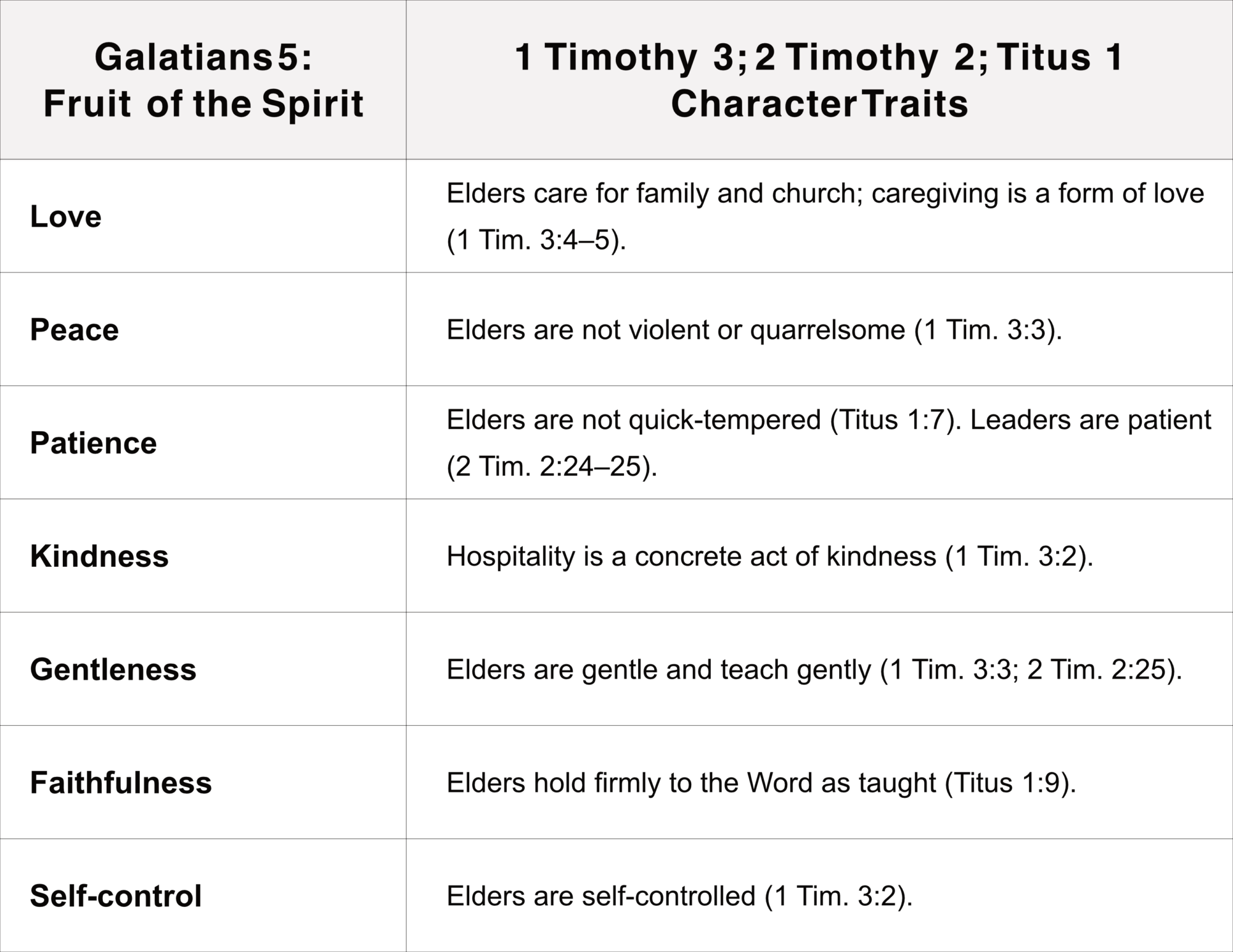
This suggests that Paul expects overseers to experience the fruit of the Spirit and to express that fruit publicly. Leaders also manifest character in the world. Paul states these character requirements for an overseer in a public letter. Because Paul publishes the list, the church can call leaders to account.
Pastors prove their moral quality in public by the way they treat their families. A man “must manage his own household well, with all dignity keeping his children submissive, for if someone does not know how to manage his own household, how will he care for God’s church?” (1 Tim. 3:4–5). Fathers can get compliance through force and threats, but godly fathers are kind, winning their children with love that fosters respect, including obedience without grumbling.
For Paul, to do the work one must first be the man.
An overseer must also be the “husband of one wife.” While this could mean that an elder cannot be single, divorced, remarried, or polygamous, the Greek literally says that he must be a “man of one woman” or “a one-woman man,” which most exegetes take to mean he must be a faithful, exemplary husband. Every point Paul makes about parenting and marriage applies to church leadership as well: A man who cannot care well for his own family, whom he knows best and loves most, cannot manage Christ’s church.
If 1 Timothy 3:1–7 implies “character first,” then 4:12–16 implies that character, skills, and duties belong together. This passage shows that the church rightly seeks skilled leaders. Paul requires Timothy, his protégé, to manifest both character and ability in equal measure. The solution to the problem of high-skill, low-character leaders is to develop leaders with both skill and character. First Timothy 4:12–16 names three skills (speech, exhortation, and teaching) and three virtues (love, faith, and purity):
Let no one despise you for your youth, but set the believers an example in speech, in conduct, in love, in faith, in purity. Until I come, devote yourself to the public reading of Scripture, to exhortation, to teaching. . . . Keep a close watch on yourself [character] and on the teaching.
Clearly, “speech” and “conduct” touch on both tasks and character. Speech is crucial, since pastors talk so much and so publicly. Thus, good conduct enhances a pastor’s speech, which can be a problem area for some. We flatter our friends, slander absent foes, and change our positions to please our hearers. When caught in sin, we spin self-exculpatory tales and disregard our accusers. If we confess, we promise to submit to discipline, then evade it. These sins call for repentance, and pastors should be the first to repent.
Paul also charges Timothy to devote himself “to the public reading of Scripture, to exhortation, to teaching” (v. 13). These are essential pastoral tasks that include studying, comprehending, and reflecting on the Scriptures, and the ability to exhort people to follow them. To preach and teach effectively, pastors must adorn their words with godly character.
Peter’s charge to elders has the same dual emphasis on tasks and character: They’re to “shepherd the flock of God . . . exercising oversight, not under compulsion, but willingly; . . . not for shameful gain, but eagerly; not domineering over those in [their] charge, but being examples to the flock” (1 Pet. 5:2–3). That is the way of the Lord.
The biblical testimony to the centrality of character is clear. The church knows this and generally pursues men of character, yet many pastors still fail morally. How can this be?
Explanation #4: The church often fails to exercise the ongoing care that nurtures lifelong fidelity and prevents moral or spiritual decline.
A man I know with decades of experience as an elder once said, “Pastors seem like politicians: They start with a sincere desire to reform the system and end up compromised or corrupted by it.” My experience as a professor and pastor corroborates this observation. Let’s therefore now ask, Do pastors falter because latent weaknesses surface when they gain authority? Or do churches act in ways that corrupt their pastors? Surely, both are true to some extent.
Churches certainly can mistreat their pastors. In recent years, for example, church wars over politics and vaccines led many to turn on their pastors. Yet pastors have always faced bitter criticism. After 20 years of faithful and fruitful ministry, an internationally respected pastor had grown so weary of attacks from his congregation that he concluded he had to build a wall between himself and his people or leave the ministry. This experience would resonate with too many pastors.
But even apart from such attacks, pastors can falter, losing their taste for holiness. Paul Tripp, in his book Dangerous Calling: Confronting the Unique Challenges of Pastoral Ministry, compares them to middle-aged men who say they want to stay fit but gain five pounds per year: The gap between stated and actual values is both manifest and injurious.
The loss of gentleness, an essential trait for pastoral ministry (Gal. 6:1; 2 Tim. 2:25), illustrates both sides of the issue. In an effort to guard themselves against criticism, many pastors harden themselves to endure, but this hardening eventually makes them harsh toward others. Some seek solace in adultery, deception, or bullying; others simply fall into these sins on their own. They probably met the criteria of 1 Timothy 3 earlier in their ministries, but something went wrong. How can churches help their leaders stay faithful?
First, we can intervene when we see pastors, however talented, start to stray. One year, I arrived to speak at a pastors’ conference and learned that the conference’s founder and director had been dismissed days earlier after a long affair with a staffer. The event’s remaining leaders berated themselves, for they had seen evidence of misbehavior for years but had refused to identify it. Their leader was talented and charismatic. He had mentored them, so they convinced themselves they had misread signs of impropriety that were, in retrospect, all too obvious. Willingness on the part of leadership to confront such sins honestly is necessary for the health of the pastor and the church.
It’s hardest to correct a rogue pastor when there is no structure for oversight and accountability. Connectional and hierarchical churches have more resources, but they can ignore and hide problems too. Counselor Dan Allender says the church needs prophets to shout that the emperor—the talented leader who strays—has no clothes, no godliness. Prophets must undermine the foolish narratives that serve corrupt or narcissistic leaders, such as this one: “I’m a great man, but my wife resents my status and fails to appreciate my skills and burdens. But behold, I’ve found an admirer, and she does recognize my eminence. She is tender and encouraging.” This can lead to emotional or physical affairs. Proverbs long ago described the seductive flatterer and the sad results (Prov. 5:3).
It’s easier to correct a leader with low status. For example, in my earliest days as solo pastor of a small church, I played basketball with church members in a local league. I was only 6′1″, but I was a leaper in those days, so I could block shots. In one game, I had five clean blocks in 30 minutes. Unfortunately, the principal referee was the indolent sort who can’t sustain his concentration. When his attention flagged and events required him to make a call, he relied on estimates of what might have happened. When I blocked shots, he apparently thought, Not so tall, probably a foul. After each block, his whistle blew. My teammates groaned; our opponents even apologized for the injustice. Still, after five clean blocks and five bad calls, I had officially fouled out of the game.
As I tramped off the court, I shouted in the referee’s general direction, “You know it would be nice if you would try watching the game. Then you might see what actually happens, instead of guessing and tooting your whistle at random.” (Disclosure: I did commit fouls on two other plays, but the referees missed them too.)
A deacon swiftly rebuked me: “You can’t shout at the ref like that.” I protested, “That ref is awful. Every block was clean.” He replied, “We know that, but you’re our pastor.” I fumed, “When I’m on the court, I’m a basketball player, not a pastor.” The deacon corrected me again: “Yes, on the court, you are a basketball player. But you are always our pastor.” Because the deacon was older and wiser, he admonished me, and I admitted he was right.
As a thought exercise, imagine that over the next decade, the church grew rapidly. Suppose that I again blocked five shots, suffered five bad calls, and became irate. How likely is it that an elder or deacon would swiftly reprove me when I led a large church? One can imagine different comments: “Our pastor is still so athletic and passionate! Doesn’t that referee know who he is?” In short, performance easily clouds judgment, especially if we fixate on growth.
Americans often assume that church growth is proof of merit. Because gifted preachers, teachers, and musicians spur growth, churches seek people with those skills. No one intends to ignore character issues, but we persuade ourselves that with proper mentoring, we can fix flawed young leaders so that the church can benefit from their gifts. Ample recent evidence shows how church leaders can be seemingly blind to a talented pastor’s flaws.
Unfortunately, gifts lead to rapid ascent and flaws can cause swift collapse. Many ministries never recover. Therefore, if only for pragmatic reasons, the church should focus on godly character—but chiefly we should do so because God does.
Churches often investigate character when they examine candidates for ordination and when ordained pastors prepare for a new call. These interviews typically focus on traditional topics—family, spiritual disciplines, and sense of calling. We rarely ask if leaders keep promises, control anger, love wealth, seek reconciliation after breaches in relationships, or practice hospitality.
Can the prospective leader both lead and follow? Does he know how to work hard but also know how to rest? Does he have friends? What happens when he disagrees with someone? Does he pray over it? Does he listen to the other party well enough to state the issue in terms the other would recognize?
The church rightly notices abuse of authority and sexual sins, but we dare not overlook the more common sins. Trouble can start so innocently.
Consider a picnic that follows the second worship service. The sermon prompts people to seek the pastor for counsel or prayer, which causes the pastor to be last in line for the picnic food. Since he must lead an event that starts soon after, he anticipates missing lunch (again). An observant woman sees this and gives the pastor her slot in line, but a grump snipes, “I thought pastors were supposed to put others first!”
The church rightly notices abuse of authority and sexual sins, but we dare not overlook the more common sins.
That could be a jest, but the pastor detects anger and shudders. His supporters shield and defend him. Slowly, walls go up, and few can correct him. The team also decides to bring meals to his office to prevent food problems. He is so thankful for the meals at first, but in time comes to expect them, and then requires them. When he travels, he also drifts toward ever-nicer hotel rooms; he needs proper sleep to fulfill his duties, right?
It can happen to anyone. When I took my first senior leadership position, a mentor told me, “Now you are important. People will want to do things for you; let them.” If he meant “Make good use of your administrative assistant,” he was right. But people also offer tickets to sporting events and the use of second homes for vacations. The gifts come from people who know their pastor’s burdens and modest salary. The leader is thankful, but if he’s careless, he may come to expect such favors. The problem is real, even if the root is carelessness, not evil intent.
Recommendations
In considering the root cause of pastoral failures, we reject the idea that we’re witnessing a media-driven pseudoproblem. Many leaders have seduced congregants, become impossibly selfish, or abused power.
But we also doubt that the church uniquely attracts abusers and narcissists. The claim merits investigation, but we need to separate “healthy narcissism,” or confidence, from unhealthy narcissism. By contrast, the church does seem to seek skill or talent more than character, and too many pastors seem to start well and then falter, perhaps on their own, perhaps because the church damages them. This also merits further study.
In light of all this, it seems right to mention a couple of ways to help enhance godliness in leaders.
First, let the church ensure pastoral candidates have mentors who regularly inquire after their character and promote it. With 2 Timothy 3 in mind, let’s ask if candidates love God and neighbor, or self and pleasure. Let’s ask if they can both lead and follow, if people are glad to be on their team, if they know how to work, how to rest, and how to handle conflict.
Second, pastors need friends who know, love, and gently correct them (Gal. 6:1). Such friends will ensure pastors have time for rest and reflection and will protect them from personal attacks and senseless criticism. This may require a godly intolerance for malcontents whose lives contradict the gospel (2:11–14). Throughout, the church must heed truth-tellers who address the enemies of peace. We also need prophets to challenge sycophants who gain status by praising powerful church leaders.
At best, pastors will lead beautiful lives that silence accusers. Personal peace will give them time to pursue godliness and to fulfill their tasks—teaching, preaching, making disciples, praying—from a love of Jesus and his people, not from a desire for self-serving power or status.
Free eBook by Tim Keller: ‘The Freedom of Self-Forgetfulness’
 Imagine a life where you don’t feel inadequate, easily offended, desperate to prove yourself, or endlessly preoccupied with how you look to others. Imagine relishing, not resenting, the success of others. Living this way isn’t far-fetched. It’s actually guaranteed to believers, as they learn to receive God’s approval, rather than striving to earn it.
In Tim Keller’s short ebook, The Freedom of Self-Forgetfulness: The Path To True Christian Joy, he explains how to overcome the toxic tendencies of our age一not by diluting biblical truth or denying our differences一but by rooting our identity in Christ.
TGC is offering this Keller resource for free, so you can discover the “blessed rest” that only self-forgetfulness brings.