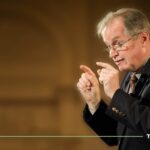
Listen or read the following transcript as D. A. Carson speaks on the Omnipotence of God from Psalm 139:1–24
David writes,
“O Lord, you have searched me and you know me. You know when I sit down and when I rise; you perceive my thoughts from afar. You discern my going out and my lying down; you are familiar with all my ways. Before a word is on my tongue you know it completely, O Lord. You hem me in behind and before, and you lay your hand upon me. Such knowledge is too wonderful for me, too lofty for me to attain.
Where can I go from your Spirit? Where can I flee from your presence? If I go up to the heavens, you are there; if I make my bed in the depths, you are there. If I rise on the wings of the dawn, if I settle on the far side of the sea, even there your hand will guide me, your right hand will hold me fast. If I say, ‘Surely the darkness will hide me and the light become night around me,’ even the darkness will not be dark to you; the night will shine like the day, for darkness is as light to you.
For you created my inmost being; you knit me together in my mother’s womb. I praise you because I am fearfully and wonderfully made; your works are wonderful, I know that full well. My frame was not hidden from you when I was made in the secret place, when I was woven together in the depths of the earth. Your eyes saw my unformed body; all the days ordained for me were written in your book before one of them came to be.
How precious to me are your thoughts, O God! How vast is the sum of them! Were I to count them, they would outnumber the grains of sand—when I awake, I am still with you. If only you would slay the wicked, O God! Away from me, you bloodthirsty men! They speak of you with evil intent; your adversaries misuse your name.
Do I not hate those who hate you, O Lord, and abhor those who rise up against you? I have nothing but hatred for them; I count them my enemies. Search me, God, and know my heart; test me and know my anxious thoughts. See if there is any offensive way in me, and lead me in the way everlasting.”
So reads the Word of God.
Well before she was 3 years old, my daughter could sing, admittedly somewhat tunelessly, “God can do anything, anything, anything. God can do anything, anything.” The vocabulary was somewhat limited. So we sing in our Sunday schools. Well, then, the smart-aleck philosophy instructor asks his first-year undergraduates, “Well, then, if God can do anything, can God make a rock so heavy he can’t lift it?”
He sits there with a smirk, knowing full well the undergraduates’ gears are turning around at high speed, and the light dawns. If the student says, “Yes, of course, God can make a rock so heavy he can’t lift it,” then, of course, God is not omnipotent because there’s something he can’t do, namely lift the rock he made.
If, instead, the student says, “No. God can’t make a rock so heavy he can’t lift it because, of course, God can lift any rock,” then there is still something God can’t do. He can’t make a rock so heavy he can’t lift it. So God is not omnipotent. It appears that God can’t not do anything. Can God sin? Is that not something else God can’t do?
What do we Christians mean when we insist rightly that God is omnipotent? We certainly do not mean God can do anything, absolutely anything, if by that we include what is logically incoherent or essentially self-contradictory. That’s what’s the matter with the rock one, of course. You’re asking God to do something such that, if he does it, he can’t do something else. There is built-in self-contradiction.
What we mean, rather, when we say God is omnipotent is something like, “God is so powerful, he can do anything he chooses to do.” The Scriptures say, “God has his way in the hosts of heaven and on the earth.” Thus, if he chooses to make a universe, he need only speak, “Let there be light,” and there is light.
If he chooses to send an Elijah to call down fire from heaven, fire will fall from heaven and devour the sacrifice and the water that has soaked it and the stones on which it is laid out. If he chooses to open up a way through the Red Sea, the way will be opened, and his covenant people will go through on dry land. He can do anything he chooses to do. He is omnipotent. All power is finally his.
If he chooses in the person of his Son to raise Lazarus from the dead, the Son simply cries, “Lazarus! Come forth,” and he who was dead comes forth, bound hand and foot in grave clothes, but he comes forth! If he chooses in the person of his Son to calm the seas, he need only say, “Peace! Be still,” and there is immediately a great calm. If he chooses to wind up history at the parousia, when the Son himself returns and the trump of the Lord sounds and time is no more, he sends the Son and that is the end of time as we know it. He can do anything he chooses to do.
Clearly, God’s omnipotence is related to God’s sovereignty about which Dr. Boyce spoke a few weeks ago. If I had to relate the two notions to each other, I would say God’s omnipotence, his ability to do anything he chooses, is logically prior to his sovereignty, to his reign. The universal sweep of God’s sovereignty, that he reigns over all things, is predicated on his omnipotence, on his ability to do anything he chooses. If God were not omnipotent, he could not be utterly sovereign.
To put it another way, God’s sovereignty is nothing other than God’s omnipotence constantly at work. Thus, the two notions can come together in some remarkable Scriptures. For example, in Revelation 19, at the end we read, “A voice came from the throne, saying: ‘Praise our God, all you his servants, you who fear him, both small and great!’ Then I heard what sounded like a great multitude, like the roar of rushing waters and like loud peals of thunder, shouting: ‘Hallelujah! For our Lord God Almighty reigns.’ ”
Some versions have it, “For our Lord God Omnipotent reigns!” The one who can do all things, he is the one who is exercising that ability, and, thus, he reigns. The truth that God is omnipotent is so frequently repeated in Scripture and in so many different connections, that before we turn to the passage I have already read (Psalm 139), I want to sketch in the relationship between God’s omnipotence and several other important themes in the Bible (four in particular), and then we’ll turn to the passage at hand. First, the end of Job. Job 38 and following.
First, God’s omnipotence is tied to human endurance and faith. Let me remind you of the plotline in the book of Job. You will recall Job was a good man by God’s own pronouncement. So good, in fact, he offered up preemptive sacrifices on behalf of his children, lest any of them should perhaps sin in their thoughts, in their hearts. He does this regularly. So concerned is he that is family be pure and right in the sight of God. He is the wealthiest of men in the East, probably in the land of Edom. He fears God and eschews all that is evil.
Meanwhile, behind the scenes, unknown to him, God takes on a wager with Satan. Satan thinks Job is merely one of these people who knows what side of his bread the butter lies. If God would simply allow Job to be properly afflicted and cursed, to suffer and hurt, then he would turn around and curse God. The only reason Job adores God is because Job finds it’s in his financial interests to adore him.
So God says, “That’s just not the case. Job, instead, is the sort of man who loves me with a pure heart. I’ll prove it. Go ahead. Afflict him, but spare his life.” In a series of apparently natural catastrophes, storms come, enemies enter the land, his entire fortune is wiped out, his 10 children are killed, his entire estate is ravaged, and his wife is prepared to tell him to curse God and die.
Instead, he replies, “Naked I came out of my mother’s womb; naked I return thither. The Lord gives, and the Lord takes away. Blessed be the name of the Lord.” The writer’s pronouncement is, “In all this, Job did not act foolishly nor did he curse God in his heart.” Then Satan comes back again. “Yes, that’s all right. He lost everything, but he still has his health. Skin for skin. Everything will a man give for his skin. Let me touch his body, and he will turn around and curse you to your face.”
Again, God gives this permission to Satan. Only his life is to be spared. Job knows nothing of this, and now he sits in an ash heap, using a bit of broken pottery to scrape his itching scabs. His three remarkable friends come in, and they do the only wise thing they do in the whole book. They keep quiet for a week. They just stay there with him holding his hand, as it were. Then, when Job begins to utter his lament, their theology requires, if God be just, then, Job must deserve this affliction.
So they say, “Job, repent of your sin and God will turn around and bless you again.” Job says, “You don’t understand. I am an innocent sufferer. I don’t deserve this. There’s a sense in which I’m a sinner with all other people. I endure suffering with others. I deserve suffering with others, but I don’t deserve this disproportionate suffering. It isn’t just. It isn’t fair, and if I turn around and say, ‘All right, I’ll just repent in order to get my goods back,’ I would be denying my integrity. I am not that kind of person.”
So the debate begins to heat up in various cycles between Job’s miserable comforters and Job himself. In chapter after chapter, one after the other has a go at him saying, “We don’t really know all that has gone on in your mind and in your heart, but you must be a terribly wicked person for all of this suffering to come down on your head so heavily. The only alternative is that God is unjust.”
Eventually, Job is so eager to defend his integrity that he comes within a whisker of accusing God of injustice. In fact, he says, “I wish I had some kind of mediator, somebody to go between God and me. I’d get him to answer a few questions before me. What do I do to deserve this? This is intrinsically unfair. I can’t deny my own justice in this matter. It would make me out to be a liar. All along I’ve been extremely scrupulous.”
Then in chapters just astonishing for their witness, he says, “Listen. The poor in the entire county I looked after them. I fed them. I made a covenant with my eyes never to look on a young woman in lust. I was extremely careful in the matter of religious observance and in family upbringing and in prayers and in sacrifice.” He goes on and on and on and on. “This is the character of my life. Do you expect me to deny all that? I want God to answer to me.”
Eventually, Elihu speaks. He carries on the debate in a number of ways I don’t have time now to unpack until God speaks in chapter 38. This is what God says. “Who is this that darkens my counsel with words without knowledge? Brace yourself like a man; I will question you, and you will answer me.”
That wasn’t quite what Job had in mind. “Where were you when I laid the earth’s foundation? Tell me, if you understand. Who marked off its dimensions? Surely you know! I mean, your bragging is so wonderful you have to be pretty powerful. Who stretched a measuring line across it?”
Verse 8: “Who shut up the sea behind doors when it burst forth from the womb?” Verse 16: “Have you journeyed to the springs of the sea or walked in the recesses of the deep? Have the gates of death been shown to you? Have you seen the gates of the shadow of death?” Verse 19: “What is the way to the abode of light? And where does darkness reside?”
Verse 22: “Have you entered the storehouses of the snow or seen the storehouses of the hail, which I reserve for times of trouble, for days of war and battle?What is the way to the place where the lightning is dispersed, or the place where the east winds are scattered over the earth?” On and on and on.
Verse 31: “Can you bind the beautiful Pleiades?” The constellations of the heavens. “Can you loose the cords of Orion? Can you bring forth the constellations in their seasons or lead out the Bear with its cubs?” Verse 34: “Can you raise your voice to the clouds?” Chapter after chapter. The Lord continues speaking to Job in chapter 40.
“ ‘Will the one who contends with the Almighty correct him? Let him who accuses God answer him!’ Then Job answered the Lord: ‘I am unworthy—how can I reply to you? I put my hand over my mouth. I spoke once, but I have no answer—twice, but I will say no more.’ ” But Job isn’t going to be let off even that easily.
The Lord comes around, as it were, for a rerun. “Brace yourself like a man; I haven’t finished yet. I will question you, and you will answer me. Would you discredit my justice? Are you so eager to affirm your justice that you are prepared to discredit mine? Would you condemn me to justify yourself? Do you have an arm like God’s, and can your voice thunder like his?
Then adorn yourself with glory and splendor, and clothe yourself in honor and majesty. Unleash the fury of your wrath, look at every proud man and bring him low, look at every proud man and humble him, crush the wicked where they stand. Bury them all together. Then I myself will admit to you that your own right hand can save you.” Then he asks some more questions about the Behemoth, about the Leviathan, perhaps the hippopotamus and the crocodile, various creatures.
“Can you handle them?” Eventually, Job replies in chapter 42. “I know that you can do all things; no plan of yours can be thwarted. You asked, ‘Who is this that obscures my counsel without knowledge?’ Surely I spoke of things I did not understand, things too wonderful for me to know. You said, ‘Listen now, and I will speak; I will question you, and you will answer me.’ My ears had heard of you but now my eyes have seen you. Therefore I despise myself and repent in dust and ashes.”
What is going on in this remarkable exchange? When Job asks these questions, he is not asking these questions from the perspective of someone who is losing his faith. He’s not asking these questions from the perspective of a modern-day agnostic who is not quite sure that God is there. “How can I believe in a God who is there and who is just if I’m suffering like this?” That’s not what’s going on in Job’s mind.
What’s going on in Job’s mind is, “I know God is there, I know he is sovereign, I know he is good, but that’s exactly what does not make sense. I know he can do anything, but if he’s good and can do anything, why am I suffering disproportionately when my integrity is unquestioned?” Job’s givens are God is sovereign and God is good, and that’s what gives him the problem. He is not prepared to deny God’s sovereignty.
He does not say, as Harold Kushner does in his book, When Bad Things Happen to Good People, “Well, God isn’t omnipotent after all. Poor God. He sort of slipped and things got out of hand. He made a bad move in the chess game, and the Devil won that round.” He’s not prepared to say that. Although Job does not know about the conversation between Satan and God, he knows, at some level, if God is sovereign, God’s sovereign hand (his omnipotence) embraces even the suffering Job himself is going through. He knows that. That’s his given.
He cannot deny that or he denies the nature of God, but if God is sovereign, if God is omnipotent and Job doesn’t deserve this suffering, then maybe it’s God’s goodness that has to be sacrificed. That is why Job begins to question even the justice of God. The first thing to recognize is, both in Job’s complaint and in God’s answer, there remains mystery. God does not answer Job’s question directly. He does not give him information that resolves the tension. He does not. At the end of the day, Job does not say, “I understand now.”
He says, rather, “I repent,” and what he repents of is not some sin that brought down this judgment, but rather, the sin that came about in the wake of the suffering: the rebellion, the questioning of God’s goodness, the way he started minimizing God’s holiness. “I’m sorry I even addressed you like that. Before, I understood something about your character, but now I have heard you speak, and I am crushed by this vision of your greatness, and I put my hand to my mouth.”
George Bernard Shaw, a great playwright at the turn of the century, mocks God’s answer in the book of Job. What George Bernard Shaw says is, “Job asks the most profound questions in the universe, and the best God can do is brag about the crocodile. What Job should do is push God harder.”
That’s what Elie Wiesel says, too, in his books about the Holocaust. “Yes, Job needs to be abashed; but still, Job needs to push God a little harder.” But that presupposes God is more interested in giving us explanations than in securing our trust. God is not nearly as interested in giving us explanations as in securing our trust.
I believe there is much more that could be said about the tensions that go on here and other parts of the Bible enlighten them somewhat, but at the end of the day, there is mystery. The givens are God’s control is absolute, God’s goodness must not questioned, human responsibility is not, thereby, weakened. Those are the givens, and the appropriate human response is faith.
If you understand how big God is, the text says in the flow of the narrative as a whole, there may come times when you will not understand, but you will trust. I don’t know you, but I am sure in a congregation this size there are some of you who have gone through some terrible suffering. As Christians, we have some advantages that Job never had.
If you want final culminating proof, for example, in the goodness of God, you can always go to Calvary. Whenever I am inclined to doubt the goodness of God, I return to the cross, for there God’s love is so greatly manifested. He gave his own Son; how shall he not also with him freely give us all things? We have some evidences of God’s love Job never knew.
What we do not have the right to do is to demand God give us an explanation for everything or to minimize or qualify God’s omnipotence as if somehow God lost control at this stage, because if we do that, we can no longer find any consolation or solace in reposing our faith in him. God’s questions to Job are designed to make Job understand God is much, much greater than Job could ever imagine, and whatever alternatives we may have when it comes to suffering, doubting God’s essential character is not an option.
What we must do, rather, is trust him, and even in the midst of tears and pain, still serve him. God’s omnipotence, in the book of Job, is tied to human endurance and faith.
Secondly and more broadly, God’s omnipotence is tied to human trust in a remarkable number of passages. I mention but one. In Romans 8:28, in a verse every Sunday school child learns by heart, we are assured, “In all things, God works for the good of those who love him who have been called according to his purpose.” The presupposition there is that God is omnipotent. In all things, God is still at work for the good of his people. That means when you lose a loved one, when nations rise against nation, when there is rampant evil, when there is terrible suffering, still God has not lost control.
Of course, in the context that immediately follows, what Paul is particularly interested in emphasizing is that Christians can trust this God for their final salvation. No matter what kind of opposition may come our way … If there is persecution so that we’re scattered like sheep, or demonic opposition (angels and demons), or uncertainties in the passage of time (the present, the future), if there is anything in all creation that sets itself up against God’s people, they must learn God is greater than all of those things.
Evils exist, demons may attack, suffering may come, and persecution may break out, but we don’t trust a God who may or may not win the chess game. He is omnipotent. All power is finally his. Again, there is mystery in that. I fully concede it. I do not know how God so exercises his power that moral human beings like you and me are, nevertheless, though constrained by God’s power, still morally responsible for all of our actions, but that is a given in Scripture. It’s a given. It’s not to be lost.
I do not know how God stands behind good and evil asymmetrically. He doesn’t stand behind good and evil exactly the same way. He stands behind good so that, finally, all of the good is creditable to him. He stands behind evil so that nothing takes place in the universe outside the uttermost bounds of his sovereignty but so that no evil is, finally, chargeable to him. It is chargeable to you, to me, to secondary agents, to the Devil and his cronies.
I do not understand how that can be. If I had a little more time, I could outline some ways in which Christians can think about it productively so it doesn’t boggle the mind too badly, but I see, nevertheless, it is taught in Scripture that God is omnipotent, yet God is good, and to deny either of those two focal points is so to diminish God that, at the end of the day, we don’t have a God to trust.
If you doubt God’s goodness, you may have a powerful God who treats us like robots, but he’s no longer trustworthy. He’s no longer good. If you have a good God who is not omnipotent, who is not genuinely powerful, then, although he might be morally praiseworthy, what’s the point of trusting him if you’re not sure he’s going to win? What good can he do you if, in the midst of your suffering, you turn to him and say, “God, help me,” and all he says is, “I’ve done the best I can”?
As soon as you lose the mystery of the tension between God’s goodness and God’s sovereignty, you may lose more than the mystery; you will lose the comfort. For a God who is not omnipotent cannot, finally, be assured of winning at the end or of helping you in your need. This text assures us, in all things, God is to be trusted. In all things, God is to be trusted.
Some of you, I’m sure, have suffered a great deal more than I have, and those of you who have and who have walked with God for many years, know some of the biggest, most practical lessons in trusting God come in the midst of tears. You learn God is trustworthy and powerful and still in control, even in the midst of those matters.
I joked with my wife. One of the things I did this past year was write a book on suffering, and it has been a rough year. My mother died. I got typhoid when I was Africa. It was a rough year. I told her, “The next time I write a book, it will be on joy.” I’m sure of this. It is, in the midst of distress, of suffering, of tears, of weakness, of disease, that we learn the confession that God is omnipotent holds true experientially, practically, and thus, we learn to put down deep roots of trust in him alone. Not in our circumstances. In him. In him.
Thirdly, God’s omnipotence is tied to the salvation of men and women. In the first chapter of Paul’s epistle to the Ephesians we read these words, beginning at verse 3. Ephesians 1:3: “Praise be to the God and Father of our Lord Jesus Christ, who has blessed us in the heavenly realms with every spiritual blessing in Christ. For he chose us in him before the creation of the world to be holy and blameless in his sight. In love he predestined us to be adopted as his sons through Jesus Christ, in accordance with his pleasure and will to the praise of his glorious grace.”
Down in verse 11, the thought is repeated within a larger sphere. “In him we were also chosen, having been predestined according to the plan of him who works out everything in conformity with the purpose of his will.” That means even God’s initiative in bringing us to salvation is, in one sense, a subset of his omnipotence. He does everything according to the purpose of his will, and according to the purpose of his will, he predestined us that we should know him.
Let me hasten to say again, this does not mean we are robots. It does not mean there is no obligation on us to repent, believe, trust, obey, and choose. Those things are all taught in Scripture. It does not mean, either, God has come to neutral men and women and somehow arbitrarily chosen some and rejected others. Rather, he has come to a lost race, and if he chooses to save one, it’s a mark of remarkable grace. Finally, Christians do learn as they look in the face of their heavenly Father to sing …
I sought the Lord, and afterward I knew
He moved my soul to seek him, seeking me.
It was not I that found, O Savior true;
No, I was found of thee.
That, too, our very salvation is tied to God’s omnipotence. There is still mystery, but God’s power must not be doubted, his goodness must not be doubted, nor is our responsibility mitigated. Those three fundamentals are still present in all of these passages. One more example before we turn to our own text.
Fourthly, God’s omnipotence is tied to Christian witness. When the first whiff of persecution breaks out in the church as recorded in Acts, chapter 4, the church gathers for prayer. Peter and John go and report to their own people (Acts 4:23) what had happened to them, and the people, when they hear their report, gather together in prayer to God. This is what they say.
“Sovereign Lord …” Isn’t that wonderful? The first thing they confess when persecution breaks out is the sovereignty of God which, of course, presupposes God’s power, his omnipotence. They said, “Sovereign Lord, you made the heavens and the earth and the sea, and everything in them.” They are reminding themselves of the sweep of God’s power.
God is so powerful that all that is exists by his word, so this outbreak of persecution cannot for any moment be thought to have escaped the bounds of his control. It is unthinkable. This is the God who speaks and universes fly into being. “Sovereign Lord, you are the Creator. We come to you in trust. Indeed, you spoke by the Holy Spirit through the mouth of your servant, our father David.”
Now they quote Psalm 2. “Why do the nations rage and the peoples plot in vain? The kings of the earth take their stand and the rulers gather together against the Lord and against his anointed one. Indeed …” they say. After they finish their quotation, they apply it to their present context. Indeed, that’s exactly what happened.
“Indeed Herod and Pontius Pilate met together with the Gentiles and the people of Israel in this city to conspire against your holy servant Jesus, whom you anointed. They did what your power and will had decided beforehand should happen. Now, Lord, consider their threats and enable your servants to speak your word with great boldness.”
Have you seen that? Isn’t that a remarkable passage? On the one hand, these prayer warriors recognized there was an evil conspiracy at hand. There was a conspiracy that involved the Jews and it involved the Romans. It involved the political people and it involved the priestly people. It involved the local leaders in their priestly robes and it involved the troops sent out (the auxiliaries) from Rome. There was a conspiracy, and now they’re threatening the church.
These Christians recognized this conspiracy was evil, and they hold these men and women responsible for it. Yet, at the same time, because they believe in the omnipotence of God, they say, “They were doing what your hand and will had determined beforehand that they would do.” When you stop to think about it, it really couldn’t be any other way, for, you see, if these prayer warriors thought there was a wicked human conspiracy and then God sort of rode in on his white stallion at the end and saved the day, then it would mean in the cross work of Christ himself all the initiative lay with the conspirators and God simply turned it around at the last minute.
Christ would no longer be perceived as the one whom God sent to suffer, the one who was, in one sense, in God’s mind, slain before the foundation of the earth, the one whom Isaiah foresaw as the suffering servant 700 years before he came, in which case, it would almost appear our very salvation was not tied up with God’s sovereign plan but with the conspirator’s malice, and God saved us as a kind of afterthought because he was such a good chess player.
On the other hand, if we were to argue that God here is so sovereign the whole thing came together by his determined decree in such a way the conspirators are, thereby, excused … I mean, God brought all the pieces together, so you can’t really blame Pilate, you can’t blame Judas Iscariot, you can’t blame Herod, you can’t blame the soldier, and you can’t blame anybody! God did it. All the rest of them were robots. Then why did Christ die in the first place?
If they were just robots, they weren’t sinners. Why did Christ die? Didn’t he die for sinners? If God is so sovereign in this instance that they’re excused of their sin, then surely, I’m excused for all my sin. God is always sovereign. Anything I do I do because I’m ordained to do it. I’m predestined to do it. I’m bound to do it. “It’s not my fault, God. It’s the way you made me. You’re sovereign.” Suddenly, there’s no point sending Christ to die in any case because I’m just a hunk of machinery.
You see, any other model in this model that maintains the truth of God’s omnipotence and the truth of our responsibility ultimately destroys the fabric of the entire Christian faith. If I had more time, I would try to show how these things can be fit together a little more tightly, but that they are both taught in Scripture, let no thinking Christian doubt. Human beings are responsible. God is omnipotent. He can, therefore, be trusted. He cannot be charged with evil.
Finally, even our Christian witness, its effectiveness, turns on the assurance that God is omnipotent. Did the Lord say, “All authority is given to me in heaven and on earth; therefore, go”? That is the assumption here, too. “Lord, you are the sovereign who created the whole world. Lord, Psalm 2 predicts these things would happen, and in fact, insist you will laugh at their malice. They have happened.
You are sovereign behind them, before them, and all around them. You brought them to pass so that your Son would die even in the midst of all of this iniquity. Now, Lord, look at it again and hear our prayer and give us holy boldness that we may speak and display your power.” Isn’t that what we need when we pray for revival? Isn’t that what we need when we pray for our witness? Unless we have that kind of vision of God, we’re not praying for much when we pray for revival.
Finally, let us turn to Psalm 139. Be of good cheer. I shall not expound the whole. Psalm 139. One of the reasons why I have rather broken the rules and expounded several passages of Scripture this evening rather than simply one is because the truth of God’s omnipotence is so pervasive and touches so many different things in Scripture, it’s rather important to get an overview so as to make sense of a discreet passage we look at a little more closely. From this chapter, I draw your attention to three things.
1. God’s omnipotence (his power to do anything he chooses to do) is intimately connected with some of God’s other characteristics, some of God’s other “omni” characteristics: omnipotence, all power; omniscience, all knowledge; omnipresence, presence everywhere.
In this chapter, God’s omnipotence is intimately tied to some of God’s other “omni” characteristics.
The point is not just a theoretical one, as we’ll see in a moment. It is very important as to how we think about God. Look at the outline of the whole chapter, the whole psalm. In verses 1 to 6, God is portrayed as all-seeing, all-encompassing. “Lord, you have searched me and you know me. You know when I sit down and when I rise; you perceive my thoughts from afar.” There is omniscience articulated here. God knows it all.
“Before a word is on my tongue you know it completely, O Lord.” Here, God even knows the future down to the very word spoken by a human, moral agent. “Before I speak, whether I say this word or that word, you know it completely.” Of course, one of the reasons why God knows it so completely is because God is so powerful. Omniscience, here, drifts into omnipotence. Elsewhere, in Proverbs, for example, we are told even the heart of the king is in the hand of the Lord and he turns it any way he wills. Even in my speech, I cannot escape the embrace of God’s knowledge or of his power.
In verses 7 to 12, we have articulated for us God’s omnipresence, his inescapableness, his ubiquity. He is everywhere. You cannot hide from God. “Where can I go from your Spirit? Where can I flee from your presence? If I go up to the heavens, you are there; if I make my bed in the depths, you are there. If I rise on the wings of the dawn, if I settle on the far side of the sea, even there your hand will guide me, your right hand will hold me fast.”
If I say, “Well, maybe I can hide from God for just a little bit. Perhaps I can get into a dark, nasty little corner, and there God won’t see me quite. Surely, the darkness will hide me, but even the darkness will not be dark to you; the night will shine like the day, for darkness is as light to you.” Now do you see God’s omnipresence is drifting into his omniscience? God knows everything. He sees everything. He’s not only everywhere, but he knows all that is going on. You cannot in this psalm separate God’s characteristics absolutely.
Now we come down to verse 13 and following. Here we find his power displayed, especially in individual creation. “For you created my inmost being; you knit me together in my mother’s womb. I praise you because I am fearfully and wonderfully made; your works are wonderful, I know that full well. My frame was not hidden from you when I was made in the secret place, when I was woven together in the depths of the earth. Your eyes saw my unformed body.”
The depths of the earth does not mean the womb is likened to the earth, a bit of dirt or something. What it means is the most secret, unapproachable, hidden place on the earth surely has to be the mother’s womb. You can’t dig at it. You can’t find out what’s going on. You can’t look at it. This was in the days before NMRs and X-ray machines.
The secret place of the earth … God can see it, even in the mother’s womb before anybody can see anything, when you’re not more than a speck. God knows what’s going on, and he sees it all. Indeed, not only as I was growing in my mother’s womb, but throughout all my life God has been a stage ahead of me. “All the days ordained for me were written in your book before one of them came to be.” There is omnipotence.
The reason this is important is, in books of systematic theology, God’s “omni” functions are usually treated separately: God’s omnipresence, the fact that he’s everywhere; God’s omnipotence, the fact that he’s all powerful; God’s omniscience, the fact that he’s all knowing. As you stop think about it a little, the one drifts into the other all the time. You can’t escape it.
If God knows all things, that is inevitably tied up to the fact that God’s power is absolute. How can he not know what he is certainly going to do? If he is determined to do something or has resolved that by not doing something certain things will take place, how does his omniscience differ from his power? The two are tied together. You cannot break God up into individual functions.
It may be useful for the purpose of theology to analyze this characteristic or that piecemeal, but what the psalmist is giving us is a whole vision of God, an entire vision of God. God’s omnipotence is intimately connected with some of God’s other functions. The practical bearing of that we’ll see in a moment.
2. Truths about God’s omnipotence must shape the way we think of God himself and his relation to the world.
Let me give you an example. The materialistic atheist thinks of science as a discipline which seeks to unpack what is going on in the world purely by looking at physical, measurable entities.
In science, for any principle or law or hypothesis or theory to hold, there must be a kind of repetitiveness in the experiments so that the same thing done the same way under the same conditions again and again and again always produces the same result. According to a materialistic view of the universe, it is this way because that’s the way the molecules work, that’s the way the energy levels work, and that’s the way the atoms work. If you get low enough down, it’s the way the quarks work (even the purple ones), and that is the way we are to understand this entire physical universe.
From the point of the deist, God set the whole thing working like a clock. He made this clock, wound it all up, and then threw it out there into the universe. Then he sort of quietly withdrew into early retirement. Now this universe ticks on. It’s slowing down a little bit, but it’s ticking on. The reason why science is possible is because God made a pretty reliable clock.
It does some weird things now and then. It springs a gear loose and shoots out a piece now and then, but basically, it’s a reliable clock. That’s why science is possible. It tick-tocks regularly, so there’s a certain repetitiveness that makes scientific experiments possible. You can’t see God in this very clearly, because he just made the wretched thing.
That doesn’t mean you can trace his footprints now (the clock is just ticking on of its own) any more than you can trace the moral characteristics of the Swiss watchmaker who made your favorite timepiece at home. He made it, then he sold it, and that’s the end of his connection with it. It’s just ticking on. That’s the deist’s view of the universe.
Many Christians, without actually thinking about it, go for a third option. They absorb a kind of God-of-the-gaps theory. Here, God is something like a deist who gets the whole thing going, but he’s sort of hovering over it. He lets it go and do its thing, but every once in a while, he sort of sticks his finger in there and replaces a gear.
Every once in a while, something gets stuck, and he goes in there and flicks out a bit of dirt. Every once in a while, it’s out of time, and he goes in there and changes the time. He’s a God who stands back and just lets the machinery roll on, and then every once in a while, he does something special, and we call that a miracle.
In this view, God is still a God who intervenes. He’s still the God who sovereignly reigns over everything, but somehow he usually just lets things go on. That’s why science is possible. When he lets things go on, then science is possible because there are all these repetitive things. Things just keep on getting repeated, so science is still possible.
When he does a miracle, then science isn’t possible. How can science measure and repeat something that happens only once when God is flicking out a bit of dirt? Many Christians think of miracles that way. They think of God that way. We go on in our lives.
We drive our cars. We know when we press the accelerator, provided everything is working, the car goes. When we press the brakes, the brakes stop the car. We don’t really know or care how it works. It doesn’t matter too much. It worked like that yesterday; it will work like that tomorrow. I presume it will work like that today.
Our lives settle down into a regular routine where God is removed from all of that until a crisis comes, and then we say “Oh, God! I’m really in it. Would you please stick your finger in the mechanism and do something? Switch a gear or something.” We want a miracle. What the doctrine of God’s omnipotence teaches us is that is a profoundly unbiblical view of God. It is a profoundly unbiblical view of God.
The God of the Bible is in control all the time. All the time. That is why, you see, in the Sermon on the Mount, Jesus can speak of God clothing the grass with the flowers. Well, the first-century writers were not stupid. They had heard of seeds. They knew if you watered them they would germinate and they would grow. They knew seeds came from other flowers of the same species, but they preferred to speak of God clothing the grass.
The Old Testament writers speak of God sending the rain. It’s not because they were pre-scientific and they didn’t know about the water cycle. Read the book of Ecclesiastes. Ecclesiastes knows about the water cycle. The water rises into the air, and the clouds go over the land, and they dump their water on the land, and the little rivulets form into the streams and the streams into the river and the river into the sea. The water rises again into the air. They knew about the water cycle.
But the fact of the matter is, most of the biblical writers would prefer to say, “God sends the rain on the just and on the unjust.” So also in this passage. Have you seen what it says? “For you created my inmost being; you knit me together in my mother’s womb. I praise you because I am fearfully and wonderfully made; your works are wonderful, I know that full well. My frame was not hidden from you.”
Well, of course. This was an agrarian society. They had seen animals be born. They had seen children be born before. They knew, after copulation, if in fact there was actual fertilization, then there would be, in fact, a baby that would grow in the mother’s womb. It’s not as if God had somehow plopped a baby in there sort of taken out of nothing, but they prefer to say, “God knit me together in my mother’s womb.”
Why? It was because of their view of omnipotence. God is not the deist who just started the whole thing running and then took early retirement, nor is he the God who watches over his watch and occasionally interferes with a finger springing a gear loose. He is the sovereign God, who in the person of his Son, to use the language of Hebrews 1, upholds all things by his powerful word, so that Jesus can teach that not even a bird falls from the heaven without the heavenly Father’s sanction.
The reason why science is still possible is because this God who is in control of all things normally does things in regular ways. He normally does things in regular ways, and because the ways are regular, there are patterns for science to discover and frames so-called laws. When God does thing in an irregular way, we call it a miracle, but it’s not that God does some things and doesn’t do other things. God’s omnipotence is always operating, but because he acts regularly and predictably most of the time, therefore, science is possible, and because he doesn’t do it all the time, we have to listen when he does the extraordinary.
Within this kind of framework, we have a different way to look at all of the world around us. It means everything we say and do should be seen as part of the reflection of God. The world has compressed us into a way of thinking that squeezes God to the very periphery. We look at a baseball game. Whoever stops to think, “Isn’t it fantastic that God should give one human being an ability to throw a ball like that”? But shouldn’t we be thinking like that?
We eat a hamburger or a filet mignon steak or a vegetarian soup, and do we say, “What an imagination God had to give us such abilities to taste different things, to enjoy such different delights, to create such artistic plates”? Do we think in those terms? Until we see God with that intimate power and control over all things, we cannot trust him in all things. He is always the God of the gaps who we must appeal to in an emergency, but not the God whom we trust. That’s part of what is meant, too, when we sing hymns like …
Heaven above is softer blue,
Earth around is sweeter green;
Something lives in every hue
Christless eyes have never seen.
It’s not just that when you become a Christian everything is so happy the blue sky looks bluer. That’s not the point. There are some artistic people who don’t know Christ at all who find blue very attractive, but they don’t detect God behind the blue. The Christian does because he holds to an omnipotent God, and everything suddenly becomes alive. Creation itself, to use Paul’s language, attests to who God is, for God is in control everywhere, even in international affairs.
I cannot read the book of Isaiah anymore without thinking of Eastern Europe. Read Isaiah 44 and 45 when you get home. What prophet ever thought of what was going to happen? No diviner guessed it. No spiritist, no soothsayer, nobody guessed what was going on. “I am the Lord. I will do this. I will raise up Cyrus, my servant, and he will free you from your captivity.”
You tell me what Jean Dixon two years ago predicted that Eastern Europe would be where it is now. What presidential advisor? What prime ministerial aid? What politician? What preacher? What Spirit-endowed prophet? What soothsayer? What astrologist? Six months before Eastern Europe exploded, who guessed? Who would have believed if somebody had written in an astrology column, “In six months’ time, Eastern Europe will be entirely transformed and the Communist party will be dying on its feet”?
Do we not hear, those of us who see the hand of an omnipotent God, “I, the Lord, do this. I raise up nations. I put down nations. I open doors and no man shuts them. I shut doors and no man opens them. I, the Lord, do these things.” Truths regarding God’s omnipotence must shape the way we think of God himself and his relation to the world, and only then can we trust him.
3. For all the mystery bound up with God’s omnipotence, this doctrine forces us to face up to a profound question … Whose side are you on?
After this section on God’s omnipotence (“All the days ordained for me were written in your book before one of them came to be”), immediately the psalmist says, “How precious to me are your thoughts, O God! How vast is the sum of them! Were I to count them, they would outnumber the grains of sand.”
The psalmist senses his responsibility to think God’s thoughts after him, to look at the world, to look at God the way God looks at the world, the way God looks at himself. Not perfectly, but so far as we can, we are to think God’s thoughts after him. “They are so precious to me, O God. How vast is their sum!”
Then he says, “If only you would slay the wicked, O God! Away from me, you bloodthirsty men! They speak of you with evil intent; your adversaries misuse your name.” What’s going on here? Isn’t this a bit of a change of pace? Do you see the point? If God is like the God portrayed in this psalm, then there is a divide in the human race.
It is not only rebellious but stupid to try to run from this God. To shake our puny fists in his face and say with Frank Sinatra, “I did it my way,” is not a mark of independence; it is sinful rebellion, and worse, it is frank stupidity, for where shall we flee from this God? Where shall we go to get away from him? Even our ability to speak is from him. All that we say comes from his sustaining power.
There is only one possible thing to do before a God like that, and that is to fall down and confess him God and King, to confess him Lord, to align our thoughts with his thoughts, to confess that every aberrant thought is sinful. Every attempt at willful independence is anarchy under the God who is omnipotent.
King David saw this 3,000 years ago, so he insisted there was a line to be drawn in the human race. There is a sense, therefore, in which believers will say, “Those who, therefore, stand against God, since I am going to stand with God, I will have to account as my enemies even as they are God’s enemies.” That is not all that is to be said of them, nor does it mean there is no sense in which God loves them, for one of the remarkable truths about this God is that this God who threatens wrath and judgment on his enemies loves them so much that he sends his own Son to die for them.
In terms of a larger, biblical framework, the very people who, in one sense, I must view as my enemies, I must also be prepared to die for in the way God’s Son died for me. Unless I first see them as God’s enemies, there is no sense of their lostness. There is no measure of their rebellion. There is no sense of the malady that is wrong. There is no identification of what is off-center in the world and, therefore, no real heart of the gospel to be preached.
There are some attributes of God which are to be emulated. “Be holy,” God says, “for I am holy.” We are to love because God is love, but there are other attributes of God that are not to be emulated but for which God is to be adored and trusted. Never does the text say, “Be omnipotent, for I am omnipotent,” but that does not mean God’s omnipotence is irrelevant because we can’t be omnipotent. Rather, God’s omnipotence establishes him to be a certain kind of God who is to be adored for what he is and trusted for his power.
That is why, in this passage, instead of hearing silly words like, “Be omnipotent, for I am omnipotent,” we read, “All the days ordained for me were written in your book before one of them came to be. How precious to me are your thoughts, O God! How vast is the sum of them! Search me, O God, and know my heart; test me and know my anxious thoughts. See if there is any offensive way in me, and lead me in the way everlasting.” Let us pray.
We confess in shame, Lord God, that we have in our minds often reduced you to a mere fraction of what the Scriptures reveal you to be. Hours, days can pass without our recognition of your greatness and reliability and constant power all around us, before us, behind us, hedging us in, protecting us, declaring your greatness and goodness to us.
Open our eyes that we may see. Grant, especially, we may grasp that all of your power is today mediated through your own dear Son who must reign until he has put all of his enemies under his feet, who even now sustains all things by his powerful word. So work in us what is pleasing in your sight, Lord God. Grant that we may work out our salvation precisely because it is you yourself who is at work within us both to will and to do your good pleasure.