Don Carson offers an exposition of this Psalm, exploring its themes of God’s kingship and the city of Jerusalem. He discusses the Psalm’s depiction of Jerusalem as both a literal city and a symbolic representation of God’s reign. Carson emphasizes the security and blessings found in God’s presence and sovereignty, highlighting the Psalm’s trajectory towards the concept of the New Jerusalem in Christian eschatology.
Great is the Lord, and most worthy of praise,
In the city of our God, his holy mountain.
It is beautiful in its loftiness,
The joy of the whole earth,
Like the utmost heights of Zaphon is Mount Zion,
The city of the Great King.
God is in her citadels;
He has shown himself to be her fortress.
When the kings joined forces,
When they advanced together,
They saw her and were astounded;
They fled in terror.
Trembling seized them there,
Pain like that of a woman in labor.
You destroyed them like ships of Tarshish
Shattered by an east wind.
As we have heard,
So we have seen
In the city of the Lord Almighty,
In the city of our God:
God makes her secure forever.
Within your temple, O God,
We meditate on your unfailing love.
Like your name, O God,
Your praise reaches to the ends of the earth;
Your right hand is filled with righteousness.
Mount Zion rejoices;
The villages of Judah are glad
Because of your judgments.
Walk about Zion, go around her,
Count her towers,
Consider well her ramparts,
View her citadels,
That you may tell of them
To the next generation.
For this God is our God forever and ever;
He will be our guide even to the end.
I suspect that those of us who have been Christians a long time, if we work and serve in churches that are not actively engaged in evangelism, find ourselves increasingly speaking a language, using categories, making biblical allusions, that mean absolutely nothing to the people all around us. If we’re still doing evangelism, then we’re aware of it, but if in fact we become ingrown and introverted communally, we may not even be aware of it.
But when you stop to think about it, quite apart from the degree of secularization that has taken place in many, many Western nations, so many of the inner-canonical connections, the tendons that hold the whole Bible together, the themes on which the entire biblical storyline is built, simply make no sense today.
Temple and sacrifice? Priest? Well, if you’re brought up a Catholic, or even an Anglican, you might have some use for priests somewhere, although what you do with priests depends an awful lot, even theologically, on where you come from. If you come from a high church tradition, there really is some mediatorial role; if you come from some low church tradition, to be priested is to become a presbyter.
But the person on the street? Priest? The person who hasn’t been to church except maybe for the odd funeral more than three times in the last four years? And sacrifice? Stand up in a service where a visitor has come in the first time for a long time, dragged in by some miserable friend, and then you read Hosea?
My wife is the only Christian in her extended family. This goes back now before we were married, when we were just engaged. Her mother came down to Cambridge where Joy was a teacher in secondary school and I was in the university. She (my future mother-in-law) never went to church herself. I mean, she had been when she was a little girl in Sunday school, but she hadn’t been for yonks except for the odd funeral or wedding.
In our church, Eden Baptist Church, we believed in biblical exposition of extended sessions in extended sermons. The minister that day, David Smith, got up and read the first chapter of Hosea. He then gave an eloquent description of the thrust of the book in which Hosea the prophet is told to marry a prostitute and God himself is displayed as the almighty cuckold and so on.
My poor future mother-in-law sat there with glazed eyes. As we tripped out of the sanctuary, I was standing behind the two women, grinning a little bit inside and wondering (because I have a nasty sense of humor) what was going on in my future mother-in-law’s head. She turned to my future wife and she said (in a voice that several around picked up), “Is this Hosea in the Anglican Bible?” It sounds like a legitimate question to me. I mean, it’s so bizarre, isn’t it?
And covenant? Well, you can have deeds of covenant concerned with buying a house, but a covenant where you sort of execute it by walking between slaughtered animal parts is a bit much! Even the theme of kingship. I mentioned this briefly the other day, but it’s worth thinking about some more.
Well, Canada, Australia, the residual bits of the Commonwealth … we still have a monarch. When we think of monarchy, then we inevitably think of Her Majesty Queen Elizabeth II and the prancing horses. They sure can put on a nice show when it comes to a wedding, can’t they? It’s quite a lovely spectacle for television and all that.
On the other hand, legally speaking, Her Majesty Queen Elizabeth II has precisely two constitutional powers left … just two. She can sign, or refuse to sign, legislation passed by Parliament to enact it. But if she doesn’t, the prime minister of the day would immediately call an election, be returned with an overwhelming majority, and she would be forced to sign.
She can dismiss Parliament. But if she does so apart from the prime minister’s asking her to do so, the same result would apply. She is a constitutional monarch. Apart from moral suasion, and pomp and circumstance (and the moral suasion has gone down quite a bit, owing to certain familial circumstances of the last three decades), there is really not a lot of clout there.
That’s what we think of when we think of monarchy. Of course, if you live in Saudi Arabia, you might have another view of monarchy. This is a very Western democratic view of monarchy. But if you live in Saudi Arabia, where you have an absolute monarchy, but mediated through about 9,000 princes, then you will have a slightly different view.
Then we cast our eyes back in history and think about what kings have or have not done. At a certain stage of life (you know, when you’re about 8) and you’re reading Sir Arthur ballads and that sort of thing; it’s all nobility and fighting dragons and rescuing damsels in distress and all of that sort of thing. Then you go to school, and you actually read some history and you discover the levels of corruption and incest and murder and rape and pillage and … some noble folk in this lot!
One remembers the conclusion of Lord Acton in the nineteenth century. “All power corrupts, and absolute power corrupts absolutely.” I saw a bumper sticker the other day: “All power corrupts, but absolute power sounds like fun.” But obviously, the assumption there is it’s because I am exercising it! It doesn’t sound like fun if somebody else is exercising it.
Then in the republics of the world.… Let’s say France. Is it the fifth republic now they’re on? They go through periodic rounds of bloodshed. Where, in words often attributed to Denis Diderot, the hope was to see “the last king strangled by the entrails of the last priest,” you have a movement called la laÔcitÈ, and it is so secularizing that the notion of freedom of religion doesn’t even register. It’s just not in the consciousness of the nation.
Kingship is just not in good odor. We got rid of them in the revolution of which they’re so proud, bloody though it may be. In America, whose revolution was not quite as bloody, King George III is really on the whole not in very good order. The biggest thing we cheer about him was that later historians assert that he was mad. Then you come to the Bible, and here you keep celebrating kingship. It is so alien.
So that, for example, when the people are in the land and being ruled by judges, and the book of Judges depicts a declining moral structure, you get the recurring refrain five times, “In those days, there was no king in Israel. Everyone did that which was right in their own eyes.” What you’re supposed to take from it is, “O God, how we need a king.” That’s not what we take from it; what we take from it is, “What we need is stable government and decent democracy,” or something like that, a really good prime minister. But how we need a king.
When kings are mentioned, they are good or bad, but they are not constitutional or absolute. They are absolute; the only question is whether they’re good or bad. So all of the associations are a bit different. One of the reasons why we like democracy, for those of us who still retain some modicum of cynicism within us, is not because we think democracies always make good choices, but because democracies provide us with a mechanism for turfing blighters out every few years … or few months, as the case may be … without bloodshed.
We’re grateful for it. One can understand why Winston Churchill said that democracy is the worst form of government, except for all the rest of them. That’s part of the reason for it, that is to say it provides a method of transition from one governing power to the next governing power in a system of laws and statutes and constitutions and competing powers, like courts, and so on. The hope is that you can make these transitions without bloodshed.
But in the Bible, we read that God is the great King, that his capital city is the city of the great King. When Jesus came preaching, he did not proclaim the republic of God or the democracy of God but the kingdom of God, and all of the associations were despotic. God’s kingdom is absolute.
This does not mean, of course, that in this fallen and broken world, the safest government we may devise may not be democratic and representative. It does mean that we must make a conscious effort of imagination to think about an absolute kingdom in a positive and hopeful sense. Our hope turns on the fact that this king is not only absolutely sovereign, but absolutely good. He is never corrupted; he cannot be corrupted.
Because he is the absolute king and absolutely good, he is absolutely trustworthy. But it takes an effort of imagination to understand that, to conjure it up. Likewise, it takes an effort in eloquence to get that idea across to a world that has no categories for those things. This psalm insists that all of our security, our witness, and our hope hinge on these truths. Psalm 48 tells us that there is security in the presence of the great King.
1. The city of the great King
Verses 1–3. “Great is the Lord, and most worthy of praise, in the city of our God, his holy mountain. Beautiful in its loftiness, the joy of the whole earth, like the heights of Zaphon is Mount Zion, the city of the Great King. God is in her citadels; he has shown himself to be her fortress.”
At one level, of course, these verses contemplate the earthly Jerusalem. To think of the capital city as being on a mountain, for example. “The heights of Zaphon” is a traditional expression in Israel, and among her neighbors, for that matter, to extol the greatness of a capital city. People spoke likewise of “Baal’s Mount Zaphon.”
Verse 3 probably conjures up, to first readers, something of the history of Jerusalem when Jerusalem was spared (perhaps, for example, under Shalmaneser and other Assyrian attacks). Moreover, even with respect to the historical earthly Jerusalem, it is important to remember that its king wielded power in a fairly absolute sort of way.
Moreover, the city was important not only because it was the city of the great King, but it was the center of the tabernacle and worship and cultic assembly. At another level, however, these verses, even while they talk about Jerusalem as the city of the great King, begin already to point beyond historic Jerusalem in at least two ways.
First, Zion is indeed, in these verses, the city of the great King, but a close reading shows that there is more emphasis on the great King than on the great King’s city. “Great is the Lord,” the psalm begins, “and most worthy of praise, in the city of our God.” Verse 2: “Yes, loftiness, the joy of the whole earth, the heights of Zaphon, Mount Zion, the city of the great King. God is in her citadels; he has shown himself to be her fortress.” What makes Jerusalem secure is not its ramparts or its location but the great King himself, a theme that is progressively teased out.
Second, the language of these verses, and later in the psalm as a whole, begins to point beyond historic Jerusalem. Verse 2: “The joy of the whole earth.” Not quite land in the context of this psalm, but by the time you get down verse 10, we read, “Like your name, O God, your praise reaches to the ends of the earth. Your right hand is filled with righteousness.” Moreover, this sort of psalm is linked, even within Old Testament theology, to a broader vision.
Remind yourself of the prophecy of Isaiah (in Isaiah 2): “Many peoples will come and say, ‘Come, let us go up to the mountain of the Lord, to the house of the God of Jacob. He will teach us his ways so that we may walk in his paths.’ The law will go out from Zion, the word of the Lord from Jerusalem. He will judge between the nations and will settle disputes for many peoples. They will beat their swords into plowshares and their spears in to pruning hooks. Nation will not take up sword against nation, nor will they train for war anymore. Come, house of Jacob; let us walk in the light of the Lord.”
Here is the absolute king, bringing the promised peace: these messianic visions in chapter 2, chapter 11, and elsewhere in Isaiah. After all, eight centuries before Christ are already expecting God’s reign out of Jerusalem to be transcendentally earth-changing. But in addition to what you find directly in this psalm, you cannot help but see that the psalm itself is on a trajectory of biblical revelation.
We’ll see in this afternoon’s session that Jerusalem probably has its roots in ancient Salem bound up with Melchizedek. (We can’t quite prove it, but it’s highly likely.) It isn’t where Saul had his throne, it wasn’t where David’s throne was for the first seven years of his ministry, but once David took the city, against all military odds, and then became the king of the 12 tribes, it was the seat of the united monarchy. After David and Solomon, once the kingdom has split, it remained the seat of the monarchy in the South until the destruction of Jerusalem in 586 BC.
So.… David, Solomon, and the building of the temple (when silver was so common it was like pennies today; you had to have gold to have real money), and then the split with Rehoboam and Jeroboam heading in different directions, and then the northern tribes go into captivity about 720 BC and the southern tribes go into captivity at the beginning of the sixth century.
The great vision of Ezekiel 8–11. That’s worth reading in a sober mood. Chapter 8 and 9 describing all the sins and idolatry and corruption in Jerusalem. God insisting that the shekinah glory must abandon the city because of all the sin. Jerusalem falls not because Nebuchadnezzar is so strong and, militarily, Jerusalem is so weak (although that was true), but because God himself abandoned the city.
It was simply unthinkable for many Jerusalemites. How could God abandon the city of the great King? How could God abandon his promises to the Davidic lineage? How could God abandon the temple? It was unthinkable. He had saved Jerusalem, against all odds, from the likes of Shalmaneser. Why could you even conceive of him not saving the city again?
But the message that Ezekiel preaches is that Jerusalem is unbearably corrupt. If Jerusalem falls, it’s because the glory in Ezekiel’s vision that rests over the temple abandons the temple and moves to the throne chariot which leaves the city, crosses the Kidron Valley, rises to the heights of the Mount of Olives, and simply watches. It’s a way of announcing that if the city is destroyed, it’s because God has decreed its destruction; he will no longer protect it.
By the time you get to chapter 11 of that great vision (the great vision that Ezekiel reports to all of the elders in the exiled community by the banks of the river), then you hear God saying, in effect, “But I have established my sanctuary with you.” The sanctuary is no longer the masonry in Jerusalem; it’s with God’s exiled people.
So we have already seen, then, that this temple language shows up in John 2 on the lips of Jesus: “Destroy this temple and in three days, I will raise it again.” But Jerusalem language shows up explicitly in Galatians 4: “We belong to Jerusalem that is above.” In other words, there was already a recognition in the mind of apostle Paul that the historic Jerusalem is not the ultimate Jerusalem.
It cannot be the ultimate Jerusalem. It’s too small, it’s too constraining for this great King. We belong to the New Jerusalem, language that is picked up in Hebrews 11; Revelation 21 and 22. In other words, this description of Jerusalem itself falls on a biblical trajectory that ultimately takes us to the very end of the Bible. This is the city of the great King.
2. The conquests of the great King
Verses 4–8. “When the kings joined forces, when they advanced together, they saw her [that is, Jerusalem] and were astounded; they fled in terror. Trembling seized them there, pain like that of a woman in labor. You destroyed them like ships of Tarshish shattered by an east wind. As we have heard, so we have seen in the city of the Lord Almighty, in the city of our God: God makes her secure forever.”
Once again, with some allowance for extravagant, somewhat hyperbolic language, the text makes adequate sense at the narrowly historical level. There were times when God really did save the people by securing this city. The most notable instance, of course, is the one I’ve already mentioned with Shalmaneser.
And yet, at another level, more things have to be said. The picture of triumph is simply too perfect. After all, Nebuchadnezzar did not flee in terror (verse 5). Even the vision of ocean-going vessels of Tarshish, Spain, shattered.… I know it’s just a metaphor, but it’s a strange metaphor to use in land-locked Jerusalem, in a nation that had no love of the sea. The Brits have saltwater in their veins, and so those of us who were brought up on English literature all learned our dose of John Masefield’s “Sea Fever.”
I must go down to the seas again, to the lonely sea and the sky,
And all I ask is a tall ship and a star to steer her by.
All that kind of stuff. It’s bound up with romance and empire and adventure and testing your mettle. Whereas, by contrast, the poetry of Israel (as in Isaiah 57) says, “The wicked are like the sea which rages forever, churning up muck and mire.” That’s not exactly John Masefield. In other words, the associations of the sea in Israel are transcendentally bad, by and large. It’s not a glorious adventure; it’s a terrifying chaos, by and large. Here the trading vessels of the most remote regions of the earth are shattered by this roiling, chaotic power.
Moreover, readers remember that the city was held hostage more than once, and when it did fall in the days of Nebuchadnezzar, it was utterly shattered and stones were thrown down. But more important yet, in these verses once again, the real hope, is not in the ramparts but in God himself. Here is where there is ultimate security. Verses 8: “As we have heard, so we have seen in the city of the Lord Almighty, in the city of our God: God makes her secure forever.”
Now when that truth is locked into the trajectory of what Jerusalem comes to symbolize in the Bible, God’s people are made secure in God’s city by God’s power, which was historically experienced in the best days of Jerusalem. So along the trajectory toward the New Jerusalem, God’s people are made secure by God and his power, preserved for the culminating social vision of transformed reality: the New Jerusalem itself.
Then Christians begin to think of all of the ways in which the promises of the Scriptures coalesce in Christ and what he promises he will do for his people. “I will build my church and the gates of hell shall not prevail against it.” You see, it’s still this warrior-defense language. Attack from without? What makes it secure? Christ.
“I know my sheep; no one plucks them from my hand.” You see again a vision of attack from without. “The Devil goes as a roaring lion, deceiving if possible the very elect, seeking to devour in both malice [the first beast of Revelation 13] and in deceit [the second beast].” And what secures us? We have the mark of the Lamb.
So the whole vision of ongoing conflict and attack from without, with all the security provided by the great King, keep surfacing in passage after passage, and metaphor after metaphor, and structure after structure. But our confidence, at the end of the day, is finally and absolutely in God.
So we read in Philippians 1, “He who has begun a good work in you will perform it until the day of Jesus Christ.” Or we meditate on the golden chain of Romans 8, “Those who are foreknown are those who are elected, are those who are called … all the way down to are those who are glorified.” The same group. It’s a golden chain; it cannot be broken. The great King guarantees it.
3. The renown of the great King
Verses 9–11. “Within your temple, O God, we meditate on your unfailing love. Like your name, O God, your praise reaches to the ends of the earth; your right hand is filled with righteousness. Mount Zion rejoices; the villages of Judah are glad because of your judgments.”
The renown is grounded in justice. Once again (verse 10), “It reaches to the ends of the earth.” In other words, the renown is not grounded only in power. The power has already been asserted in the previous verses. We can trust him; his power is so overwhelming that we are secure because of it. But it is grounded in justice. Thus the praise in verse 10 is both the renown that God deserves and the responses that it evokes because of the righteousness of God’s ways. This renown arises from right judgments and makes God’s people rejoice.
4. The faithfulness of the great King
Verses 12–14. “Walk about Zion, go around her, count her towers, consider well her ramparts, view her citadels, that you may tell of them to the next generation. For this God is our God forever and ever; he will be our guide even to the end.”
One might be forgiven for initially thinking that verses 12 and 13 reflect a slightly intemperate pride in the physical strength of Jerusalem, a pride that becomes part of a national heritage and is passed on to successive generations (verse 13). Is this just a piece of pre-Christian Israelite jingoism? Every nation indulges in it: some over football games, some over military conquests, some over industrial strength, and some over race. Is this just a bit of jingoism because of spectacular ramparts?
But once again, even in the historical arena, the psalmist’s focus in on God himself. One thinks, for example, of Psalm 136 or the security that is in God in Deuteronomy 6. More importantly, it is this God-centered vision that grants God’s people serenity and security forever and ever, to the end of the earth. The point is that this God keeps his word. He is a covenant-keeping God. He is trustworthy.
This works out in the insecurities that we face in this world at large. In the political arena, in the social and cultural arena, in personal arenas … in every arena, God is our security. This God is our God forever and ever, and he will be our guide even to the end.
We live in a time when there are lots of political insecurities, bound up with terrorist threats, even the possibility of nuclear holocaust resurfacing again as more and more nations manage to get “the bomb.” Social and cultural upheaval.… It’s not that there is upheaval where there wasn’t before, it’s that the changes now come so fast.
When I was pastor of a church in Vancouver, some time ago, we had an old woman in the church named Mrs. Carr. She was 94. We sent a vehicle around Sunday morning to pick up Mrs. Carr and Mrs. Cripps. Mrs. Cripps was 90; she was large, overweight, whiny, and complaining. Mrs. Carr was about four-ten in high heels, and she was chirpy, alert, humorous, and she had outlived three husbands. One was a fisherman, one an orchard-keeper, and I’ve forgotten what the third one was. They all died of natural causes; they probably couldn’t keep up with her!
Mrs. Carr was a very spritely Christian indeed. The young people loved her because she was so spritely. They would rag her and see what would happen. I remember one day, a couple of our young people (who should have known a little better) said, “So you once owned an orchard with your husband, did you?”
“Yes.”
“What do you know about apples?”
“Oh, a fair bit.”
“I bet you can’t name a whole lot of different apples.”
“I can!”
“What kind did you have?”
“Well, we grew mostly McIntosh.”
“How many apple kinds did you know in your area?”
“Thirty-two.”
“Oh no, not 32!”
“Yes, 32.”
“Name them.” So she did. She was one of those.
One day, we had a new usher on one of the aisles of the building. In those days, the people who were a little bit hard of hearing were accommodated by sitting in certain pews where there were earphones. That’s very old-fashioned technology, but that’s what we did in those days. They would sit in certain pews where there were earphones plugged into the rack ahead; they’d have to sit in those pews and they’d pick up one of these things and listen in so they could hear properly.
This particular morning, this usher tried to “ush” Mrs. Carr and Mrs. Cripps into a pew that was maybe one-third back, not closer to the front where these speakers were. So in a stage whisper that could be heard over about a third of the hall, Mrs. Carr (all four-foot-ten of her) pulled a sleeve of the young man and said, “A little closer to the front, sonny; the old lady with me can’t hear too good.” This was Mrs. Carr. She was an absolute delight.
Then I went off to the UK, did a PhD, and came back. I went to see Mrs. Carr. She had now lost not only three husbands but all her siblings and all her children. She had just outlived everybody. It wasn’t that the church didn’t love her; the church did. They doted on her. But somehow, things had changed so much.
She was born before the invention of the telephone (she was born in 1875; the phone was invented in 1876), and she had lived to see men on the moon. It had just been too much change and no more connection with the past, and she just sort of died because she no longer fit. I took her funeral when she was 100. But it did take 100 years.
We’re facing social change so fast now that it elevates feelings of insecurity in whole social groupings. Traditions passed on from parents to children are, as often as not, despised in the West. In the West, by and large, we keep emphasizing youth. I was in China a couple of years ago. In this large assembly, somebody got up and introduced me by saying, “We would like to announce that Professor Carson has just had his sixtieth birthday.”
Can you imagine anyone introducing me like that here? They’d try to hide it up. I mean, by now I should be putting something in my hair to hide the gray or buying a wig or something. Please! But there, they were saying, in effect, “He might finally be worth listening to. He’s at least 60.” Do you see? It’s another culture where there is a certain respect for age and tradition and so on. But that’s all right. Bring the Chinese to the West; we’ll change that in two or three generations.
You see, it’s a different way of looking at things, and it contributes to this fast turnover without stability. That’s where we live: insecurities everywhere. They are compounded by personal insecurities, when wheels come off in our own lives and things don’t work out as we expect. But this God is our God forever and ever. He will be our guide even to the end.
So way back in ancient Jerusalem, already the foundations are being laid. We belong to a city, a stable city with an absolute king, a stable God who is absolutely trustworthy. Here is the faithfulness of the great King.
Is this the only passage in Scripture that builds so much on the security of God around the imagery of ancient Jerusalem? No, in point of fact, it’s very common. It’s very common, in fact, in another psalm that we know more commonly, which is why I didn’t chose it. I chose this one, which is less known. But the other psalm you will recognize right away:
God is our refuge and strength,
An ever-present help in trouble.
Therefore, we will not fear though the earth give way
And the mountains fall into the heart of the sea,
Though its waters roar and foam
And the mountains quake with their surging.
There is a river whose streams make glad the city of God,
The holy place where the Most High dwells.
God is within her, she will not fall;
God will help her at break of day.
Nations are in uproar, kingdoms fall;
He lifts his voice, the earth melts.
The Lord Almighty is with us;
The God of Jacob is our fortress.
Come and see what the Lord has done,
The desolations he has brought on the earth.
He makes wars cease to the ends of the earth.
He breaks the bow and shatters the spear;
He burns the shields with fire.
‘Be still, and know that I am God;
I will be exalted among the nations,
I will be exalted in the earth.’
The Lord Almighty is with us;
The God of Jacob is our fortress.
Amen and amen.
Free eBook by Rebecca McLaughlin: ‘Jesus Through the Eyes of Women’
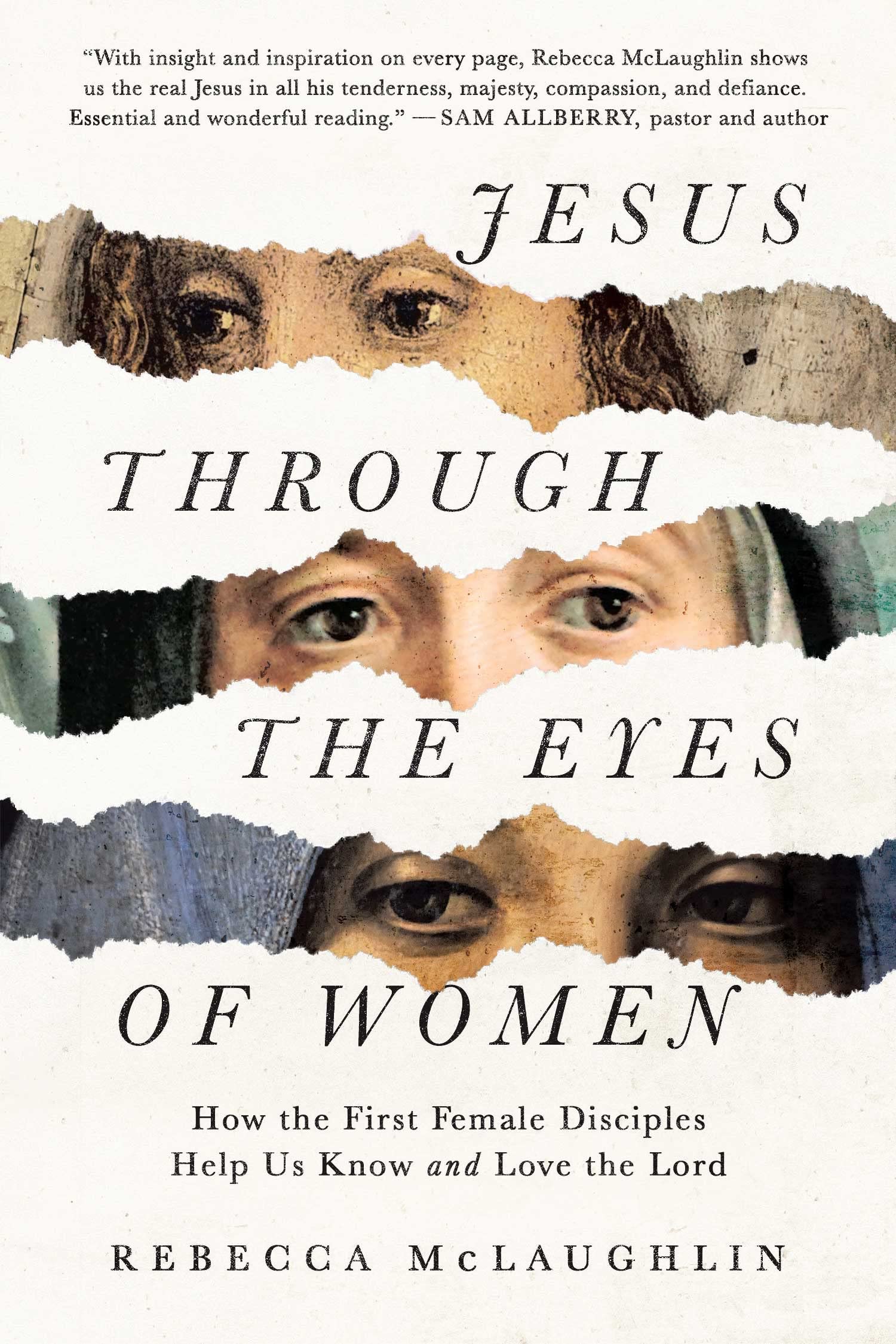 If the women who followed Jesus could tell you what he was like, what would they say?
Jesus’s treatment of women was revolutionary. That’s why they flocked to him. Wherever he went, they sought him out. Women sat at his feet and tugged at his robes. They came to him for healing, for forgiveness, and for answers. So what did women see in this first-century Jewish rabbi and what can we learn as we look through their eyes today?
In Jesus Through the Eyes of Women, Rebecca McLaughlin explores the life-changing accounts of women who met the Lord. By entering the stories of the named and unnamed women in the Gospels, this book gives readers a unique lens to see Jesus as these women did and marvel at how he loved them in return.
We’re delighted to offer this ebook to you for free.