Listen or read the following transcript as D. A. Carson speaks on the topic of The Triumph and Failure of Reformation from Nehemiah 9.
Male: Let’s remain standing to pray. “Who may go up to the hill of the Lord and stand in his holy place? He who has clean hands and a pure heart, who does not lift up his soul to an idol or swear by what is false.”
Our Father, we confess that we are men of unclean lips, who dwell among a people of unclean lips, and who of ourselves have no hope of anything but just exclusion from your holy place. We pray that you would turn us now toward you and to your Son. We pray that you would give us true repentance of heart and life. We pray that you would fix our hope on Christ Jesus our Lord. We pray that you would open our ears and soften our hearts to hear and receive and rejoice in your Word, and that you would work in us all that pleases you. We ask this in Christ’s name and for his honor and glory, amen.
Please do sit down. We’re going to read from Nehemiah, chapter 9.
“On the twenty-fourth day of the same month, the Israelites gathered together, fasting and wearing sackcloth and having dust on their heads. Those of Israelite descent had separated themselves from all foreigners. They stood in their places and confessed their sins and the wickedness of their fathers. They stood where they were and read from the book of the law of the Lord their God for a quarter of the day, and spent another quarter in confession and in worshiping the Lord their God.
Standing on the stairs were the Levites, Jeshua, Bani, Kadmiel, Shebaniah, Bunni, Sherebiah, Bani, and Kenani, who called with loud voices to the Lord their God. And the Levites, Jeshua, Kadmiel, Bani, Hashabneiah, Sherebiah, Hodiah, Shebaniah, and Pethahiah, said, ‘Stand up and praise the Lord your God, who is from everlasting to everlasting.
Blessed be your glorious name, and may it be exalted above all blessing and praise. You alone are the Lord. You made the heavens, even the highest heavens, and all their starry host, the earth and all that is on it, the seas and all that is in them. You give life to everything, and the multitudes of heaven worship you.
You are the Lord God, who chose Abram and brought him out of Ur of the Chaldeans and named him Abraham. You found his heart faithful to you, and you made a covenant with him to give to his descendants the land of the Canaanites, Hittites, Amorites, Perizzites, Jebusites, and Girgashites. You have kept your promise because you are righteous.
You saw the suffering of our forefathers in Egypt; you heard their cry at the Red Sea. You sent miraculous signs and wonders against Pharaoh, against all his officials, and all the people of his land, for you knew how arrogantly the Egyptians treated them. You made a name for yourself, which remains to this day. You divided the sea before them, so that they passed through it on dry ground, but you hurled their pursuers into the depths, like a stone into mighty waters. By day you led them with a pillar of cloud, and by night with a pillar of fire to give them light on the way they were to take.
You came down on Mount Sinai; you spoke to them from heaven. You gave them regulations and laws that are just and right, and decrees and commands that are good. You made known to them your holy Sabbath and gave them commands, decrees, and laws through your servant Moses. In their hunger you gave them bread from heaven and in their thirst you brought them water from the rock. You told them to go in and take possession of the land you had sworn with uplifted hand to give to them.
But they, our forefathers, became arrogant and stiff-necked and did not obey your commands. They refused to listen and failed to remember the miracles you performed among them. They became stiff-necked and in their rebellion appointed a leader in order to return to their slavery. But you are a forgiving God, gracious and compassionate, slow to anger and abounding in love. Therefore you did not desert them, even when they cast for themselves an image of a calf and said, “This is your god, who brought you up out of Egypt,” or when they committed awful blasphemies.
Because of your great compassion you did not abandon them in the desert. By day the pillar of cloud did not cease to guide them on their path, nor the pillar of fire by night to shine on the way they were to take. You gave your good Spirit to instruct them. You did not withhold your manna from their mouths, and you gave them water for their thirst. For 40 years you sustained them in the desert; they lacked nothing. Their clothes did not wear out, nor did their feet become swollen.
You gave them kingdoms and nations, allotting to them even the remotest frontiers. They took over the country of Sihon, king of Heshbon, and the country of Og, king of Bashan. You made their sons as numerous as the stars in the sky, and you brought them into the land that you told their fathers to enter and possess. Their sons went in and took possession of the land. You subdued before them the Canaanites, who lived in the land; you handed the Canaanites over to them, along with their kings and the peoples of the land, to deal with them as they pleased.
They captured fortified cities and fertile land. They took possession of houses filled with all kinds of good things, wells already dug, vineyards, olive groves, and fruit trees in abundance. They ate to the full and were well nourished. They reveled in your great goodness. But they were disobedient and rebelled against you. They put your law behind their backs. They killed your prophets, who had admonished them in order to turn them back to you. They committed awful blasphemies.
So you handed them over to their enemies, who oppressed them. But when they were oppressed they cried out to you. From heaven you heard them, and in your great compassion you gave them deliverers, who rescued them from the hand of their enemies. But as soon as they were at rest, they again did what was evil in your sight. Then you abandoned them to the hand of their enemies so that they ruled over them, and when they cried out to you again, you heard from heaven, and in your compassion you delivered them time after time.
You warned them to return to your law, but they became arrogant and disobeyed your commands. They sinned against your ordinances, by which a man will live if he obeys them. Stubbornly they turned their backs on you, became stiff-necked, and refused to listen. For many years you were patient with them. By your Spirit you admonished them even through your prophets, yet they paid no attention, so you handed them over to the neighboring peoples. But in your great mercy you did not put an end to them or abandon them, for you are a gracious and merciful God.
Now therefore, O Lord our God, the great, mighty, and awesome God, who keeps his covenant of love, do not let all this hardship seem trifling in your eyes, the hardship that has come upon us, upon our kings and leaders, upon our priests and prophets, upon our fathers and all your people, from the days of the kings of Assyria until today.
In all that has happened to us, you have been just; you have acted faithfully while we did wrong. Our kings, our leaders, our priests, and our fathers did not follow your law; they did not pay attention to your commands or the warnings you gave them. Even while they were in the kingdom, enjoying your great goodness to them in the spacious and fertile land you gave them, they did not serve you or turn from their evil ways.
But see, we are slaves today, slaves in the land you gave our forefathers so that they could eat its fruit and the other good things it produces. Because of our sins, its abundant harvest goes to the kings you’ve placed over us. They rule over our bodies and our cattle as they please. We are in great distress. In view of all this, we are making a binding agreement, putting it in writing, and our leaders, our Levites, and our priests are affixing their seals to it.’ ”
Don Carson: In the Old Testament, times of corporate confession of sin and renewed covenantal vows are not all that uncommon. One thinks, for example, of Joshua before he leads the people into the Promised Land in Joshua 24, or the example of Ezra in Ezra 9. Certain psalms, very much like this passage, cast a retrospective glance at the history of the people of God in order to lead the people to repentance, like Psalm 78. Or one thinks of Daniel 9, a private prayer but offered up on behalf of the entire nation, with many phrasings very similar to this.
In the New Testament, the emphasis on confession, as in 1 John 1; on repentance, as in Acts; and on covenantal renewal, as in the Lord’s Supper, is scarcely any weaker, even if it is configured rather differently. I wonder sometimes if our local churches, or perhaps some of our larger assemblies, would be well advised to undertake similar corporate confession, perhaps in conjunction with the Lord’s Supper.
Yet the confession and renewal of the covenant depicted in these two chapters have another dimension to them. Like other instances of corporate confession in the Old Testament, there is a very strong retrospective look at God’s faithfulness on the one hand and the transgression of the people on the other. In other words, this is retrospect, looking backward in order to call people to repentance today.
Yet read against the broader canvas of the entire Bible, these chapters also betray prospect. There is a primary emphasis on retrospect, but they glance forward. They gaze backward, but they glance forward, as we shall see. We must do the same as we look at this chapter, both as retrospect and as prospect.
The festivals of joy in chapter 8 have come to an end, but capitalizing on the evident instinct of the people for lament and confession, as they realize just how far they are removed from what Scripture actually says, the leaders arrange for this new assembly. So we spend our time now in reading these two chapters as retrospect.
First, the setting: verse 1 to the first part of verse 5. The setting is the third public reading, after the two described in chapter 8, and we have now reached the twenty-fourth day of the month. The first reading was on the first day of the seventh month, then the second with the leaders was on the second, and then, of course, that led the way to the Feast of Booths with its regular readings all through that conference as well. Now a third separate public reading, and the leaders not only engage in this new Bible conference with enthusiasm but clearly prepare a communal response.
In some ways, this assembly echoes Nehemiah’s initial prayer, where he remembers God’s words, “But if you return to me and obey my commands.” Now the people are returning to God and vowing to obey his commands. In fact, this verb return is used repeatedly in the chapter in front of us. Verse 26: “But they were disobedient and rebelled against you. They put your law behind their backs. They killed your prophets, who had admonished them in order to turn them back to you.” That’s exactly the same verb. “In order to turn them back to you.”
“They committed awful blasphemies.” In other words, they rejected repentance. Or again, verses 28–29: “As soon as they were at rest, they again did what was evil in your sight. Then you abandoned them, and when they cried out to you, you heard from heaven, and in your compassion you delivered them time after time. You warned them to return to your law.” The same verb again.
Or again in verse 35: “Even while they were in their kingdom, enjoying your great goodness to them in the spacious and fertile land you gave them, they did not serve you or turn from their evil ways.” Have you noticed? In each of these instances, it’s what the people did not do. Now, in effect, this assembly is saying, “And this is what we want to do. We want to repent. We want to return.”
They recognize at the beginning of the chapter that they are compromised by intermarriage with pagans (verse 2). More broadly, they confess their own sins and the sins of their fathers, comprehensively. We read, “Those of Israelite descent had separated themselves from all foreigners. They stood in their places and confessed their sins and the wickedness of their fathers.”
There are major public displays of mourning and contrition (verse 1): fasting, wearing sackcloth, having dust on their heads. There is no reason to think that these are merely formulaic rituals, not in the light of the intensity of the grief and lamentation that the reading of the Word of God had precipitated a bare three or four weeks earlier. The Levites have prepared for the occasion (verse 3). There is this grand reading of Scripture, day by day, and they spend their time in confession and worshiping.
Then we read (verse 4), “Standing on the stairs were the Levites, who called with loud voices to the Lord their God.” They cry, “Stand up and praise the Lord your God, who is from everlasting to everlasting,” and then this intensely moving and probing prayer of confession. That brings us, then, to the prayer itself, from verse 5b to verse 37. I do not have time to expound this prayer in detail, but I shall draw attention to four characteristics of it.
1. The Levites read their place in history.
There are numerous places in Scripture where the history of the people of God is surveyed in order to encourage repentance. That’s what Psalm 78 is about, for instance. It is what Acts 7 is about. In Stephen’s speech, do you recall what he says? He runs through the history of Israel to show that at every stage, when God intervened and brought the people onto a new level, the people failed, whether it was with the temple, whether it was with Abraham, whether it was with the prophets.
So it shouldn’t be too surprising if people fail when he sends his Son. That’s the thrust of the argument. Sometimes the argument is made up of units of thought that say, in effect, “In the light of God’s goodness, how on earth could we be so wicked?” That sort of thinking is found throughout the Prophets. Here, for example, is Amos 2, verse 9, and following. God is speaking.
“ ‘I destroyed the Amorite before them, though he was tall as the cedars and strong as the oaks. I destroyed his fruit above and his roots below. I brought you up out of Egypt, and I led you 40 years in the desert to give you the land of the Amorites. I also raised up prophets from among you and Nazirites from among your own young men. Is this not true, people of Israel?’ declares the Lord. ‘But you made the Nazirites drink wine and commanded the prophets not to prophesy.’ ”
In other words, it’s the shattering contrast between the goodness of God in providing so much and what the people have done with it that is meant to bring shame and confession. Now it’s the people themselves who are seeing precisely those contrasts. They review their history under the guidance of the Levites’ preparation in precisely those sorts of ways.
So you begin at verse 6. There is great stress on the goodness of God in creation. “You alone are the Lord. You made the heavens, even the highest heavens, and all their starry host, the earth and all that is on it, the seas and all that is in them. You gave life to everything, and the multitudes of heaven worship you.”
There is a huge emphasis in Scripture, in various parts, on the fact that human responsibility is grounded in the doctrine of creation. We did not make ourselves. We do not own ourselves. We are not God’s junior peers, as it were, offering our two cents’ worth now and then. Human accountability is grounded repeatedly in the doctrine of Scripture. Indeed, when God made everything, he made everything good.
Then verses 7–8. God raised up Abram. “You are the Lord God, who chose Abram and brought him out of Ur of the Chaldeans. You named him Abraham,” which itself was covenantally significant. “You found his heart faithful to you. You made a covenant with him to give to his descendants this land. You kept your promises because you are righteous.”
Then in verses 9–12, they move on to the exodus, still surveying the history. “You saw the suffering of our forefathers in Egypt. You heard their cry at the Red Sea. You sent miraculous signs and wonders against Pharaoh, and eventually you made a name for yourself, which remains to this day. You divided the sea before them, so that they passed through it on dry ground, but you hurled their pursuers into the depths, like a stone into mighty waters. Then you led them out by a pillar of cloud, and by night with a pillar of fire,” and so on.
Then the giving of the Law and the wilderness journeys. Verses 13–15: “You came down on Mount Sinai. You spoke to them from heaven. You gave them regulations and laws that are just and right, and decrees and commands that are good. You made known to them your holy Sabbath and gave them commands, decrees, and laws through your servant Moses. Moreover, not only did you give them laws, you provided for their every need. You gave them bread from heaven, and in their thirst you brought them water from the rock. You told them to go in and take possession of the land,” and so forth.
Now after all of the setup, the contrast. Verse 16: “But they, our forefathers, became arrogant and stiff-necked and did not obey your commands. They refused to listen and failed to remember.” Isn’t that a massive indictment? “They refused to listen and failed to remember.” How much of covenantal faithfulness in both testaments is bound up with remembering?
Read Deuteronomy 6. Remembering and remembering, and then passing it on to the new generation, so that the new children, who weren’t there at the actual time of the exodus, remember in turn, so it becomes part of their heritage. Peter, likewise, writing to people in order to stir up their pure minds by way of remembrance.
“Do this in remembrance of me.” Isn’t it shocking that we have to have a rite to remember Christ’s death? “They refused to listen, and they failed to remember.” They failed to remember precisely because they were not pursuing the God-ordained rites and rituals and festivals by which people remembered. It was more important to make money. It was more enjoyable to join the pagans.
“So they didn’t listen, and they failed to remember. They didn’t remember the miracles. They became stiff-necked in their rebellion. They even talked about going back to slavery. By contrast, you’re a forgiving God. You could have wiped them out in the desert with perfect justice, but you are gracious and compassionate, slow to anger, abounding in love. Therefore, you did not desert them, even when they deserved it, even when they cast for themselves an image of a calf and said, ‘This is your god who brought you up out of Egypt,’ or when they committed awful blasphemies.”
Then the wilderness years. Verses 19–21: “Because of your great compassion you did not abandon them in the desert. By day the pillar of cloud did not cease to guide them on their path, nor the pillar of fire by night to shine on the way they were to take. You gave your good Spirit to instruct them. You did not withhold your manna from their mouths. You gave them water for their thirst,” and so forth.
Then in the land, God gave judges repeatedly, despite the cycles of degeneration (verses 22–28). God again and again gave them military victories, allotting them kingdoms and the like. “People took the land and ate to the full and were well nourished,” we read in verse 25. “They reveled in your great goodness.”
Verse 26: “But they were disobedient and rebelled against you. They put your law behind their backs. They killed your prophets, who had admonished them in order to turn them back to you. They committed awful blasphemies. You handed them over to their enemies, who oppressed them. But when they were oppressed they cried out to you. From heaven you heard them, and in your great compassion you gave them deliverers, the judges, who rescued them from the hand of their enemies.” And so on throughout verses 29–31.
Then in verse 32, the language changes. Instead of talking about the forefathers as they, now the language becomes first person plural. You’re into the later dynastic period. “Our kings. Our prophets. Our rulers.” “Now therefore, O our God, the great, mighty, and awesome God, who keeps his covenant of love, do not let all this hardship seem trifling in your eyes, the hardship that has come upon us, upon our kings and leaders, upon our priests and prophets, upon our fathers and all your people, from the days of the kings of Assyria until today.”
In other words, they group themselves now with their most recent history. “In all that has happened to us, you have been just. You have acted faithfully while we did wrong.” And so the argument goes, all the way down to verse 37. Note well. When people are genuinely broken and aware of their deep guilt before God, the issue in their eyes is never, never theodicy. Never. We do not struggle with the deep questions of how relatively innocent people can suffer when we are busy confessing our own guilt.
A society that produces many, many, many books on theodicy is not a repentant society. I could name you at least 15 major academic volumes on this topic in the last three years. I can’t think of one that calls the nations prophetically to repentance in the same sort of rigorous way. Because despite the fact that it’s a theodicy, we’re still trying to justify ourselves before God and wonder if God, granted this rotten world, can possibly be justified in our eyes. That’s the nature of theodicy.
But when people see God’s sovereignty and his goodness and his compassion as clearly as these Levites do, and when they see their own sin in comparison with it, theodicy is simply not the issue. Shame is. Contrition is. Repentance is. How then should we be praying and confessing our sins in the light of our history?
Some of our history, of course, is shared with all believers everywhere. We have one sovereign God of the universe, creator of all things. We are dependent upon him not only for our very being but for every breath we breathe, every heartbeat. It is all sanctioned by his overruling, sustaining providence. Of course, like Christians everywhere, we can and should look to the cross and the resurrection, the goodness of God in incarnation and redemption, and the gift of the Spirit as the down payment of the promised inheritance.
So then in the light of such magnificent gifts, was the church of the first century always perfectly responsive and obedient? Are we? But I suspect that we must also look at our own particular history. We belong to the part of Europe where the Reformation substantially succeeded. It came close in France, of course, and then the Huguenots were slaughtered and evicted and enslaved, and they went another path.
Moreover, in the English-speaking world, not only do we have a heritage of Reformation truth, but we have, hands down, the most amazing Christian literature. It vastly outstrips anything in any other language, in any other 10 languages in the world. We produce a lot of rubbish as well. Don’t misunderstand me. I’m certainly not suggesting that everything is good. But when you start examining the heritage of godly commentaries, godly theologies, godly books on ethics, godly books on just about every conceivable topic …
I was at L’Institut Biblique de GenËve four or five weeks ago. Probably 80 or 85 percent of the pastors were from Southern France, and the rest were from Geneva. It was a conference for pastors. In open Q&As, they asked questions about this or that or the other, this or that or the other, and in instance after instance after instance, I could think of a book I could recommend in English where I know perfectly well there is simply nothing equivalent in French.
What about Swahili or Kikuyu? Despite valiant efforts by a small kernel of people, the actual amount of Christian literature in Mandarin is farcical compared with the need. In Mandarin, for goodness’ sake, with a billion speakers. Not only so, but we have had strong doctrinal churches, various kinds of reformations of one sort or another, even when our lands have been right on the edge of catastrophic destruction.
Those who examine these things say that on Easter 1740, precisely six people showed up at St. Paul’s for Holy Communion. That’s how far religion had sunk. There were 280 crimes on the books for which capital punishment was prescribed, including stealing a loaf of bread. The rich were getting richer, the poor were getting poorer, and children from the age of 4 and 5 were down in the mines. Then in 1734, Howell Harris began to preach in Wales. In 1738, George Whitefield began to preach to the miners outside of the coal fields in the southwest. In 1740, Wesley began to preach.
For 50 years of spectacular gospel ministry, not only was the gospel preached with amazing boldness and courage, despite endless ridicule, but men and women grew up in place, who were simultaneously passionate about the gospel and all the entailments of the gospel and justice and integrity and righteousness in the land, without becoming fastened on the entailments while losing the gospel or merely assuming the gospel.
It was an amazing movement of God. That’s our heritage. I whine about crossing the Atlantic twice in a week. On the other hand, it takes me about eight hours to do it. George Whitefield crossed the Atlantic 13 times. It took him between six weeks and three and a half months, always by sail.
It wasn’t just the evangelical awakening either. There have been other movements of God on both sides of the Atlantic. On the other side of the Atlantic, one thinks of the corresponding movement, sometimes called the Great Awakening, centering in Northampton in New England (not the Northampton over here), connected with Jonathan Edwards and others; the movement about 1859 and 1860, starting in New York, that swept across the country.
Oh, God has been good, and we have been unfaithful. We love money more than service. We want self-fulfillment more than self-death. We entertain ourselves to death, to use the words of Postman. We have so many things to do, so many choices, that we can’t possibly do the important things. We have this glorious literature that no one reads, except a few eggheads like those represented in this room.
When I was at Emmanuel, you could go into the college library, which is the second best Puritan library in the world, and look at volume after volume after volume that hasn’t been touched, in some cases, for centuries. There was one small part of me that just wanted to go up and down the aisles touching them all to make sure they weren’t abandoned quite.
As a people, we find ourselves in a place where a very substantial part of the nominal church doesn’t even assume the gospel anymore. It has so reinterpreted it that freedom of self-expression in every conceivable arena of life is justified as the gospel itself, an entirely domesticated gospel with no passion for holiness or righteousness or the glory of God.
Do you remember the sober words of the Lord Jesus in Matthew, chapter 11, verse 20 and following? “Woe to you, Cana! Woe to you, Bethsaida! For if the miracles done in you had been done in Tyre and Sidon [pagan cities of the coast], they would have remained to this day. If the gospel preached in you had been done in Sodom, it would have remained to this day.”
Do you not hear the voice of God saying, “Woe to you, London! Woe to you, Washington! If the gospel that you have known had taken root in you, it would have been a paragon of virtue and righteousness. It will be better for Kabul, Afghanistan, on the last day than for you.” God’s judgment is meted out in part as a function of the grace we have received, of the light we have received, of the revelation we have received.
The text is not saying that in terms of objective social criteria somehow Cana is more wicked than Sodom, but in terms of the privilege it had received, its hardness to Christ makes it far more culpable than the rejection of integrity demonstrated by Sodom. In that light, how shall we escape?
Do you know one of the most frightening verses I find in all of Holy Writ? James. “Do not be many teachers, knowing that you shall receive the greater judgment, because to whom much is given, from him also shall much be required.” So what do I do? I go around the world teaching people and compounding judgment for myself. You see, the more you know, the more you’re responsible for. That includes you and me. That’s the first element in this prayer. The Levites read their place in history.
2. They reflect biblical language and biblical meditation.
There is scarcely a clause in this prayer that is not drawn from earlier Scripture. It would take me far too long to provide an exhaustive list, and the major commentaries do this in any case. See Williamson or, better yet, Myers. But permit me a very partial list just from the first part of the prayer so that you get the idea.
Verse 11: The Egyptians, we are told, were hurled like a stone into the mighty waters. So Exodus 15:5 and 10. Verse 15: With uplifted hand God fulfilled his word. Exodus 6:8 and Numbers 14:30. Verse 17: The people rejoiced in God’s nature, for he is a forgiving God, gracious and compassionate, slow to anger and abounding in love. That, of course, is Exodus 34:6, but many, many other passages as well. It becomes almost a formula. It’s found, for instance, in Psalm 86:15.
Verse 18: Blasphemers said to the golden calf, “This is your god, who brought you up out of Egypt.” So Exodus 32, verses 4 and 8. Verse 20: They remembered the gift of God’s “good Spirit.” The expression comes from Psalm 143, verse 10. Verse 23: This privileged people are “as numerous as the stars of the sky,” a constantly repeated quote introduced in Genesis 22:17, found in Exodus 32:13, and many other places.
Verse 25: On entering the Promised Land, they are given its cities, its houses, its wells, its vineyards, its olive groves, exactly the same order as found in Deuteronomy 6:11. Verse 26: But the people of God put his law behind their backs. So Psalm 50:17 and Ezekiel 23:35. Verse 27: God handed them over to their enemies. So Judges 2:14; Ezra 5:12, and many other passages. And I could go on and on and on. There are scores and scores and scores of them.
Moreover, many of the prayer’s most memorable lines are drawn from the prayers of earlier believers. Hezekiah is quoted in verse 6, Jeremiah in verses 6 and 10, Moses in verse 6, Daniel in verses 10 and 17, Solomon in verse 27, David in verse 31, and Ezra, a contemporary, in verse 8. Yet none of the prayer sounds clichÈ-driven. Despite the fact that it is steeped in Old Testament language, it sounds fresh. It’s remarkable.
I have a friend. Some of you would know him, so I won’t mention his name to protect the guilty. He’s a lovely man, really a lovely man, trained in a part of the country where he was taught to pray with a certain kind of ministerial twang. Not merely in Elizabethan English but with a ministerial twang in Elizabethan English.
I first got to know him 30 years ago, and he had perhaps the ugliest dog on God’s green earth. I don’t know what it was. It was a huge thing and just as ugly as sin. It was an ugly dog. It was ever so friendly almost all the time, but every time my dear friend began to pray, this dog howled. It was such a friendly dog despite its ugliness, and you forgave it its ugliness just because it was so friendly, and then he would start.… Even for grace, let alone we set aside time in the afternoon to pray, as we did. This dog would howl.
So you’d put him into the next room in case it was somehow.… Our heads were down. Maybe he thought he was being ignored. No, we put him in the next room and he’d howl. If he could hear us, he’d howl. We had to put him at the other end of the garden if we were speaking out loud and the windows were open. You had to put him away, because if he heard you, he’d howl. My friend opined that perhaps this.… It had crossed his mind that maybe this dog was possessed.
Well, if demons can infest pigs, I suppose they can infest hounds, but to be frank, I had a simpler explanation. I think this dog had learned. “Eternal and heavenly Father, in thine infinite mercies we bow in thy sacred presence,” and on it went with a certain twang and a certain language and a certain pitch and a certain whine. I’m not judging the man’s heart. I mean, I loved to pray with him and all that. He was full of Scripture, and yet you felt it was clichÈ-driven and artificial, and the dog thought so too. I noticed the dog didn’t do it when I prayed.
Here is freshness and candor and frank contrition, even while the language and categories burst with Scripture. In fact, if I could take a little more time, I could show you not only that these phrases, these clips, from other Old Testament passages are embedded in the prayer, but very often they presuppose that the author knows the context in which they’re found and is bringing it with him. This is a very carefully prepared prayer by the Levites as they lead the nation in corporate contrition.
3. They focus on God.
We have seen this implicitly in the movement of the historical flow of the prayer, which oscillates between focusing on God’s goodness on the one hand and focusing on our failure on the other, but it is worth listing some of the things predicated of God. It would take too long to work through them all. Let me show you just a few of them so that you get the idea.
Verse 6: God alone is the Lord, and he’s the Creator. Verse 7: He’s the God who chose Abraham and led him. Verse 9: He’s the God who witnessed the sufferings of his people and led them out of Egypt. Verse 10: He’s the God who made a name for himself, and in the context, through the spectacular events of the exodus. Verse 11: He’s the God of spectacular miracles, the most spectacular here being the crossing of the Red Sea.
Verse 13: He spoke. He disclosed himself in the giving of words on Mount Sinai, the giving of the Law, and not merely the Ten, but all of these regulations and laws that are just and right. Verse 15: He provided them with bread, manna, and water in the desert. Verses 20 and 30: He gave his good Spirit, and in the context it means, in each instance, he gave his good Spirit so that the people were taught through the mouths of the prophets.
Verse 22: He gave them the land. Verse 23: He enabled them to multiply and become numerous. Verse 29: He warned them again and again. He didn’t just clobber them, blindsiding them because they haven’t been fast enough. He warns them when they become arrogant. Verse 31: He doesn’t end them or wipe them out. He doesn’t abandon them, because he is gracious and merciful and compassionate. This brings us, then, to the heart of the issue.
4. They recognize that the heart of their sin lies in the failure of their relationship to God.
Do you have any of these painful memories that some of us have? Maybe you’ve been far too good so you’ve never done this, but I have some of these painful memories, where I recall things I’ve said to someone or things I’ve done or a relationship that went astray and it was quite frankly my fault or where I’ve lost my cool or where I have been really idiotic in response or shot off my mouth without knowing what I was talking about. All of these stupid little things across all 50-odd years of my existence.
There are times when I wake up in the sort of netherworld of halfway asleep and halfway awake, and one of these comes back to mind, and I break out in a cold sweat as I remember the sheer stupidity, sinfulness, and arrogance of the whole thing. Am I the only one who has any of these? Sometime back it dawned on me how twisted those memories and my responses are, because almost every one of them finds me squirming at my embarrassment before other people, not at my shame before God.
Look at it another way. When we try to show the relevance of the gospel of Jesus Christ in larger public context.… Perhaps we’re talking about social policy and writing to our legislators, for example, and we want to do something to preserve marriage more faithfully. So we point out all of the social evidence (and there’s quite a lot of it) to show that children grow up more secure and better taxpaying citizens and more likely to enter into godly relationships themselves if they are brought up in a disciplined home with one husband and one wife, and so forth.
Of course, it’s not absolute, but in terms of gross statistics, the evidence is so strong. You just can’t deny it. “So shouldn’t we, therefore, pass laws that justify this kind of thing, that strengthen the marriage?” we say. Thus, you see, we are saying Christianity is socially relevant. Don’t you see? Isn’t that what we say?
Sometimes, in order to get legislation passed, you have to do that sort of thing, precisely to show the social relevance on a broader base than merely the opinion of the Christian community, but nevertheless, implicitly we’re saying we have this insight because, of course, we have this religion. In some contexts I don’t object to that argument, but it will never call the nation to repentance. Never has, never will.
The heart of our evil is not at the horizontal level; it’s at the vertical level. We have offended God. It’s not as if an Amos cannot point out all the social injustice. It’s not as if parts of Isaiah cannot do the same. That’s not in dispute. God is not advocating some kind of ethereal religion that is abstracted from all of life and social concerns and integrity and how to free slaves, and so forth.
But when you read through the Old Testament, what is it that is repeatedly said to make God angry? Quite a few things are mentioned, but repeatedly, underlined again and again and again. Idolatry, the de-Godding of God, the dishonoring of God, the relativizing of God, disobedience toward God, the breaking of God’s covenant, which is, of course, why a David, after adultery and murder, conspiracy, and all the rest, can still say something like, “Against you only have I sinned and done this evil in your sight.”
In one sense, of course, it’s not true. He sinned against Bathsheba. He sinned against Uriah. He sinned against the generals of the high command. He sinned against the people. He sinned against the baby in Bathsheba’s womb. He sinned against the people as a whole. There’s scarcely anybody he hasn’t sinned against. But in the deepest sense, the one most offended in every sin is God.
Idolatry is simply loving anyone or anything, any movement, any position, any thought … anything … more than loving God. That’s all it is. That’s why covetousness can be called idolatry by the apostle Paul. Covetousness is wanting something and wanting it so badly it frames our desire. It’s not God we covet then; it’s something else.
That’s why the first commandment is to love God with heart and soul and mind and strength. It’s the only commandment we always break when we break any other commandment. It’s the first commandment. That means our fundamental problem is, in fact, God, because he is the one we have offended. Despite all of his goodness and compassion, he is the one we have disobeyed. Here is the heart of this prayer of confession.
Thirdly, the renewal of the covenant in 9:38 to 10:39. This is far from being the only written covenant renewal in the Old Testament. There’s one under Joshua. There’s one under Hezekiah. There’s one under Josiah. In part, of course, the Lord’s Supper is a New Testament counterpart. After all, does not Jesus say, “This is the new covenant in my blood, which is shed for many for the remission of sins”?
So when we take these elements and we are told, “Do this in remembrance of me,” as we take the elements, we are saying, in effect (amongst other things), “I remember.” Thus to say, “I remember,” while, in fact, we are acting like public sinners, despising others, disowning God, cherishing and nurturing secret sin, is to profane the covenant. It is not to renew the covenant. It is, in fact, to blaspheme against the covenant. That is why the Lord’s Supper must never, ever become a merely automatic rite or the like.
But here I shall draw attention to only two of the features of this renewed covenant. Nehemiah 9:38: “In view of all this, we are making a binding agreement, putting it in writing, and our leaders, our Levites, and our priests are affixing their seals to it.” I want to talk, first of all, about its structure.
All of this covenant renewal is in line with a program Nehemiah set forth as early as 1:9. He envisages the people returning to God and obeying his commandments. Some of this return is exemplified in the willingness to build a wall and the seriousness of relearning Scripture and now in the deep public confession such reading involves. Even the last (let us be quite frank) can be merely emotionally cathartic. I have seen instances like that, when people grieve over their sins in public, in spectacular display, and change nothing.
So what now takes place is willed, principled, binding, written agreement, sealed with personal seals by the leaders, a corporate commitment. What you find, then, is that the various bodies making this commitment are listed. The governors and their administrators in chapter 10, verse 1, and following. Then the Levites. Seventeen Levites are mentioned, divided between three leaders and 14 associates.
Then other leaders, and then, in verses 28–29, the rest of the people, those who were separated, that is, clear of these entanglements with the pagans, and who were old enough to understand. Not just men, but men, women, and anybody old enough to understand, so that it was a binding commitment on those who understood. Strong, solemn oath, binding, with curses attached to it, so that if we do not obey, let this be done to us (verses 28–29).
“The rest of the people … priests, Levites, gatekeepers, singers, temple servants, and all who separated themselves from the neighboring peoples for the sake of the law of God, together with their wives and all their sons and daughters who were able to understand … all these now join their brothers, the nobles, and bind themselves with a curse and an oath to follow the law of God given through Moses the servant of God and to obey carefully all the commands, regulations, and decrees of the Lord our God.”
Now then, that’s the preamble. The pledge itself has six clauses divided into two groups of three. In group one, the pledges are, first, verse 30: “We promise not to give our daughters in marriage to the peoples around us or take their daughters for our sons.” That is, the promise of separation from the pagan world in terms of intermarriage. This is part of the problem that has already arisen. It has shown up in Ezra 9 and 10. It’s going to show up again in Nehemiah 13.
Secondly, verse 31, the first part: “When the neighboring peoples bring merchandise or grain to sell on the Sabbath, we will not buy from them on the Sabbath or on any holy day.” Sabbath observance. Thirdly, verse 31b: “Every seventh year we will forgo working the land and will cancel all debts.”
This pledge integrates two laws relating to the seventh year: the law stipulated in Exodus 23:10 and following regarding the fallow year for the sake of the poor, and the law mentioned in Deuteronomy 15 regarding canceling of debts, which is also for the sake of the poor, and addresses some of the economic problems already confronted by Nehemiah in chapter 5. That’s the first group.
The second group is equally grounded in the Torah, but each of these three is tied also to the temple. First, verses 32–33, the assumption of the temple tax, which is supposed to support the temple. “We assume the responsibility for carrying out the commands to give a third of a shekel each year for the service of the house of our God: for the bread set out on the table; for the regular grain offerings and burnt offerings; for the offerings on the Sabbaths, New Moon,” and so on and so forth.
Probably now one-third of a shekel, even though originally the law stipulated one-half of a shekel, because at this point the shekel itself was a little bit larger, a little bit heavier, and I suspect that’s why they were counting the equivalent weight. Now if you read the surrounding literature, Ezra and so forth, as well, there was Persian support for the temple, recorded in Ezra 1:9–10 and Ezra 7, but either it was inadequate, just too small, or it was temporary and was now being stopped.
In any case, this is obeying the law of Exodus 30:11–16. It guarantees the continuing service of the temple of God. Secondly, verse 34: “We, the priests, the Levites, and the people, have cast lots to determine when each of our families is to bring to the house of our God at set times each year a contribution of wood to burn on the altar of the Lord our God, as it is written in the Law.” Now the Law did not specify how it was to be done, but it did specify this constant burning.
So now a roster is to be organized in order to facilitate the law stipulated in Leviticus 6:12–13. A little later on, in his second administration, Nehemiah himself organizes the roster, mentioned in 13:31. Finally, verses 35–39. Here there is a series of three promises lumped together, in each case to support temple staff so as to maintain corporate worship. Then, finally, the conclusion in the very last line of the chapter. “We will not neglect the house of our God.”
So the structure of this covenant of renewal is clear enough, but it immediately raises the second point: the focus, the emphasis, of this covenant renewal. Isn’t it remarkable? At one level, of course, this covenant binds the people to obey all the Law. Back in verse 29, they bind themselves to follow the law of God given through Moses the servant to obey carefully all the commands, regulations, and decrees of the Lord their God.
But when the concrete individual pledges are itemized, the first three do not deal with things like, let us say, covetousness or idolatry or the like, and the last three are entirely bound up with support of the temple. What’s going on? Is Nehemiah perhaps to be understood as some kind of half-baked, pre-Jesus, pro-Pharisee, far more interested in ritual purity than in the moral law of God? It’s an interesting covenant of renewal, isn’t it?
Let me suggest two factors that might help orientate us. First, these pledges all have to do with the relationship of the people to God in terms of the covenantally stipulated ordinances. That is, this is how these people, under the terms of the Mosaic covenant, are to be rightly related to God. If they’re sloppy in these areas, they are sloppy in their relationship to God. How can you get sloppy over the temple and still maintain fidelity to God and call it moral law?
In other words, just as the confession is bound up with a God-centered view of things, so that confession is with respect to denying, disowning, de-Godding God, so also the pledges are in the covenantally prescribed domains, where you preserve what is central in the covenantal outworking of the people’s relationship to God, which turns on the temple. It turns on the sacrificial system. It turns on the feast. It turns on the Day of Atonement. It turns on all of those sheep that are killed on Passover, and so on.
That brings me to a second observation. Read, if you will, two very interesting verses in Hebrews, chapter 7. Now this is in connection with the coming of Jesus as High Priest according to the order of Melchizedek, and I don’t have time to unpack the whole context, but listen to the logic of verses 11–12.
“If perfection could have been attained through the Levitical priesthood …” Forget the parenthesis so that you get the logic first. “If perfection could have been attained through the Levitical priesthood, why was there still need for another priest to come, one in the order of Melchizedek, not in the order of Aaron?”
Now understand the logic first. The logic is that the Levitical priesthood was established at the time of Sinai, but the announcement of the Melchizedekian priesthood is in the time of David. “You are a priest forever, according to the order of Melchizedek.” The superscription insists this is a psalm of David. So this comes centuries after the announcement of the Levitical priesthood.
The argument is if the Levitical priesthood could have done it all, then why does God, centuries later, announce another priesthood? Then goes further yet and says, “For when there is a change in the priesthood, there must also be a change of the law.” That is, the priesthood is so bound up with the entire law that if you change the priesthood, you change the entire law. You just can’t escape that.
Now go back to the parenthesis, and it becomes more shocking yet. “If perfection could have been attained through the Levitical priesthood (for on the basis of it the law was given to the people), why was there still need for another priest to come?” For many of us, that just blows our categories out of the water, because most of us have adopted categories of analysis of the law based, finally, on Thomas Aquinas.
The tripartite distinction of law: moral, civil, and ceremonial law.… You can find the labels back into the Patristic period, but as a tripartite distinction for explaining what continues and what does not, that is essentially and deeply Thomistic, and Calvin got it from Thomas. In this way of looking at things, then, what we think is this. The most important structure in the law is the moral, and then the civil bits and the ritual bits are just sort of there. They’re temporary. They’re bound up with that economy. What do you expect? They drop away.
Well, at a certain heuristic level, that’s not entirely wrong, but it’s not the way Hebrews analyzes the whole thing. He says that entire law covenant is based on the Levitical structure. That’s what the parenthesis says. For on the basis of the Levitical structure, the entire law was given. In fact, when you actually read through the Law, when you actually start reading Leviticus, when you actually start reading Exodus, doesn’t it sound like that?
You get to the Ten Commandments. It’s pretty powerful stuff and all of that, and then the rest of the book is how to build a tabernacle. Then you get to Leviticus and how to build a tabernacle and how to build an ephod and how to have sacrifices and how to take mold out of the house with your priest, and so on. You get to Numbers, and apart from a few numbers and other sorts of things, then endless more ritual and structure, and Deuteronomy summarizes the whole. That, brothers, is the Law. It seems to me that Hebrews got it about right.
The whole sacrificial system, the priestly system, the Levitical system, lies at the very center of the thing. On the basis of it the law was given, so if you change that Levitical structure, you have to change the whole covenant. That’s what Hebrews says. Now if I had a lot of time, I would show you how that can be configured into a responsible systematic theology that doesn’t drift you toward Marcion or Darby.
On the other hand, it really is important to remember the categories that Hebrews itself uses. It seems to me that is precisely what is being presupposed in this prayer of commitment. In terms of what is central in the law, it’s faithfulness to God himself. In terms of the law-given stipulations about how we relate to God in the categories of the covenant, the categories of the temple.
Now all of this covenantal renewal, as moving as it is, as probing as it is, is essentially retrospective. One “re-news” what is already in place. It is retrospect. Now in closing, let me say a few words about the prospect. Here I would like to invite you to turn to another New Testament passage, John, chapter 7, verse 37. “On the last and greatest day of the feast …” The context, from chapter 5 on, shows this to be the Feast of Tabernacles. It’s the Feast of Booths.
“On the last and greatest day of the feast, Jesus stood and said in a loud voice, ‘If anyone is thirsty, let him come to me and drink. Whoever believes in me, as the Scripture has said, streams of living water will flow from within him.’ By this he meant the Spirit, whom those who believed in him were later to receive. Up to that time the Spirit had not been given, since Jesus had not yet been glorified.”
Now I know full well there’s another reading of that text by changing the punctuation a wee bit. I’ve discussed it at length in my commentary, and I’m not going to try and resolve it all here. It takes too much time. What is interesting from our perspective is this little expression, “As the Scripture has said.” The commentators struggle with what Scripture is meant. I’ve come to the conclusion that the Scripture that is meant is, in fact, Nehemiah 9.
Now I’ve given a much longer defense in the commentary. You can read it there. But let me point out just a few of the connections. Nehemiah 9, as it surveys what God has done, looking back on the exodus, reminds the people that God gave them manna (verse 20), otherwise called bread from heaven in verse 15. Don’t forget John 7 follows John 6, which talks about the new manna, the new Bread from heaven, using precisely that expression, Jesus himself.
John’s gospel shows how Jesus fulfills all of the Old Testament feasts. He is himself the new Passover, so why should he not also be the new Feast of Tabernacles? Not only so, but this is one of the rare places where the feast is explicitly connected with the Spirit. “Give your good Spirit.” Now the Spirit is being promised in a way much beyond what the Old Testament people received.
In the Old Testament, in these two passages, 9:20 and 9:30, the Spirit is understood to be imbuing the prophets, who then teach the Word of God. But it is part of Old Testament promise of the new covenant, whether in Jeremiah 31 or in Ezekiel 36 or Joel 2, that in this coming age, the Spirit will be poured out on all of the people. Not merely on the prophets in a mediated, representative tribal structure, but on all of the people.
When one works through the feast, one finds connection after connection after connection of this chapter with John 7. Thus, in the stream of redemptive history, I would want to argue that there is a new covenant being announced in the same way that old covenantal structures typologically announce many things. We’ve gotten used to the fact, I think, that law can have a predictive function.
We’re used to it, for example, when we talk about the temple (after all, Jesus is the new Temple), when we talk about the priesthood (after all, Jesus is the new Priest), when we talk about Yom Kippur (after all, Jesus offers that sacrifice), when we talk about the Passover (Jesus is our Passover). So we’re used to the fact that you can have predictive prophecy not only in words but in institutions.
Thus, the Davidic kingship begins to find its fulfillment ultimately in a kingship that transcends mere Davidic locale, even though it is still grounded genetically in that dynasty. For, you see, as one moves through Scripture, there is not only a kind of typological connection, but there is a ratcheting up. Let me give a simple example.
In Exodus 25:8, God is saying, “Have them make a sanctuary for me, for I will dwell among them.” And elsewhere, “I will dwell among them; they will be my people, and I will be their God.” Leviticus 26, verse 11 and following: “I will put my dwelling place among you, and I will not abhor you. I will walk among you and be your God, and you will be my people. I am the Lord your God who brought you out of Egypt,” and so on.
So in the context, God will dwell with them and live among them and be their God, precisely in the context of the tabernacle and then later the temple. Similar words are used at the dedication of the temple. Then Jeremiah comes along in the sixth century, and now he promises the new covenant. “ ‘This is the covenant I will make with the house of Israel after that time,’ declares the Lord. ‘I will put my law in their minds and write it on their hearts. I will be their God, and they will be my people.’ ” Same language.
Then you come to Revelation 21, and now you have a vision of the new heaven and the new earth and all of the glories of the New Jerusalem descending. What language does God use? Lo and behold, verse 3: “Now the dwelling of God is with men. He will live with them. They will be his people. God himself will be with them and be their God.” Same language. If you only look at that expression, which keeps recurring and recurring, you could think the level of experience of God is exactly the same at every point, but you can’t possibly think that when you see how, in the context, the language is constantly being ratcheted up.
In the context of Revelation 21 … “I will be their God. They will be my people. I will wipe every tear from their eye. There will be no more death or war or crying of pain, for the old order of things has passed away.” Here in the new heaven and the new earth, “I will be their God, and they will be my people.” That context is nothing less than the consummation. Moreover, when you go back, it’s first bound up with the tabernacle. Then it’s bound up with the temple.
Then in the narrative of things, Ezekiel, in his visionary experiences of Ezekiel 8–11, is transported 700 miles from the banks of the Kebar River to Jerusalem in order to see that the great glory of God abandons the temple and rides on a mobile throne outside the city across the Kidron Valley to the top of the Mount of Olives. He looks over the city of Jerusalem as the city is about to be abandoned.
It is a way of saying that when destruction falls from Nebuchadnezzar, it’s not because Nebuchadnezzar is so strong and God is so weak, but because God has judicially abandoned the temple. The temple is no more than abandoned masonry. In chapter 11, Ezekiel says, quoting God to the people now in exile on the banks of the Kebar River.… God himself says, “I will be a sanctuary for you. I will be your temple. Not the masonry; I will be your sanctuary.”
Then one day, centuries later, on the streets of Jerusalem was heard one who said, “Destroy this temple, and in three days I will raise it up.” More enigmatic stuff from Jesus that nobody understood. John comments after he had risen from the dead, “Then they remembered his saying, and they believed the Scripture.”
So when you come to the climax in Revelation 21–22 … “I saw no temple in that city, for the Lord God Almighty and the Lamb are its temple.” In fact, the whole city is built like a cube. Why? There’s only one cube in the Old Testament. It’s the Most Holy Place. It’s a way of saying, “Now everybody is in the Most Holy Place. You don’t need a temple. You’re in the presence of God, the Most Holy Place, all the time. You don’t need any of the mediating fixtures. I am their God. I will be their God; they will be my people.”
All of the ways this is worked out in small doses … under the Mosaic covenant, under the promise of the new covenant, in the domain of the church … is now brought to triumphant resolution. Things got ratcheted up across the whole storyline of Scripture. This happens in line after line after line through Scripture.
You know how you sometimes get people saying, “In the Old Testament, God is presented as the God of wrath; in the New Testament, he’s presented as the God of mercy”? You know that’s not quite true, but you sort of wonder if there’s a little bit of it, because after all, there’s all that genocide in the Old, and then you have, “Turn the other cheek” in the New. What do you do with this quite? In fact, biblically speaking, both are ratcheted up.
In the Old Testament, God is presented as slow to anger, abounding in mercy. “He will not always chide. Like as a father pities his children, so the Lord pities those who fear him.” He’s a God of mercy and compassion, of tenderness. In the New Testament, his love and his mercy are ratcheted up, as you see yet more fully how this issues in the incarnation and the cross and the resurrection and the bestowal of the Spirit and the promise of what is to come.
And the wrath? The wrath manifests itself in the Old Testament primarily in terms of sword and famine and pestilence and plague. In the New Testament? Hell itself. Read the last half of Revelation 17, and then tell me with a straight face that God is presented as a softer, kinder God in the New Testament. The people are trampled in the winepress of God’s fury until the blood is squeezed out of them and rises to a horse’s bridle to a distance of 186 miles.
The reason people think the God of the New Testament is, in fact, a softer God is because they don’t believe much in hell anymore anyway. They’re far more afraid of the temporal judgments of the Old Testament. To put it more bluntly, what you must see is that just as the portrayal, the disclosure, of God’s mercy and compassion and love is ratcheted up as you move from the old covenant to the new, to the consummation, so the disclosure of God’s wrath is ratcheted up as you move from the old covenant through the new to the disclosure of a heaven to be gained and a hell to be feared.
That’s what’s going on here. All of these links of covenant renewal bound up with Spirit and the Feast of Booths, and so on, find a new level of fulfillment in John 7, with the coming of Jesus, the bestowal of the Spirit, secured by Christ himself, who is the mediator of the new covenant, and introduces us to a whole new level of the Feast of Booths, where we hide and find our security in Christ alone and look back on our great exodus event, the cross itself, as the people of God looked back on their great exodus event when they escaped from the chains of Egypt.
Just as Old Testament believers waited for the coming of the Messiah and until he came needed seasons of deep repentance and renewal, so we too, New Testament believers all, await Messiah’s return. The glories of the new covenant have not yet been consummated in the new heaven and the new earth, and until they are, we need seasons of deep repentance and covenant renewal until Jesus comes again. Let us pray.
Great and awesome God, we confess our sins this day. You have been gracious, not only in the great moments of redemptive history but in our small history, pouring out reformation and revival, preachers, literature, churches, missionary societies, exposure to communion of the saints, and in a part of the world where there is relatively little strife compared with many parts and comparatively many freedoms compared with many parts, and we have been wicked.
We have not feared your Word. We have not acted as if we believed the promises or trembled as if we feared judgment. We have enjoyed all of the trinkets of a passing society and have not lived with eternity’s values in view, despite the injunction of the Master. We have loved ourselves, and while confessing that we are to love you with heart and soul and mind and strength, and we are to love our neighbors as ourselves, so many of our decisions, our use of money, our priorities, have really been bound up with self-interest and self-fulfillment and family promotion and racial preference.
We have often drifted toward prayerlessness or coldness in all things religious, so that we exercise these things with a duty but no longer a delight. We become two people. Outwardly there is still a kind of conformity to expected piety, while inwardly we are wondering if somebody is going to get a bigger church than we. We succumb to jealousy and silly rivalries. Our pleasures are bound up with who wins in cricket, much more than they are bound up with someone converted.
Sometimes, Lord God, we simply doubt your Word. We go through the motions, but we no longer believe that Christ is building his church. We confess, Lord God, that frequently we succumb to covetousness, and some of us dishonor our parents, but some of us really do not hunger for purity of mind and heart. We hear the voice of God saying, “Be holy, for I am holy,” but it does not stir us.
When we consider the broader culture of which we are a part, we see the rise of sexual freedom as if somehow this is a right endued by creation itself upon human beings. We see the breakup of our marriages and infidelity, of disrespect for parents. We see the rising crimes of our day and social and racial hatreds. We live in a culture that can no longer agree on a contract with a handshake because there’s not enough integrity left. We need more batteries of lawyers than we need engineers.
But you are pure. You still say that righteousness exalts a nation but sin is a reproach to any people, and we are undone. Will you not forgive us our sins, merciful God, by the merits of Christ Jesus? Will you not renew a right spirit within us? Will you not renew your covenantal faithfulness to us? Have mercy upon us, we pray. For Jesus’ sake, amen.
Free eBook by Rebecca McLaughlin: ‘Jesus Through the Eyes of Women’
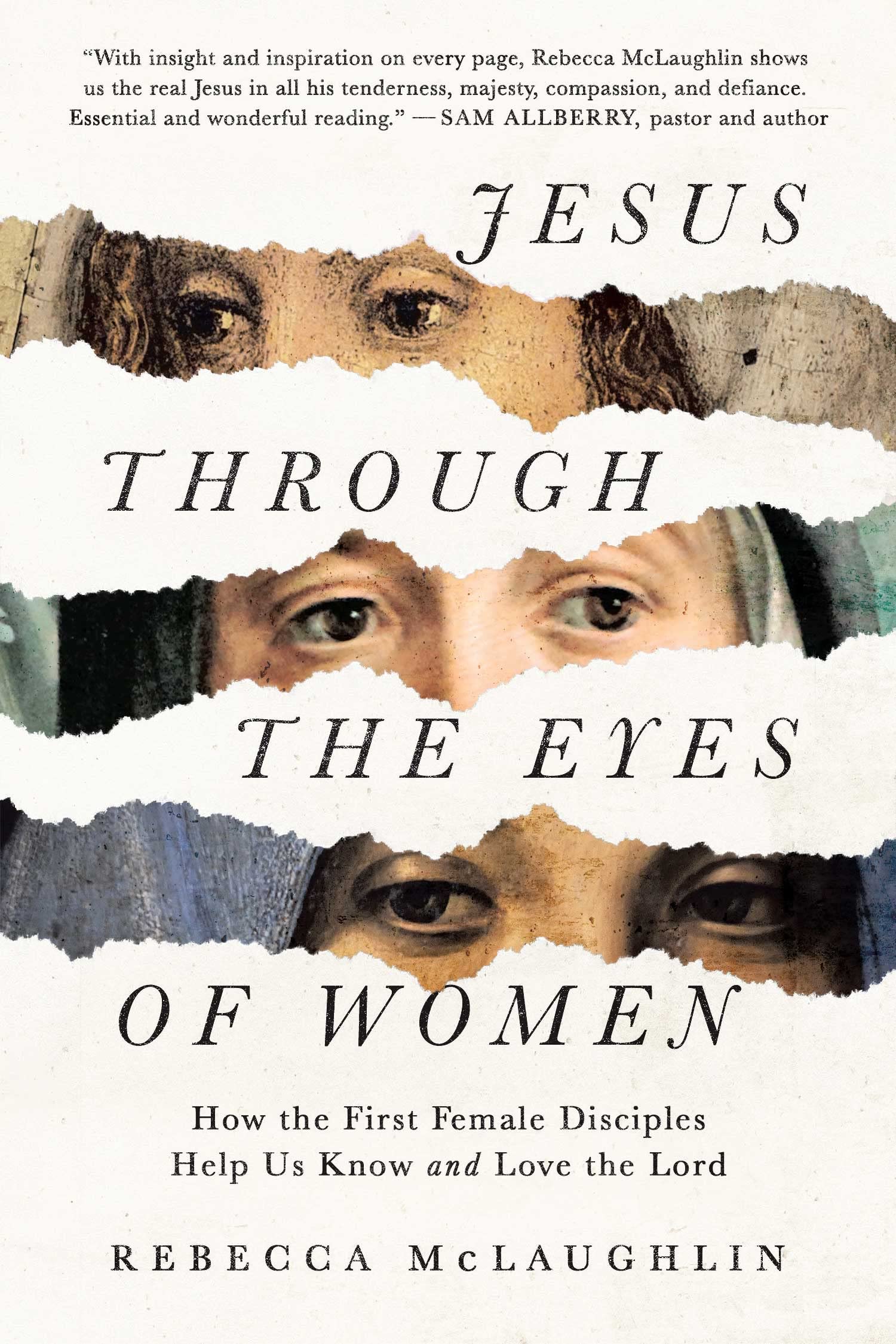 If the women who followed Jesus could tell you what he was like, what would they say?
Jesus’s treatment of women was revolutionary. That’s why they flocked to him. Wherever he went, they sought him out. Women sat at his feet and tugged at his robes. They came to him for healing, for forgiveness, and for answers. So what did women see in this first-century Jewish rabbi and what can we learn as we look through their eyes today?
In Jesus Through the Eyes of Women, Rebecca McLaughlin explores the life-changing accounts of women who met the Lord. By entering the stories of the named and unnamed women in the Gospels, this book gives readers a unique lens to see Jesus as these women did and marvel at how he loved them in return.
We’re delighted to offer this ebook to you for free.