In this sermon, Don Carson addresses skepticism surrounding the resurrection, focusing on the story of Thomas from John 20:24-31. Carson discusses different types of doubt and uses Thomas’s encounter with the risen Jesus as a case study to show how personal experiences and scriptural evidence can affirm faith in the resurrection.
There are many, many causes of doubt. Sometimes doubt is caused by brute ignorance. Some years ago I was pastor of a church on the West Coast of Canada, in Vancouver, and we had a lot of college- and careers-age young people in that church. One, in particular, by the name of Peggy, who was a student at the University of British Columbia, was ebullient and creative, full of life, full of love for Jesus. She was a charming and vivacious Christian.
She came to me on one occasion and said, “There’s a guy at the university by the name of Fred. He doesn’t believe anything, but he wants to take me out to ask questions about Jesus.” I said, “Uh-huh.” She said, “No, no, no, no. I’m telling you the truth. I’m not trying to hook up with somebody who doesn’t know Jesus at all. I just want to share my faith with him.” I said, “Uh-huh.” She said, “No, no. You don’t have to worry about me.” I said, “Great. Great. I don’t worry about you. Go out with him, and then bring him to see me.”
So she did. That Saturday night I was in my study at the church, trying to finish off some things I had left too late for the next day. There was a knock on my door, and in bounced Peggy. She said, “This is Fred. He wants to talk to you.” Now I could see right away that wasn’t true. I was merely a barrier on the way to Peggy. But he was clearly nervous, so I said, “Come on. Let’s go out.”
We went to an all-night cafÈ and sat down and got some food and coffee. We probably talked till 1:30 in the morning. It didn’t go anywhere. Next Saturday night, 10:30 at night, another knock on the door. In come Peggy and Fred. They had been to see a movie together. We went out to the cafÈ. This time he had a whole list of questions. I talked with him till about 1:30, almost 2:00 in the morning. He was serious, asking serious questions. I gave him some references to read, some suggestions of articles he should look up. I pulled a couple of books off my shelf at the end, and they disappeared.
Next Saturday night, same thing, 10:30 at night. Out to the restaurant. He had a new set of questions. He had actually read everything I’d given him to read. This went on for 13 weeks! Now what this was doing to my sermons on Sunday, I have no idea, but on the other hand, at the end of the 13 weeks.… I mean, he was such an interesting chap. She was ebullient, tangential, vivacious, creative.… There was no way she could have been an engineer. She couldn’t rub two thoughts together in a linear direction.
On his part, he was linear, dour, taciturn, straight, wanted some answers, not very vivacious. At the end of the 13 weeks he said to me, “All right. I’ll become a Christian.” Over the years, I’ve seen quite a few people come to know Christ, and I have never had guy come to know Christ quite as directly, as taciturnly as that chap. But you see, he didn’t know anything. What he needed, first and foremost, was some information about what the Bible actually said. In due course, he was captured by Christ and he became a Christian.
Some people have doubts because they have adopted a major philosophical stance as a chosen way of looking at things that necessarily undermines other things. For example, here’s a quotation from the famous atheist Aldous Huxley who, in his book Ends and Means, wrote, in 1937, “For myself, the philosophy of meaninglessness was essentially the instrument of liberation. The liberation we desired was simultaneously liberation from a certain political and economic system and liberation from a certain system of morality.
We objected to the morality because it interfered with our sexual freedom. We objected to the political and economic system because it was unjust. The supporters of those systems claimed that in some way they embodied the meaning, the Christian meaning, they insisted, of the world. There was an admirably simple method of confronting these people and, at the same time, justifying ourselves in our political and erotic revolt. We would deny that the world had any meaning whatsoever.”
Now in fact, in due course, he distances himself from that stance, and so on, but you hear the big choice. You find very similar writings in Michel Foucault, who likewise makes a self-determined choice in defense of his branch of postmodernism. Sometimes doubt is fostered, not by a deliberate philosophical choice, but by 10,000 atomistic choices.
I have seen instances, for example, where somebody or other is, in all appearances, a devout Christian, actively involved in a local church, reading the Bible, praying, married, bringing up their children in what I would judge to be a wise and godly way and so on. Then somehow, the pressures at work, perhaps, climbing up the administrative ladder, the desire for a little more and a little more, means at some point they step aside from the discipline of seeking God or of meeting with his people or talking to others about the Lord.
They’re not praying anymore. They’re not reading the Bible anymore. They’re not reinforcing their faith by talking with other brothers and sisters in Christ. Gradually, money or prestige becomes more and more important. Besides, there is a charming lass at work who understands him so much better than his wife does. Five years down the road, they wake up, and they’re sleeping beside somebody they shouldn’t be sleeping with. The wife is left behind.
He gets up. He looks at himself in the mirror, and he says, “I don’t believe any of that religious rubbish anyway.” How did he get there? There was no major philosophical turning point. No serious wrestling with claims of Christ. All there is, is all kinds of little, atomistic decisions, too many of them selfish. Not one of them very significant, but all of them together, sad, and ultimately tragic.
Sometimes doubt can be fostered by sleep deprivation. I speak to those of you who are over-worked, to those of you who are students. The sleep deprivation can come from bad habits or a zealous perfectionism, or not ordering our time very well. But the point is that we human beings, our mind and matter and spirit, are all tied up together.
You push yourself to the limit, and you’re inviting depression. You’re inviting a break down. You begin to look at the world through very gloomy, gloomy, dark gray glasses. That can affect faith and perspective of God, and it can foster cynicism. Then the godliest thing you can do in the entire universe is get some sleep. Not pray. Get some sleep.
Sometimes people entertain doubts because they go through some huge crisis, the loss of a really, really close friend, a shattering loss, perhaps, in war or to cancer. Or sometimes they come out of an abusive home and they just never got over it. As a result, they are loaded with shame or guilt or defeat, and that can foster its own share of doubt. Now why am I cranking through these ways of causing doubt? I certainly haven’t exhausted the list. I’ve barely scratched the surface.
The reason I mention them is, these, and other kinds of doubt, are dealt with either directly or tangentially in some place or other in the Bible. But you must not think Thomas’ doubt, described in this chapter, represents all kinds of doubt. It represents certain kinds of doubt. Jesus answers those kinds of doubt here. Other kinds of doubt have to be addressed in other ways.
I don’t want you to think that what I’m going to talk about now, about the conversion of Thomas and his doubt, is a sort of a universal answer to every kind of doubt. It’s not that. We have to look at it very closely and listen very carefully to see what it is he is doubting and why, what kind of answer is brought to him by Jesus, and why he turns as he does, if we’re to understand what the text says and how it bears on us.
Let me set the stage so you understand the context. Jesus has been crucified. Quite frankly, his own disciples had not expected this to happen. They thought, with his miraculous powers and with his apparent authority, he was the promised hope from the earlier part of the Bible. He was the promised Messiah, was the word they used. Christ. He was the promised champion. He would get rid of the Romans. He would bring about justice in the kingdom. He would bring about a revolution for God’s own covenant people, the Israelite nation. He would do all of this.
Instead, he falls foul of political corruption. He is brought up on trumped-up charges of being politically dangerous in the Roman Empire, and he’s executed. The Romans had three methods of execution, and crucifixion, the worst one, was for non-citizens, for slaves, for scumbags, for guerrilla warriors. He had suffered all the shame and ignominy of that.
They were not expecting Jesus to come back from the dead, even though Jesus had told them, on quite a number of occasions, that he did have to suffer, he did have to die, and he would come back from the dead. He had told them again and again and again. They said to themselves, in effect, “Jesus is always saying these enigmatic, symbol-laden things. This is deep, deep.” but they didn’t believe it was real.
The way you can tell it’s real is because when Jesus is in the grave, now, and they’re still meeting, not knowing quite what to do, probably about ready to get back north, where most of them were from, Galilee, (they’re down in Jerusalem) they’re in a locked room for fear that maybe some of the temple police will come and arrest them. They’re not in that room saying, “Yes! I can hardly wait till Sunday!”
They don’t expect the resurrection on Sunday. Instead, they’re terrified out of their wits. They don’t know what to do. They don’t expect anything good. Then some of the first reports of the resurrection of Jesus begin to come in. This gospel includes some of them. They were read for us. Other gospels include other reports, and eventually, on that first Sunday, Jesus actually shows up in a locked room where 10 of his closest 12 followers … we call them apostles … were present.
One had, by this point, committed suicide because he was instrumental in betraying Jesus. Another one, Thomas, wasn’t there. We pick up the account in verse 24. “Thomas (also known as Didymus) …” Which simply means “the twin.” “… was one of the Twelve, and he was not with the disciples when Jesus came. So the other disciples told him, ‘We have seen the Lord!’ ” Now we can follow the account in three steps.
1. The cry of a disappointed skeptic
Thomas says, “Unless I see the nail marks in his hands and put my finger where the nails were, and put my hand into his side, I will not believe.” Now what kind of doubt is that? This is not the doubt, for example, of a philosophical materialist, that is, of a person who believes all that is, is matter, energy, space, and time. He’s a first-century Jew.
He believes what we call the Old Testament, that is, the first two-thirds of the Bible. He believes God lives and God has spoken in times past. He is a monotheist. He believes in one God. He believes the promises of the Old Testament Scriptures. He’s a devout man, but he’s burned. He had placed so much confidence in Jesus, and now Jesus turned out to be, God help him, a disappointment.
Not personally, not in what he said. He liked all of that, but he thought Jesus was the promised champion who would turn things around. Instead, he’s been butchered, and he’s afraid, now, of being snookered by a certain kind of religious enthusiasm that will say, “Okay. Okay. He was crucified. That’s bad, but we’ve seen him, you know. He’s really spiritually back. He’s back again, and he’s still alive, really, you know.”
Having been snookered by, as far as he was concerned, one misunderstanding of who Jesus is, that would simply compound the issue. He wanted some evidence. He wanted a certain kind of evidence. He wanted the kind of evidence that would assure him the same body that went into the grave was the body that came out. These really cheap, cheesy whodunits, where somebody comes back, and it turns out to be a twin? Too easy, by half.
For sure, Thomas doesn’t want a twin to show up, or somebody who’s a pretty good close mix. Of course, people worried about things like that in those days a little more than we do today. For example, supposing we lived in a time, not so long ago, a couple hundred years, where there were no photographs. Or go 500 years.… No lithographs. Nothing. No presentations. No cell phones that you can get a picture of something on. No computers. No newspapers.
How many of you would know what President Obama looks like? How many of you would know what John Howard looks like? How many of you would know what Julia Gillard looks like? Probably very few of us have seen any of these people in person. So how many people knew what Jesus looked like? Yeah, Jesus could preach to 5,000, but the people at the back didn’t have a very good view of his face.
That was one of the reasons why, when the authorities went to arrest him, they actually wanted somebody, one of his close associates, to go up and finger him. His apostle Judas actually betrayed him with a kiss. “Hey. Oh, Master,” he says, and then he kisses him in order to designate the right one. Now you wouldn’t have had to do that today. We’ve got DNA and fingerprints and photographs and facial recognition software and who knows what.
But I can imagine Thomas saying, “I don’t want to be snookered by somebody close, somebody who looks like him, somebody with the same personality. The only evidence I’m going to be satisfied with is: listen, I saw the wounds. I saw the wounds.” In those days, when people were crucified, they were either tied or nailed through the hands and wrists. They pull themselves with their arms in order to open up their chest cavity to breathe.
Muscle spasms would start, and they would collapse. They would be suffocating so they would pull with their arms, push with their legs, feet nailed, arms nailed. Then when they died (that could go on for days) they were taken down. But sometimes, if there were a reason for finishing off some people early, instead of allowing them to die just hanging there, then soldiers would come along and smash their shinbones. That way they couldn’t push with their legs anymore, and they would suffocate very quickly. But in Jesus’ case, when they came to him, they saw he was already dead, so they never did smash his shinbones.
What they took was a small Roman javelin, shoved it up under his ribcage and pierced the pericardium, and blood and water came out. So he had a wound most people who were crucified never had. He had a deep wound in his side. So Thomas says, “I not only want to see the marks in his hands and his feet, I want to see this wound in his side. Unless I see them and touch them, I will not believe.”
Now in one sense, there’s something admirable about this man, because there are some people who have such smarmy notions of faith they’re willing to believe almost any kind of rubbish. I’m far from saying it is a mark of godliness in the New Testament, or intelligence or brightness, to believe every notion of religious postulation that comes along. There were charlatans in the first century. There are charlatans today.
A couple of decades ago there was a particular faith healer in California by the name of Popoff. He had a particular shtick. When people came in, they sat down in this large theatre, and somewhere in the course of the meeting he would say, “The Lord is telling me.… The Lord is telling me there’s a woman in row J, seat 14. You have severe back pain. Come forward and be healed.” Sure enough, there was a woman in J14 with severe back pain, and she came forward. He would lay his hands on her and pray for her, and she would go away healed.
Well, the press got wind of this pretty quickly, of course. They tried visiting all of these people and checking out to see if there was collusion. They couldn’t get anybody to admit there was any collusion at all, and they were getting a little frustrated. Then ABC, which, where I come from, is not Australian Broadcasting Corporation but American Broadcasting Corporation, went in with a mini-cam and one of these devices that scans the radio signals and locks on the strongest signal. They suspected something. They noticed that Popoff had a hearing aid.
Now what a faith healer is doing with a hearing aid, I’m not quite sure. I won’t go down that one. They suspected there was something going on, because they had noticed how the system worked. When people came in, people were invited to fill out cards with prayer requests, and if somebody filled in a card with a really, really terrible one like, “I’ve just been diagnosed with a vicious melanoma, and I’ve got six weeks to live,” then Mrs. Popoff, who was amongst the attendants pulling in these cards, would throw them in the bin.
But if there was one that had some decent chance of it being psychosomatic or the like, like “back pain,” then she would see where the person went. She would put on the card “J14.” Then in the middle of the meeting, she radioed down, because this was actually a receiver, not a hearing aid, “Dear, we’ve got one. J14. A woman with back pain.” All of this was picked up by the equipment of ABC and, on national television, they played what it looked like without the radio frequency, and then they played it again with the radio frequency.
“The Lord is telling me.… The Lord is telling me …” Then they would play it again.
“Dear, we’ve got one. We’ve got one. A woman with back pain problem. J14.”
“The Lord is telling me.… The Lord is telling me …”
I have to tell you, his ministry popped off. The really sad thing in all of this is, seven or eight years later, I was back in California for something and was in a hotel room. I flicked some channels and there, on one of the religious channels, he was back! Now he wasn’t quite as big as he was before, doing very similar things. People have such short memories, can be gullible, and can believe silly things. My only regret is it was ABC that exposed this jerk. It should have been just sensible Christians who expose that which is fraudulent in Jesus’ name. That’s really sad. It’s manipulating people.
Thomas doesn’t want to be amongst those who are just gullible. He wants to make a distinction between genuine faith and just sheer gullibility. So here was a man, in other words, who had all kinds of doubts about Jesus’ resurrection, and he wants to be sure the man who is allegedly out of the tomb and resurrected is the man who went into the tomb, dead with those scars. That’s what he wants. Here’s the cry of a desperate skeptic.
2. The adoration of an astonished skeptic
We’re told, a week later, his disciples are in the house again, and Thomas, now, was with them. There are 11 people there. Though the doors were locked, Jesus came and stood among them as he had the previous week. Jesus had never done things like that before his death and resurrection.
There really was something strange and different about Jesus’ resurrection body. He never did things like that before. He came and stood among them, and he said, “Peace be with you.” Probably, shalom, which is a notion of peace that can mean something like, “Hi there.” But in a richer context, in a pregnant context, it has overtones of well being, both for this life and for the life to come.
He says again, “Peace be with you.” In fact, in the context of the whole book, this is because he has borne the sins of his people through his death on that cross. People have a right basis now for being reconciled with God, for having peace with God. So in a word that can mean “Hello,” or it can mean, nevertheless, “Peace, peace with God,” he says to them, “Peace be with you.”
Then he turns to Thomas, and he says, “Put your finger here. See my hands. Reach out your hand and put it into my side. Stop doubting and believe.” Then Thomas says, “My Lord and my God!” Now why does he say that? Because on one reading it seems like saying too much. Why doesn’t he say something like, “Oops. I was wrong.” Or why doesn’t he say something like, “You are alive after all!” Isn’t that what’s called for? Why does he claim so much? Why does he say, “My Lord and my God!”?
Now.… Am I allowed to say this? Do you have some friendly people in your neighborhood who go door to door selling Watchtower magazine and so on? They don’t believe Jesus is God, so they have their own interpretation of this passage. They offer two explanations. One of them says what Thomas really said when he saw Jesus was, “My lord! My god!” Now there are problems with that interpretation.
One is that although every culture has people who speak vulgarities and blasphemies, a pious Jew like Thomas in the first century would not be taking God’s name like that. However surprised he was, whatever vulgarities he might have slipped into, that wouldn’t have been one of them. Worse, Jesus then blesses him for saying it, afterwards! Moreover, it doesn’t handle the little word and.
Even if by some fabulous stretch of the imagination you could suppose Thomas actually managed to say, “My lord! My god!” how do you turn that into, “My Lord and my God!”? No, you have to see this is a confessional element, and it’s very strong. You have to ask, “Why? Why doesn’t he say, ‘I was wrong.’ Or, ‘You are alive!’?” Or something of that order.
But there is evidence right through this book that gives you the answer. This is not something you have to make up. A whole week has gone by since the first appearances. There have been two or three others that have taken place, too, as you can tell from the parallel accounts. Two people were traveling down from Jerusalem to the little nearby village of Emmaus. Jesus appeared to them, and they went back and reported what they had seen and heard.
All of these people telling Thomas, and Thomas is saying, “I just can’t believe it. I will not be snookered. But supposing they’re telling the truth? No, no, no, no. I can’t believe it. I’ve got to see, and I’ve got to touch. But supposing they’re telling the truth? What would it mean? No, no. I can’t believe it. But what would it mean?” Inevitably, he will start thinking through the kinds of things Jesus said in his ministry, the kinds of things Jesus actually said on the very night the police picked him up.
For example, to one of the 12 apostles who had said to him, “Show us the Father, and we’ll find it easier to believe you,” he said, “Have I been with you such a long time, Philip, and yet you haven’t known me? He who has seen me has seen the Father.” That takes us back to what we talked about the first night. How do you see God? For the insistence of the Bible is God, this one God, is nevertheless a complex God. Not a simplex God, a complex God.
In the very heart of this God, the Son (sometimes called the Word) actually becomes a human being. So much so, if you want to see God.… Oh, you can’t see him in all of his glory. I know that. You can’t see him with eyeballs when he is a spirit being. I know that. But if you want to see God as close as you can get, if you want to see what God is like, what his character is, what he says, what he does, if you want to see what sort of being God is, you study Jesus. That’s what this book says right from the beginning.
“The Word was with God. [God’s own fellow.] The Word was God. This Word became flesh, and we have seen his glory,” the apostle writes. Here is Jesus himself saying, “He who has seen me has seen the Father.” Or elsewhere, he says, “Before Abraham was, I am,” which already establishes preexistence, because, after all, Abraham had been dead for 2,000 years at this point.
He doesn’t even say, “Before Abraham was, I was.” In other words, “I’ve got quite a long span of life behind me.” He takes the name God gives to himself in the Old Testament, I am. “I am who I am. I define myself. I am what I am.” Jesus takes on the very same name on his own lips. “Before Abraham was, I am.” The people in Jesus’ own day understood what he was doing, all right, what he was claiming. They took up stones to stone him to death for blasphemy for that one.
So there are all of these little hints that are dropped through the text, and it’s not just these. There are others in other gospels. The last third of the Bible is made up of 27 documents. None is very long. They begin with Jesus’ earthly life, and they run for about a hundred years. The first four, called Matthew, Mark, Luke, and John, covered Jesus’ earthly life and his death and his resurrection.
We have been looking at John’s gospel, but the other three, Matthew, Mark, and Luke, also have other accounts that are equally important for Thomas’s self-understanding. After all, he was there for these things, too. Let me just mention one of them. On one occasion, it’s reported in two of the other gospels, Jesus is speaking in a packed house, and people are not seated in comfortable chairs as you are. They would be standing, squashed in there.
Many of the houses in that time on the eastern end of the Mediterranean had flat roofs because, in the cool of the day, people would go up on outside stairs and take the evening breeze up there while their houses were cooling down after the sweltering heat. So on this particular occasion, Jesus is speaking inside this house, and there is a paralyzed man who is brought by four of his friends on some sort of low pallet or mat. They bring him up to the door. They know Jesus has this reputation for being able to do utterly spectacular miracles, and so they try to get in.
People shoo them away. “Go! Get out! The Master’s talking. Wait your turn! Wait your turn! There are other people here, too. He’s talking. Just mind your own business.” But they won’t wait, so they carry this fellow on the outside stairs up on the roof. Then they listen to where Jesus is talking. When they find the place where Jesus is talking, they start taking up the tiles. They lower him down on the heads of the people below. If the crowd won’t move aside, out of courtesy for a paralyzed man, maybe they’ll move aside because a bed is coming on their heads.
This bed comes down. Then Jesus looks at him. He pauses, and he says, “My son, your sins are forgiven.” Immediately some of the theological experts are abuzz. “Who does this chap think he is to forgive sins like that? That’s a function of God.” You need to think about this one. Supposing, God forbid, but supposing you head home tonight, and you are attacked, beaten up, left for dead, perhaps gang raped.
You end up in a hospital. Your limbs are in casts. You’re going to be there a long time. You’re feeling utterly shattered and demoralized, unclean. I hear about this. So tomorrow morning, before I get on my plane, I go and see you in the hospital. Some other things have happened overnight, and I am able to say to you, “Be of good cheer. The scoundrels who did this, I have found them, and I have forgiven them.” What would you say?
You’d splutter through your plaster, “I mean, of all the infernal cheek! I mean, who are you? You have to be the offended party. You have to be the one who was beaten up. I mean, how can somebody who wasn’t beaten up actually forgive somebody else’s sins? This is ridiculous! Get out of here! Get on your flipping plane!” Wouldn’t you be saying something along those lines? And, you know, you would be right.
Only the offended party can forgive. I don’t know any more moving way to think about that one than by reading a little book by Simon Wiesenthal called The Sunflower. Simon Wiesenthal’s entire family was wiped out in the Holocaust. He alone survived. He was in Auschwitz. In the closing days of the war, before the Russians came in and freed those who were still in Auschwitz.… In the closing days, he was suddenly pulled out of the line as he was returning from a work party.
He was pulled out of the line as he was heading back to the camp and shoved into a room and told there was a soldier who wanted to talk to him. It turned out it was a young German lad, 18 to 20 or so, just a boy, who had wounds that were transparently mortal. He was dying, and because he had been involved in some pretty malicious things in that camp, and against Jews generally, he was feeling terribly frightened and guilty. He knew he was going to have to face God. He knew he was dying, and he wanted to talk to a Jew.
So he explained, gasping for air, what he wanted. He wanted forgiveness from a representative Jew. Simon Wiesenthal listens to this, and he knows that his entire family has been wiped out. He sees the brutality all around him. And this little book, The Sunflower, is only about 85 pages long. Most of it is actually looking at Simon Wiesenthal’s mental processes as he’s listening to this desperate request for forgiveness, for absolution.
Wiesenthal concludes, in his own mind, still without saying anything, that the only people who have the right to forgive the Nazis are those who suffered most from the Nazis, and they’re all dead. Those who have survived don’t have the right to pronounce forgiveness in the name of those who are dead. Therefore, there is no forgiveness for the Nazis. He listened to the request, and he didn’t say a single word and walked out of the room.
After the war was over, he wrote this little book, The Sunflower, recounting this experience. He sent it around to ethicists in many parts of the world. Catholics, Protestants, Jews. This little 85-page book. He said, “Was I right?” At the time, it kicked off a huge ethical debate. The whole premise was, “Do I have the right to forgive people of offenses that were not against me?”
But in the Bible there is an extra element you have to throw in. In the Bible, the biggest offense is always, without exception, against God. So for example, a thousand years before Jesus there was a king by the name of David. David was, by and large, a good man. By and large, he followed God pretty closely. He was a good administrator, a good military leader. He united the tribes. He was, by and large, a good king, but in his middle years, he actually seduced a young woman next door while her husband was at the military front fighting David’s wars.
When it turned out she got pregnant and his affair would become public knowledge, he arranged, through the military, to get the chap bumped off. His unit was told to go into a skirmish somewhere, and everybody else in the unit had a code word for stepping back at a particular point. The code word was given. This young man didn’t have the code word. He was left on the front all by himself, and he was killed. David thought he had gotten away with it.
Now eventually, David is confronted. He is deeply repentant and sorry. Then he writes a psalm, a poem, that is found in the Bible. It’s Psalm 51 if you want to look it up at some point in your Bible when you get home. There he pours out his heart in contrition and shame and guilt. Amongst all the things he says are these lines, “Against you, you only, have I done this evil in your sight.”
You hear him write that, and you think, “Come on, David. What planet are you on? You certainly sinned against Bathsheba. You seduced her. You sinned against her husband. You had him bumped off. You sinned against the baby in Bathsheba’s womb. You certainly sinned against the high command. You corrupted it. You sinned against your own family. You betrayed them. You sinned against the nation. You’re supposed to be the chief judge, and this is what you do? Is there anybody you haven’t sinned against? And you have the cheek to stand there and say, ‘Against you only have I sinned and done this evil in your sight’?”
Yet, in the most profound sense, David is right. He’s not denying he did evil to all of these other people. That’s not what he’s saying. What he’s saying is the most profound offense, whenever we commit any … call it a horizontal offense. The most profound offense is always vertical. The one who is most profoundly offended when we do evil is always God. Always.
If you cheat on your income tax, God is most offended. You feed your porn habit; God is the most offended. You nurture bitterness; God is the most offended. You learn to hate people; God is the most offended. You cheat on your exams; God is the most offended. Always, always. This is his universe. Always. That is why, in the Bible, besides the fact that we need one another’s forgiveness (we do need reconciliation, we do need to work things out; those things are talked about in the Bible, too) what we must have the most is forgiveness from God. We must have that.
There is Jesus, with this man down in front of him, and he says, “My son, your sins are forgiven.” The theological authorities say, “Who can forgive sins, but God only? How do you pronounce …? It’s not as if this chap has done something vicious against Jesus in the flesh. It’s not as if the man’s paralyzed because he’s said some nasty things about Jesus behind his back or something like that. Jesus is pronouncing forgiveness with the authority of God himself! Who can forgive sins but God alone?”
Who indeed? And Thomas was there, and reflecting on all of these things over that long week between that first Sunday appearance and the second Sunday appearance, he begins to glimpse, he begins to understand this is more than a man. He probably even remembers some writings from the Old Testament Scriptures. The Scriptures that have been there in 39 small books for all of these centuries.
He perhaps remembers lines that we cite today, still, at the Christmas season, that look forward to a great hero in David’s line, the Davidic line. A son who was born to us, a king who would reign on David’s throne. “And he shall be called the Mighty God, the Everlasting Father, the Prince of Peace.” He begins to see just how incredibly magnificent, staggering, this is. There’s another stream of things he might have thought about, too. It’s certainly thought about by slightly later Christians, just a few years later.
Whether Thomas got this one, I don’t know, but if you have been following this series during these nights, you know that in John’s gospel, Jesus keeps pointing out he is going to the cross. He is the Bread of Life, and he has to give his life so that others who eat him, metaphorically, actually live. He is the Good Shepherd who gives his life for the sheep. He dies so they might live. Imagine a God-man coming and giving his life! That’s bizarre! But that’s where all of Jesus’ life is going.
World War I was one of the most stupid wars that has ever taken place on the history of this planet, just horrendously stupid. A trench stretched 2,300 miles across Europe with armies on both sides with howitzers and machine guns, mowing each other down for the gain or loss of a few thousand yards, year after year after year after year. Millions killed. Bloody stupidity. Out of that came several poets.
One of them a relatively minor poet, Edward Shillito, wrote one very moving piece. It’s called “Jesus of the Scars.” He describes the horrendous darkness and bleakness of all the wounds and the suffering he finds in the trenches. Then he says:
If when the doors are shut like this, Thou drawest near,
Only display thy hands, those wounds of Thine;
We know today what wounds are, never fear;
Show us Thy wounds, we know the countersign.
The other gods were strong, but you were weak.
They rode, but Thou didst stumble to Thy throne [the cross].
And to our wounds only God’s wounds can speak,
and not a god has wounds, but Thou alone.
These pieces come together in his mind, clearly the things from earlier, just a few days earlier, that Jesus had taught them (the things in Jesus’ whole ministry, the promise that he was going to the cross), and he bows before him, and he says, “My Lord and my God!”
3. The service of this converted skeptic
This is worth looking at. Listen to the way the chapter ends. Jesus says to him, “Because you have seen me you have believed; blessed are those who have not seen and yet have believed. Jesus performed many other signs in the presence of his disciples, which are not recorded in this book. But these are written that you may believe that Jesus is the Messiah, the Son of God, and that believing you may have life in his name.”
Now verse 29, where Jesus says, “Because you have seen me you have believed; blessed are those who have not seen and yet have believed …” Those lines are often taken today to mean something like, “Well, dear old Thomas, you finally did believe. Of course, it took quite a lot of evidence. It would have been a lot better if you hadn’t had to have all of that evidence. It’s much better to have the kind of faith where you don’t need evidence. Blessed are those, rather, who don’t see and yet believe. You’re in, Thomas, but it’s second-class faith.”
Isn’t that the way we understand these verses, more or less, today? That’s partly because, today we often think of faith as something like a subjective religious choice. It’s got nothing really to do with truth or with evidence. Did some of you read Dan Brown’s book on The Da Vinci Code? In it, Sophie says, “But you told me the New Testament is based on fabrication.” Langdon, the hero of the book, says, “Sophie. Every faith in the world is based on fabrication. That is the definition of faith—acceptance of that which we imagine to be true, that which we cannot prove.”
Now dear old Langdon has just contradicted himself. If it’s fabrication, then of course, it’s not true. It’s just made up. But then he has defined faith as acceptance of that which we imagine to be true, but that we cannot prove. Which assumes it might be true, or it might not, but you just can’t prove it. Isn’t that the way we think of faith today? If you go to the streets of Melbourne with an interview microphone, and you say, “I’m sorry. I’m doing a survey. Would you mind talking to me for a minute? What is faith?” I guarantee you’ll get two answers.
One answer is, “Faith is something like religion. There are many faiths. There are many religions.” And that usage is found a couple of time in the Bible. That’s it. The other definition.… It will be worded variously, but it will come out something like, “Faith is a sort of personal, subjective, religious choice. It has got nothing to do with truth or with what’s real. It’s not scientific. You have your faith, and I have my faith.”
Isn’t that the way faith is understood? Even some Christians think of faith that way, and some Christians who think of faith that way use this verse to prove it! But I have to tell you, although faith is used many, many times in the Bible, it’s never, ever, used that way. Not once. There’s a spectacular part in one of the writings of the other early apostles whose name was Paul. It’s in his first letter he wrote to the Corinthians, the people who live in Corinth.
In there he says, as part of an argument he’s having with them, “Supposing, for argument’s sake, Jesus did not rise from the dead …” Now Paul insists he has. He gives lots of evidences for it and lists some of the people who actually saw Jesus risen from the dead. But he says, “Suppose, for argument’s sake, Jesus is not risen from the dead. What would follow from that?
Well,” he says, “in the first place, all the witnesses who saw Jesus, up to 500 of them, sometimes in ones and twos and twelves; sometimes on a mountainside, sometimes in a closed room, sometimes by a lake, where he’s actually eating fish and cooking for them, the people who knew him well, all of these people who saw him, would all have to be lying or deluded. In addition to that, your faith would be futile.” In other words, you would be believing something that is not true.
For faith to be genuine in the Bible, its object has to be true. The Bible does not encourage you to believe something that’s not true. Not ever. So in the Bible, the way faith is encouraged is by explaining, articulating, giving evidence of the truth. That’s the way you encourage faith. The Bible doesn’t say, “Oh, it doesn’t matter if it’s true or not. Just believe it. That’s faith. It’s just faith. You can’t prove it.” Well, you can’t prove it like a mathematical theorem, and there are some things you receive that come down, revelation from God. I know that.
But the resurrection is something that is attested by witnesses, by people who heard and saw and touched and handled. Paul does not want you to believe that if it’s not true. “If Jesus has not risen from the dead,” he says, “and you believe he has, your faith is worthless. It’s all a joke.” He goes further and says, “And you are, of all people, most to be pitied.” Those who claim to believe things that are not true are not to be commended for their deeper spirituality. They are to be pitied for their gullibility.
So what’s going on here, likewise, is not puffing a kind of faith that has no evidence. That’s not the point at all. The point is Jesus sees he’s going away. He’s going away for a long period of times. And there will be many, many people who will hear about Jesus’ resurrection, like us in this room, who will never have the opportunity this side of the end, to touch his wounds.
Thomas has that privilege. I don’t. Because by the time I come along on the historical scene, Jesus has returned to his heavenly Father. He does not offer his body again and again to be touched. I cannot verify the wounds, so Jesus draws a contrast between Thomas, who is in the first century and does see these evidences himself, and those who will never see and yet believe. They believe on the basis of these testimonies, these evidences that are written down, which is why verse 29 leads immediately to verses 30 and 31.
“You’ve seen. You’ve believed. And don’t you understand? Jesus performed many other signs in the presence of his disciples, as this demonstration of Jesus’ resurrection was in the presence of his disciples, including Thomas. And these ones are recorded in this Book. There are many others that are not recorded in this Book, but these are written that you may believe Jesus is the Christ and by believing you may have life in his name.”
In other words, the Bible’s appeal, my appeal, to you tonight, is not to become gullible. It’s not to believe something that is probably not true. It’s not to believe something that is only a personal choice. I insist these things are true. I think the evidence for them is overwhelming. I think God has disclosed himself. I think God, by his Spirit, actually draws men and women to believe him, to trust him.
When you begin to see how these pieces fit together and see who this Jesus is, you want to cry with Thomas, “My Lord and my God!” There is a poet in London today by the name of Christopher Idle who summarizes some of these things.
If Christ had not been raised from death,
Our faith would be in vain,
Our preaching but a waste of breath,
Our sin and guilt remain.
But now the Lord is ris’n indeed.
He rules in earth and heav’n:
His gospel meets a world of need—
In Christ we are forgiv’n.
If Christ still lay within the tomb,
Then death would be the end,
And we should face our final doom
With neither guide nor friend.
But now the Savior is raised up,
So when a Christian dies
We mourn, yet look to God in hope—
In Christ Christians arise.
If Christ had not been truly raised,
His church would live a lie;
His name would nevermore be praised;
His words deserve to die.
But now our great Redeemer lives;
Through him we are restored;
His word endures, his church revives
In Christ, our risen Lord.
I’m going to pray, and if at this juncture, either because of what you’ve heard tonight, or because or what you’ve heard over the last few nights, you’ve come truly to see this Jesus is the God-man, the One whom God sent to bear our sins in his own body on the tree and has been vindicated by God by being raised from the dead, and you see he is, in truth, Lord and God, then will you pray this prayer in your own mind as I pray it? And at the end say to him, “Yes. Amen.”
Let’s pray.
I do not claim to understand all of this, Lord God. But I do see that you are true and holy and good, and I need your forgiveness. I am sorry for the way I’ve tried to live such an independent life, much preferring my own idols. Forgive me, for Jesus’ sake, for I see you have sent him to take my death, my guilt. I see that because he is risen from the dead, I may have life now. I do repent, I do believe, and I do confess him, my Lord and my God. In Jesus’ name, amen.
Free eBook by Rebecca McLaughlin: ‘Jesus Through the Eyes of Women’
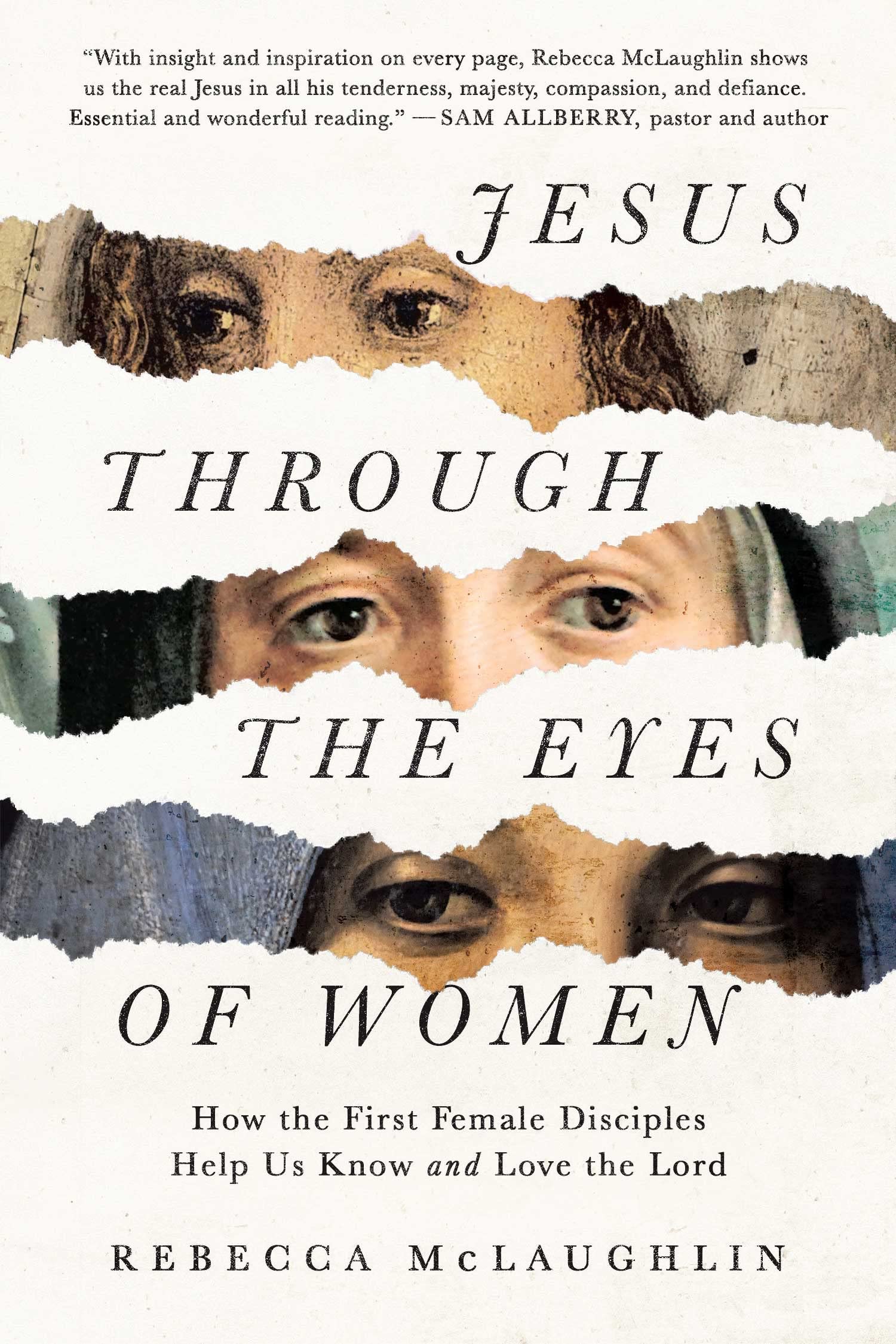 If the women who followed Jesus could tell you what he was like, what would they say?
Jesus’s treatment of women was revolutionary. That’s why they flocked to him. Wherever he went, they sought him out. Women sat at his feet and tugged at his robes. They came to him for healing, for forgiveness, and for answers. So what did women see in this first-century Jewish rabbi and what can we learn as we look through their eyes today?
In Jesus Through the Eyes of Women, Rebecca McLaughlin explores the life-changing accounts of women who met the Lord. By entering the stories of the named and unnamed women in the Gospels, this book gives readers a unique lens to see Jesus as these women did and marvel at how he loved them in return.
We’re delighted to offer this ebook to you for free.