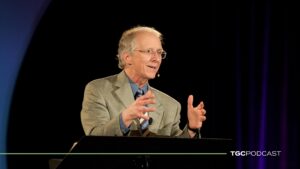



Listen or read the following transcript as D. A. Carson speaks on the topic of Biblical Authority from 2 Timothy 3:10-17
Male: We got together some time ago to pray and re-focus. We had our speakers in line, and we were so delighted with the lineup we had. We believed we needed to add one more. We were sitting at a table in a restaurant, and one of the elders said to me, “You need to ask D.A. Carson to speak on the authority of the Scripture.”
I said, “I already asked him, and he turned me down flat.” Our elder looked at me straight in the eye and said, “Ask him again.” We prayed about that. I wrote him back. I don’t know what I said to you, Dr. Carson, but you said to me you were just in Europe, and for some reason, sanity left you when you got my email, and you just simply said yes.
I know, Don, you have been preaching in England just now. I know it has been a vigorous schedule, and because of a sense of God’s calling, you have decided to come here. I don’t know that I need to introduce you further but to simply say what a joy it is to have you join us today and minister the Word of God. Would you come as I pray for you and ask God to bless you?
Heavenly Father, for this precious teacher of the Word, we give you thanks. Thank you, heavenly Father, for pastors and church leaders who are here today. We have come to be instructed, and we already feel so rich and so full because of the meal that has been set before us. Father, I thank you as well you have also brought my brother here today, our brother here today, to minister the Word to us.
Father, I pray again that our hearts would be open and receptive to this Word. Father, we again confess to you, even though we know for certain the Bible is the Word of God, heavenly Father, we also know how our evil inclinations want to take us away from this most sacred book. As our brother ministers, O Father, press this book deeply upon us. In Jesus’ name, amen.
Don Carson: I should apologize for dropping in and then taking off tomorrow morning at 6:00. It’s not a very civilized way of attending a conference and supporting people. Moreover, I would have very much loved to listen to Bruce Ware and David Short and Kent Hughes and others with whom I’ve had so many links over the years. Please forgive my rudeness, but John is right. I have just come back from England, and I’m about to go to Thailand, so I really shouldn’t be here.
I’m sure the Lord thinks this is a great idea; my wife doesn’t. Nevertheless, I find it so difficult to say no when I find there is a rising number of centers around the continent and elsewhere in the English-speaking world as well where people are asking questions about what is the center? How do we hold the center of the gospel, understand it well, and articulate it wisely and boldly and courageously in a culture that seems to be disintegrating on quite a few fronts? I’m grateful for the opportunity to address you.
The passage that was assigned to me was 2 Timothy, chapter 3, verses 10 to 17, but I’m going to begin from the beginning of that chapter (2 Timothy 3:1) and read all the way down to chapter 4, verse 8, so the context is clear. Hear then what Holy Scripture says.
“But mark this: There will be terrible times in the last days. People will be lovers of themselves, lovers of money, boastful, proud, abusive, disobedient to their parents, ungrateful, unholy, without love, unforgiving, slanderous, without self-control, brutal, not lovers of the good, treacherous, rash, conceited, lovers of pleasure rather than lovers of God—having a form of godliness but denying its power. Have nothing to do with them.
They are the kind who worm their way into homes and gain control over weak-willed women, who are loaded down with sins and are swayed by all kinds of evil desires, always learning but never able to acknowledge the truth. Just as Jannes and Jambres opposed Moses, so also these men oppose the truth, men of depraved minds, who, as far as the faith is concerned, are rejected. But they will not get very far because, as in the case of those men, their folly will be clear to everyone.
You, however, know all about my teaching, my way of life, my purpose, faith, patience, love, endurance, persecutions, sufferings—what kinds of things happened to me in Antioch, Iconium and Lystra, the persecutions I endured. Yet the Lord rescued me from all of them. In fact, everyone who wants to live a godly life in Christ Jesus will be persecuted, while evil men and impostors will go from bad to worse, deceiving and being deceived.
But as for you, continue in what you have learned and have become convinced of, because you know those from whom you learned it, and how from infancy you have known the Holy Scriptures, which are able to make you wise for salvation through faith in Christ Jesus. All Scripture is God-breathed and is useful for teaching, rebuking, correcting and training in righteousness, so that the man of God may be thoroughly equipped for every good work.
In the presence of God and of Christ Jesus, who will judge the living and the dead, and in view of his appearing and his kingdom, I give you this charge: Preach the word; be prepared in season and out of season; correct, rebuke and encourage—with great patience and careful instruction. For the time will come when men will not put up with sound doctrine.
Instead, to suit their own desires, they will gather around them a great number of teachers to say what their itching ears want to hear. They will turn their ears away from the truth and turn aside to myths. But you, keep your head in all situations, endure hardship, do the work of an evangelist, discharge all the duties of your ministry.
For I am already being poured out like a drink offering, and the time has come for my departure. I have fought the good fight, I have finished the race, I have kept the faith. Now there is in store for me the crown of righteousness, which the Lord, the righteous Judge, will award to me on that day—and not only to me, but also to all who have longed for his appearing.”
This is the Word of the Lord.
It is worth saying at least a few words about the picture Paul paints before we plunge into what he says is the solution to the picture he paints in verses 10 and following. He says he is living in the last days. In fact, in the New Testament, dominantly the expression last days or last times or last hour refers to the entire period between Christ’s first coming and his second coming.
At the end of history, Christ came, and already his kingdom has dawned. Jesus says, “All authority is given to me in heaven and on earth.” First Corinthians 15 insists all of God’s sovereignty this side of the resurrection is mediated exclusively through Christ Jesus. True, his reign is contested; nevertheless, history has moved on, and as a result, the old order of things, John tells us, is passing away.
In fact, 1 John, chapter 2, insists, “My dear children, it is the last hour; and as you have heard that antichrist is coming, so too already there are many antichrists by which we know it is the last hour.” What does Paul think is characteristic of these last days? This is a pretty depressing picture. Notice what he says. There are 18 items, 19 traits, a sort of catalogue of vices.
The first four depict selfishness. He says people are lovers of themselves. In other words, they are breaking the first commandment, to love God with heart and soul and mind and strength. It is the commandment that is broken every time we break any other commandment. You cannot break any other commandment without breaking that one. It is de-Godding God. It is defying him to his face. It is what makes sin so wretchedly heinous.
They are lovers of money. In 1 Timothy 6, Paul says this is a source of all kinds of evil. They are boastful, proud. The first four depict selfishness. Then there are two items suggesting socially destructive behavior. They are abusive, we’re told, in word and deed and disobedient to their parents. In other words, there is a rebelliousness at heart that breaks out in the family and, if in the family, then of course, in the broader society as well. It reflects an attitude, finally, toward God himself, for the Scriptures insist this is the first commandment with promise.
Then there are for “un” words: ungrateful, unholy, unloving, and unforgiving. In other words, there is not only positive vice, but there is an absence of positive virtues. There is no gratitude, there is no holiness, there is no transparent love, and there is no forgiveness. It is a painfully negative society.
Then there are two more that reflect speech and behavior: slanderous and without self-control. Then there are two more “un” terms hard to see in our English translations. Most of our translations have something like brutal, but it is literally untamed, savage in that sense, a word that could be used equally for a ferocious lion and for people who act like them. Not lovers of the good. That is, unloving of the good.
Then there are four items which might show how Paul is moving from characteristics of the age to the false teachers themselves. They are treacherous. They are traitors. They are rash. They are conceited, and they are lovers of pleasure rather than lovers of God. It’s one thing to deal with someone who is anti-God from the beginning; it’s a lot more difficult to handle someone who has begun well in the gospel way and then gradually introduces some elements that are taking us just a little bit adrift and then a little farther adrift.
If you start saying, “Wait a minute. Is that really biblical?” someone is going to say, “Don’t you hear all the good things this brother is saying? Don’t be judgmental! You know it’s not Christian.” So you shut up a little bit, and you let them drift a little bit more. Then you say, “Wait a minute. Does that really square with Scripture?”
Eventually, it may take 20 or 30 years before you see there is now a separation, a different direction that is really terribly sad, but in the first stages when you’re trying to discern these things, it’s difficult precisely because they are treacherous. That’s not where they were. This happened in the first century, of course, and it happens today, too.
It’s easy to handle someone who has been so off base from the beginning that they’re not even close to the gospel (a Joel Osteen, perhaps), but on the other hand, it’s much more difficult to handle someone who starts off genuinely faithful with Scripture and then gradually, gradually slides away. Treacherous. Rash with very little long-term thought of the consequences of abandoning God’s most Holy Word. Conceited. Far too impressed with their own opinions.
Finally, lovers of pleasure rather than lovers of God. The last description, having a form of godliness but denying its power.… Religion itself becomes a show. People are more concerned about how things are presented than their content, and above all, there is a spiritual powerlessness to the whole thing. There may be a mad rush of enthusiasm, but where is the kind of power that makes people so transformed, so aligned with the character of God that those around them say, “Yes, yes, yes, we see here the power of the Spirit of God in their lives, and we see it is good”?
“Have nothing to do with them,” Paul writes. This is an important principle, but be careful, for it is sadly true that one or more of these 19 traits may show up from time to time amongst any of us, and if we try cutting off absolutely everyone who reflects any of these entries in this vice catalogue, we’ll be excommunicating everybody starting with ourselves.
Yet, the principle is still important. Where there is a pattern of these things, then you spot the evil characteristic of the last days, and it does recur again and again. “My dear children,” 1 John says, “do not be deceived. Whoever does righteousness is righteous.” Then, in his final paragraph describing these false teachers, Paul establishes a couple of other things that are worth thinking about before we plunge in to what he wants us to do, how he wants us to respond.
First, these false teachers prey on the vulnerable, not least on occasion with connotations of sexual connection. Verses 6 and 7: “They are the kind who worm their way into homes and gain control over weak-willed women, who are loaded down with sins and are swayed by all kinds of evil desires. They are always learning but never able to acknowledge the truth.”
The language suggests a kind of sneaky infiltration even into homes, gaining control over certain women. This text is not suggesting all women are weak-willed and easily seduced any more than it is saying there is a desperate evil of this sort amongst all men. What is envisaged, rather, is a confluence of evils: on the one side power, control, manipulation, and on the other side weak-willed women with their own baggage of sins and neuroses endlessly taking courses on this or that spirituality, never arriving at the truth, and wanting some figure to hang onto.
Listen. I’m old enough now to have seen more than a few ministers go off the rails spiritually, and almost never have I seen a situation where it is purely sexual. The sexual component is huge, but there is almost always a desire for control, a desire to be stroked, a desire to manipulate others and to be approved, and very rarely have I seen a woman in that situation merely setting herself up as a seductress.
Rather, there is a complex set of desires to attach one’s self to someone who is powerful, a desire to be somewhere near the center, and the sins and the sexual overtones and the weaknesses and the defilements from both sides come together in a horrible clash of evils that destroys families and brings down churches.
Finally, Paul uses language of depraved minds. What else can you say? Stop talking about it as minor peccadilloes or a momentary weakness. It is awful, and sooner or later, their folly becomes evident to everyone (verse 9). It might take a long time, sometimes 20 or 30 or 40 years, but the truth will out.
This is really cheerful, isn’t it? Indeed, some commentators think this picture is a little bit over the top. They even call it a caricature. After all, there are lots of nice people out there, and common grace produces many kindnesses from the pagans, and some authorities among other religions are very fine people, aren’t they?
I don’t think Paul would deny any of those kinds of things. Paul is as aware of what we now call common grace as anyone, but when Paul paints with this broad brush he is not saying every false teacher is characterized equally by all of these things. He is describing these people of the last days in typical categories. At the end of the day, such people are cut off from what the Word of God actually demands and teaches and promises and sets up as being faithful to the living God. What counsel does Paul give to Timothy in light of these realities? Four things.
1. Hold the right mentors in high regard.
Now you will see why I read these opening verses and took them slowly, for I don’t think you can properly understand verses 10 and 11 unless you understand the preceding verses. Over against these sorts of people, he says, “You, however, know all about my teaching, my way of life, my purpose, faith, patience, love, endurance, persecutions, sufferings—what kinds of things happened to me in Antioch, Iconium and Lystra, the persecutions I endured. Yet the Lord rescued me from all of them.”
In other words, over against these people who are seducing others and are leading the church astray, Paul tells Timothy, “It is your obligation to find the right mentors and hold them in high regard.” There will always be a lot of siren voices. The question is.… To whom will you listen? Because so many of us here are pastors, let me put it this way. Do you ever say to anybody in your congregation, in your sphere of responsibility, “Do you want to know what Christian living is like? Watch me”? Do you ever say that? Why not? Isn’t it biblical?
Doesn’t the apostle Paul say, “Be imitators of me even as I am also of Christ”? I first began to take this seriously when I was an undergraduate at McGill studying chemistry and mathematics many, many moons ago. Another chap and I in our dorm decided to start an evangelistic Bible study, and because we were scared witless and didn’t want to be too embarrassed, we decided not to ask more than three people to come, figuring probably not more than two would show up and we wouldn’t be outnumbered.
By week five, we had 16 and still only two of us who were Christians, and the other chap was more self-restrained, which means he didn’t say anything and I was holding the can. I very quickly found myself out of my depth, but mercifully, there was a chap on the campus studying divinity for the Anglicans, if you please.
Even then, the Anglicans were not, by and large, the most evangelical component in Canada’s ecclesiastical community; nevertheless, this chap was really quite remarkable. He had been a very, very remarkable convert and had a kind of boldness in his apologetic and in his witness that was very commendable. He became an anchor to a lot of us on campus.
His name was Dave Ward. When I got into trouble, I would take a couple of my guys down to see Dave Ward. This evening we sat down together. He was one of these rough gems. No tact. All rough edges. Slam! Bang! Even in making his coffee he looked crude. He was one of those sort of chaps.
We sat down and slammed down a few mugs of coffee. Finally, he turned to the first one. “Why have you come?” The first one said, “Well, I think when you’re at university you ought to study as widely as possible, so I’m interested in Buddhism, and I’m interested in Islam. Then this Bible study started, and I thought I really should learn a little bit more about Christianity, so I’ve been attending, and I have some questions. That’s why I’m here.” Dave looked at him. “Sorry. I don’t have time.” The chap said, “I beg your pardon?” He said, “I don’t have time.”
He said, “I’m a student just like you. I don’t have time to just sit around and chew the fat with people who aren’t really interested in the gospel. If you’re interested in world religions, I’ll suggest some books. I’ll suggest some things you ought to read to understand Christianity a little bit better, but I don’t have time just to sit around and philosophize. Sorry. You came to the wrong place.” He turned to the next guy. “Why have you come?”
The next chap said, “I come from a family I think you people would call liberal. We really don’t believe in all this resurrection stuff. It’s a bit much, but we’re a fine family, a good church-going family. We belong to the United Church of Canada, and we love each other. We care for each other. We do good in the community. We’re stable. We love God. What do you have that we don’t have?” David looked at him. He looked at him, and then he said, “Watch me.”
The other chap, whose name was also Dave, said, “What do you mean?” He said, “Move in with me. I have an extra bed. Three months until the end of term. Move in with me. Watch me. I know you have your own lectures, but when you don’t have your own lectures, anytime you stay with me. You live with me. I’ll pay for your food. You just follow me around. See how I behave, what’s important to me, what I do with my time, the way I talk. You watch me, and at the end of three months, you tell me there’s no difference.”
The younger Dave didn’t take him up on it literally, but he kept going back and going back and ultimately was converted and became a medical missionary. “Watch me.” Isn’t that exactly what Paul is saying here? He’s not simply saying, “These chaps are wrong, slightly misguided. Here’s the correct doctrine.”
There is a correct doctrine in there. “You know all about my teaching.” He’s not denying there’s teaching, but then he adds, “… my way of life, my purpose, my faith, my patience, my love, my endurance. Also, the things I’ve been persecuted for. You know how I’ve suffered, how many times I’ve been beaten up and whipped. Now the Lord has rescued me. You know the whole thing. Now, Timothy, choose your mentors and hold the right mentors in high regard.”
You want to avoid like the plague becoming a guru if by guru you mean someone who is standing aloof from the crowd, someone who is above the fray, someone who never has any trials or sorrows, someone who has reached such a state of perfection that you are intimating by your conduct and speech, “If only the world could become like you, this would be a grand place.”
You want to avoid that, but when the Christian is saying, “Watch me,” then that Christian is saying, in effect, “I’m one poor beggar telling another poor beggar where there is bread. I’ve drunk deeply of the wellsprings of grace. God knows I need more of it. If you watch me, you’ll see some glimmerings of the Savior, and ultimately, you want to fasten on him. Watch me.”
Even at the practical level isn’t this really crucial today? We have rising numbers of converts in our church who come out of no Christian background at all. They don’t know anything about family devotions. They don’t know anything about Christian rearing of children. Initially, they don’t know anything about sharing their faith. They don’t know how to do a Bible study. Many of them have never read a single book. Whatever reading they’ve done, they’ve done on the web. How are they going to learn any of these things?
In the local church, shouldn’t this be going on all the time so that young Christians are looking around and saying, “That one! I’d like to be like that one”? And shouldn’t you who are older be looking around for younger Christians and saying, “Hey, Bill, I know you’ve only been a Christian six months. I’d like you to come to a Bible study. I’d like you to do a Bible study with me for one year. Commit yourself to that. I’m going to teach you”?
Shouldn’t we be taking young couples and saying, “Let me show you how you have family devotions with kids”? Shouldn’t you? For if this is saying, on the one hand, choose your mentors and hold them in high regard, isn’t it saying to those who are older, “You must imitate Paul and say, ‘Be imitators of me even as I also am of Christ’ ”?
Part of the proper functioning of a local church is the encouragement to build up these kind of mentoring relationships because this establishes a frame of reference that is way outside what the world is doing. We find a whole generation of young men who can’t make emotional decisions. They don’t know how to be men. Somewhere along the line, don’t we need some older men to take them under their wing and say, “I want to show you how to be a Christian man”? Shouldn’t we be doing similar things with young women? Hold the right mentors in high regard.
2. Hold few illusions about the world.
Verses 12 and 13: “In fact, everyone who wants to live a godly life in Christ Jesus will be persecuted, while evil men and impostors will go from bad to worse, deceiving and being deceived.” It is worth remembering there have been more Christian martyrs in the last 150 years than in the previous 1,800 years combined.
When I was a lad, I was brought up reading things like Foxe’s Book of Martyrs. That’s still worth reading, but it’s very old-fashioned. Nowadays, you ought to be reading things like McCormick’s The Killing Fields on the sufferings of the church in Cambodia. We still have not seen a definitive work on the sufferings of Christians in southern Sudan. There have been at least 8,500 martyrs in Indonesia in the last seven years and on and on and on and on, but it’s not just that, of course. It’s not just the gross statistics.
If the rate of Christian martyrdom of the last 10 years were to continue at exactly the same rate for the rest of our lives, one in every 200 Christians in the world today will die a martyr’s death. Did you know that? This is a church of 4,000? So 20 are going to get bumped off. Of course, it’s not distributed evenly, is it? I know that, but especially today when we ought to be thinking globally, shouldn’t that raise our consciousness of what the church is going through in so many parts of the world?
Of course, it’s not just martyrdom. There are all kinds of inconveniences and beatings and discouragements and rising slanders and opposition in many parts of the West, too. Minor things compared with large attacks, but after all, the Devil and his friends, according to Revelation 12 and 13, run in two directions. The Beast himself shows up (the Devil himself, that old serpent, in chapter 12) and he has two beasts: the beast out of the sea and the beast out of the land.
The beast out of the sea goes for vicious attack, actual persecution, violence. The beast out of the land is described as the False Prophet, deceiving if it were possible the very elect. Still an attack. For Christians who have a deep desire to form their families, their relationships, to establish work projects with integrity, honesty, truth-telling, avoiding the salacious and the demeaning, the merely politically correct, suddenly, the world doesn’t seem quite such a safe place, does it?
You don’t want to be negative because God’s common grace is still a wonderful thing (I understand that), but we should not be naÔve. If we sort of expect the world ought to be really good, we are going to be really disappointed. Listen. Hold few illusions about the world. Christians should always be horrified by evil but never surprised by it.
We’ve just come through the bloodiest century in human history. There are websites that have charted all the people who have been killed apart from war by their own governments in the twentieth century. A minimum of 170 million people apart from war. Do you really think the twenty-first century is going to be any better?
We should not misunderstand this statement in verse 13, “Evil men and imposters will go from bad to worse,” as if this is suggesting in every generation evil will be worse than in the previous generation. That’s not what is being said. What’s being said is it is a perennial reality in these last days that people start off and then get worse. Apart from the intervening of grace, there is a slide.
Hitler didn’t start off being Hitler. Pol Pot didn’t start off being Pol Pot. Joe Stalin didn’t start off being Joe Stalin. Rather, you embark on a track and evil men and seducers become worse and worse, deceiving and being deceived. We shouldn’t be surprised by it, so that when suffering does break out, then we shouldn’t be saying, “Good grief! Can you believe what’s happening to me? This is Canada. It doesn’t happen here.”
But it does, you know. I’m old enough to remember when Baptist ministers in French Canada spent eight years in jail between 1950 and 1952, and we kids who were brought up then, were sometimes beaten up as maudits Protestants. That’s all changed now. Now Quebec is the most secular place in North America with the highest abortion rate and lowest birth rate.
Evil can change its faces, but we must understand apart from the intervention of the grace of God, apart from some movement of the Spirit of God to reform society and hold back evil, then evil men and seducers become worse. We shouldn’t be surprised by that. It’s what the Bible says, and if we look at our own hearts, we understand how easy it is for that to happen. Hold few illusions about the world.
The particular things that form in a particular society vary, of course, enormously. One of the challenges we face today is a redefinition of tolerance and intolerance. There is a whole history of tolerance, of course, that is actually worth spending some time on. I don’t have time to tackle it tonight, but for the last 200 years or so, most of us until the last 25 years were shaped by the view of tolerance established by the eminent French thinker Voltaire.
Voltaire said he may detest what you are saying, but he will defend to the death your right to say it, and that was understood to be tolerance. In other words, it allowed for people to take wildly different positions while still insisting people have the right to expound and defend their radically different positions.
Today, increasingly, tolerance is being described as the position that refuses to say anybody is wrong. That’s hugely different. Voltaire would say you’re wrong, but you have the right to be wrong and the right to defend your position. The new tolerance is inclined to say you don’t have the right to say anybody is wrong. That’s intolerant. This new approach to tolerance, and historically it is rather new, is morally corrupt and intellectually bankrupt. It is intellectually bankrupt because it is incoherent.
How does a capitalist come along and say to a Marxist, “I cannot find anything in what you are saying that is wrong” or vice versa? Or a Christian to a Muslim? It is not generating careful and honest conversation to say, “There is nothing in your belief system I would like to criticize. I tolerate you.”
The very notion of tolerance is you have to disagree with someone before you can speak of tolerating them. If you don’t disagree with them in the first place, you don’t need toleration, so it’s intellectually incoherent, but it’s also morally bankrupt because the one area where you do disagree with people, there the new tolerance is intolerant. That one area is over the understanding of tolerance.
If you disagree with this view of tolerance, then quite frankly, you are intolerant, and of course, we really must exclude intolerant people which, thus, becomes morally bankrupt. It is a remarkable change. We shouldn’t be surprised things like that happen because what this does, of course, finally, is challenge the claims of Christians that Jesus Christ alone is the Savior, that there is only one way to God.
We should be amongst the first to insist others have the right to be wrong, and we should make very sure we are not speaking out of anger when we disagree with people, but we still must speak. If eventually people start bringing pressure on us, then we will have to say with the apostles in the early chapters of Acts, “Judge for yourselves whether we listen to you or whether we listen to God.”
If, in due course, it does lead to actual persecution or the like, then we should follow the apostles yet further and be grateful we are counted worthy to suffer for the name. What can you say? Listen. Hold few illusions about the world. We’re finally getting to the theme I was assigned. You can view everything I’ve said so far as a lengthy introduction.
3. Hold onto the Bible.
Verses 14 and following. The importance of God’s Word runs right through God’s Word. Thus, for example, Psalm 1 sets out two ways. “Blessed is the man who does not walk in the counsel of the ungodly or stand in the way of sinners or sit in the seat of mockers.” That’s one pattern. “Rather …” That’s what he doesn’t do. “… his delight …” Positively. Verse 2: “… is in the law of the Lord and on his law he meditates day and night.”
In other words, his mind is being shaped by God’s thoughts. If the mind of the ungodly person is described in verse 1 who is walking according to the counsel of the ungodly, of the wicked, the believer is being shaped by God’s thoughts. He is thinking God’s thoughts after him. Or there is Joshua taking over now the leadership of the people of God, and he is told, “This book of the law shall not depart out of your mouth, but you shall meditate on it day and night. Then you shall make your way prosperous, and then you shall have good success.”
When I first went to Trinity, there was an old homiletician who taught there who was known for his one-liners. He had a lot of them. One of his best was, “You’re not what you think you are, but what you think, you are.” Isn’t that what Proverbs says? “As a man thinks in his heart, so is he.”
When I was brought up in Quebec, I lived on La RiviËre Saint-FranÁois, the Saint Francis River, the dirtiest river in Quebec. We had three paper mills upstream at a time when green was not on everybody’s agenda. In the summer, the place stank. It either stank of the effluent from the mills or from the tons and tons of chlorine dumped in there to make it drinkable.
Out of our taps came all of this chlorine-infested water. It was the dirtiest river in Quebec. What can I say? Eventually, one of the bottled water companies came in. This is decades ago when there were not a lot of people with water coolers around. I can’t remember whether it was Hinckley and Schmitt or some other company.
Both in English and in French they had their slogans. The English slogan was, “You are what you drink.” Let me tell you, in Drummondville that slogan worked. Sixty-seven percent of body weight. You are what you drink. But the Bible says you are what you think. “As a man thinks in his heart, so is he. This book of the law shall not depart out of your mouth.”
When Moses anticipates the time there will be a king in Israel, he writes (Deuteronomy 17, verses 18 and following), “When he takes the throne of his kingdom, he is to write for himself on a scroll a copy of this law, taken from that of the priests who are Levites. It is to be with him, and he is to read it all the days of his life so that he may learn to revere the Lord his God and follow carefully all the words of this law and these decrees and not consider himself better than his brothers and turn from the law to the right or to the left. Then he and his descendants will reign a long time over his kingdom in Israel.”
He becomes king. What does he do? Fill his cabinet? Appoint an auditor to check the books of his predecessors? Make sure he has a decent commander in chief? No. He’s to take out a quill pen and copy out this book of the law which might be either Deuteronomy or the entire Pentateuch, not dump it from a web connection onto his hard drive without it passing through anybody’s brain.
He is to copy it out longhand in Hebrew so clearly that this becomes his reading copy for the rest of his life, which he then is to read every day so as to learn to revere the words of the Lord his God and not turn aside to the left or to the right and not think of himself as better than anybody else just because he’s king, for goodness’ sake. In God’s universe what difference does that make, except privilege and responsibility?
If only those three verses of the Old Testament law had been obeyed, all of Old Testament history would have been different, wouldn’t it? Think of all the things said in Psalm 119. Think of the crucial passages in Proverbs about the entrance of God’s Word bringing light, and so on. This is everywhere. Here, three things must be said.
A. All Scripture is God-breathed.
That’s what is said in verse 16. We’ll start there and pull in verses 14 and 15 in a moment. Here there might be three clarifications. The text says all Scripture, not as some translations like to have it, every scripture regardless of religious providence. Some people have wanted this to mean every scripture: scripture of Islam, the Qur’an; the scripture of Hinduism, the Bhagavada Gita; or some of the sutras from Buddhism. No. This is saying all Scripture, and what is meant in the context of this sort of confessionalism amongst Christians is, first and foremost, the Old Testament. That is what is meant.
It did not include things we talk about today as the Gnostic gospels. The media has played up a great deal the Gospel of Thomas and the Gospel of Judas, and so on, which we’ve known about for a long time, of course, for there have been various voices that have tried to argue originally Christianity was a very broad, flexible religion that included things today we call both orthodoxy and heterodoxy.
Only later as the orthodox won at the end of the second century and into the third century and the confessions of the fourth century and so on did the people they then called heterodox get squeezed out. This is standing history on its head. It is horrendously bad history. It’s not, first and foremost, a theological question; it’s, first and foremost, a history question.
That is to say, as early as Paul’s Galatians, perhaps the earliest New Testament book but certainly one of the very, very early ones, Paul is already saying, “Though we or an angel from heaven preach any other gospel than this one, let him be damned.” There is already an understanding of a distinction between orthodoxy and heterodoxy in the very earliest strata of the New Testament, and it is virtually impossible to date any of the Gnostic gospels into the first century. They are second century and on.
In other words, the truth of the gospel very quickly spun off in various kinds of heresies and disagreements and so on that the apostles had to face even in the first century and then issued into a variety of books in the second century, and these were not all viewed equally as Christian books. They simply were not. They were accepted by various groups, but Scripture itself was more tightly restrained. I wish I had time to talk about the question of Canon a little more. I will say a little bit more about it in a moment. It would be worth an entire evening on its own.
All Scripture is God-breathed. That is, it is not just that the human authors were inspired, that God breathed into them in some sense, but the result, the product, the Scripture itself is God-breathed. In other words, Paul focuses much less on the mode of inspiration and much more on the product of inspiration. As soon as you say it, it becomes obvious.
For example, Jeremiah is given words from God which he then dictates to his secretary Baruch, and Baruch writes them down. Eventually, the opponents capture him and his book, and they tear it in strips and throw the strips into the fire. Do you remember? You’re the reader. What should you be thinking at this point?
In fact, you should be engaging in a very enthusiastic belly laugh, because this has just been dictated through Jeremiah by God. Do you really think God has forgotten what he said? It is so idiotic, which means the story goes in the direction you expect it to go. God gives all his words to Jeremiah again who dictates them to Baruch, and Baruch writes them down again. Do you really think God has short-term memory problems?
On the other hand, there are lots of other passages in the Old Testament where whatever is going on is not dictation. David comes in after a long day, and he’s stretching out and ready to go for a nice sleep when he hears a voice saying, “David, not yet. Dictation time,” so he gets up and gets his quill pen. “All right. I’m ready. A bit tired, but I’m ready.”
“All right. Write the following: The Lord …”
“The Lord …”
“… is my Shepherd.”
“… is my Shepherd.”
“I shall lack nothing.”
“I shall lack nothing.”
There’s no way you can read Psalm 23 as if that’s the way it’s given, can you? Whatever the mode of inspiration, Psalm 23 comes out of David’s experience and reflection as a shepherd and thinking through how, analogously, the Lord God himself is also David’s shepherd.
The point is, according to Paul, not the particular mode of inspiration in different passages but, rather, the product of inspiration, namely the text itself is God-breathed. That’s really crucial, because whatever mode of inspiration God uses in a particular instance, it’s still, if it is Scripture, God’s own product by whatever means. There could be all kinds of diversity of means and different human styles and different vocabularies.
There can, likewise, be different literary genres, so that Scripture exercises its authority and articulates what it is saying in very, very different ways, so that Scripture is made up of discourse and parable and oracle and lament and psalm and genealogy and aphorism and apocalyptic and letter and history and on and on, and each of those literary forms has its own way, its own peculiar literary way of making its own resonating appeal in the human mind and heart.
That’s the way God has given us his Word. It’s wonderfully rich even at that level, but if it’s Scripture, it’s God-breathed. The way it makes its appeal may be different. Its form may be different. The particular vocabulary of different human authors may be really transparently very different from those of another author, but it is still God-breathed.
The Scripture itself is from God. Otherwise, what else does God-breathed mean? That is, it is authoritative precisely because it has God’s authority. You must not think of Scripture as having a kind of authority independent of God. Sometimes in the past we have almost given that impression.
Systematic theology is sometimes insistent on starting with Scripture itself, and almost we have sought to establish Scripture before we’ve started thinking about God, almost as if, although we would never be so crude as to put it this way, Scripture has its own authority independent of God, but there is a profound sense in which that’s all backwards. That is, you begin with God, and if a text is God-breathed, then the Scripture has whatever authority God himself assigns to it as his own product, which is why sometimes Paul, for example, writing to the Galatians can say, “Scripture foreseeing that …” and so on.
If by Scripture you simply mean the words on the page, the writing, it doesn’t foresee anything (it’s just words on a page), but if you see this is God’s God-breathed Word, then to say Scripture foresees is to say exactly the same thing as God foresees. We sometimes distinguish in English between authority and power. If you put a rhinoceros in a china shop, you have a great deal of power in that setting. Not much authority, but a great deal of power.
Occasionally, however, there are legitimate authorities and no power to bring about what the nominal authority actually wishes to exercise, but with God, because all authority is finally his and because all power is finally his, it becomes astonishingly difficult to separate the two. Just very difficult. He is the one who has all authority and even mediates it out, as it were, to governments and to heads of family and to leaders in local churches, but it’s still his. That is one of the axioms of Scripture. It shows up again and again and again.
Whatever authority is, it’s first and foremost from God, and God help us, we corrupt it again and again and again, but still the authority itself is anchored finally in God. If, then, you have a God-breathed text, the text has God’s authority, and in this case, likewise, it has God’s power in effecting change as well. Here is God disclosing himself.
It is worth remembering Jesus himself taught this so explicitly, didn’t he? “The Scripture cannot be broken,” he says. In 2 Peter, chapter 3, we’re told the apostle Peter looked on the writings of Paul and acknowledges some of them are a bit difficult to understand but says some people like to twist those writings, as they do the other Scriptures, which already presupposes in Peter’s time, Paul’s writings are being viewed in the church at large as Scripture, in line with other Scriptures. All Scripture is God-breathed.
B. It is an incalculable privilege to be taught the Bible as a child in the context of a godly home.
Listen how the paragraph begins. Verse 14: “But as for you, continue in what you have learned and have become convinced of, because you know those from whom you learned it, and how from infancy you have known the Holy Scriptures, which are able to make you wise for salvation through faith in Christ Jesus.”
Elsewhere we’re told, in particular, through Timothy’s mother and grandmother, through Lois and Eunice, he was shaped with a Christian mind. I know some of us who have been reared in Christian homes have in moments of weakness or stupidity thought to ourselves it would have been nicer to have been brought up in really reprobate families and then had a glorious conversion.
Some of us brought up in Christian homes can’t even nail down when we became Christians. Then we hear somebody from some really awful background speaking of the glorious transformation that came, and we think, “Boy! I wish I had a testimony like that.” Do you hear what you’re saying? It’s awful!
Do you know what my earliest memory is? If you go back far enough, they sort of get blurred. I’m not sure I can put them in perfect sequence, but so far as I remember my earliest memory is sitting in the bathtub. When my mother did me, she was efficient. When my father did me, he told Bible stories, and he was slow and methodical. It was his style. He reviewed the last one and took you a little farther forward. Some Bible stories are very effective in the bathtub (Naaman, for example).
The family devotions we had when we were growing up and sword drills.… Oh, it’s a bit of a stupid thing, isn’t it? People competing to find out who can find a passage, but the point is I do know the books of the Bible in sequence. We had memorizing contests in our family. Of course, because I was brought up that way, then when my daughter came along, we did similar sorts of things.
She sat there in her highchair and had to endure family devotions from the very beginning as soon as she had a highchair. She was a verbal little tyke. I don’t know where she got it from, but she was a very verbal little tyke. Partly, I think it came from her mom who just loved to read English nursery rhymes to her. The English are terrific with nursery rhymes, so even when our daughter was just a few days old, she’d get plopped on one of our knees and we’d read her nursery rhymes.
She wasn’t learning anything, but it was socialization. We had four books of nursery rhymes with a picture on one side and a nursery rhyme on the other side. Each of them had 25. When she was about six weeks shy of 2 she could open up any of those books, see the picture, and recite the entire nursery rhyme. You know how these kids like to have things read to them and read to them and read to them, and about 50,000 times later, they’re still wanting them read to them.
“That one. That one.” We said to her pretty often, “Would you like me to read to you?” She would pick up a book and say, “Read to you, please.” It suddenly dawned on me (I was a little slow), if she could learn nursery rhymes, she could learn some Bible. About six weeks before she turned 2, I started reading 1 Corinthians 13. I read 1 Corinthians 13, then the first paragraph of 1 Corinthians 1. The next night 1 Corinthians 13 and the second paragraph of 1 Corinthians 1. The next night 1 Corinthians 13 and the last paragraph of 1 Corinthians 1.
I was working through 1 Corinthians but every time 1 Corinthians 13. About three weeks into it, I dropped off the last word of each phrase and looked at her. “Though I …”
“Speak.”
“… with the tongue of men and of …”
“Angels.”
“… but have not …”
“Love.”
“… I am only a resounding …”
“Gong.”
“… or a clanging …”
“Cymbal.” She just popped them all in. Bang! Bang! Bang! Bang! Two weeks later, she said, “Tiffy do it.” She grabbed my Bible, stuck it in front of her in her highchair, and she recited 1 Corinthians 13 with only two mistakes. Mind you, my wife and I dropped off our chairs laughing when she got to the bit, “When I was a child I understood as a child.”
By the time she was 3-1/2, she had memorized about 23 chapters of Scripture with the reviewing and all of this. By that time, she was chafing at it. We could see that. She had a younger brother along by this time, and it changed the dynamics again. We went to Bible stories. We didn’t read any Proverbs or any apocalyptic, none of the deeper chapters of Isaiah, but Bible stories we read till the cows came home.
She doesn’t even realize how much this is stamped on her. She’s in her mid-20s now. She’s on the West Coast and I’m in Chicago, but occasionally we’re somewhere together in church and a Scripture will be read, and she’ll poke me and say, “Was that one of my chapters, Dad?” It’s still coming back to her. “… how from infancy you have known the Scriptures which are able to make you wise unto salvation.”
Don’t talk about the authority of the Bible in abstract terms if it doesn’t work out in the deepest family commitment to pass it on to another generation. It is not merely a theoretical question. It’s a practical question. Note, too, that line I just quoted. It’s not just that they have learned the Bible in some data sense.
“You have known the Holy Scriptures, which are able to make you wise for salvation through faith in Christ Jesus.” It’s not only learning the stories, but ultimately, learning them in such a way, learning all the biblical forms, all the biblical data, in such a way that you see how it all comes together to be profoundly christological and gospel centered.
There is a way of reading the Bible where people don’t see that, and sometimes, God help us, it comes out in our preaching, so that you can read through huge chunks of the Bible and all you get out from preachers on occasion is little moralisms, nice little stories, but people don’t see how the strands actually fit together and constitute a wisdom full of salvation, full of the gospel itself, full of Christ-centeredness.
Thank God for homes where you’ve been taught the Bible in a christologically rich way. You understand how the types and the patterns of the storyline and the drift flow together so that people are reading their Bibles intelligently, wisely, wise unto salvation, for if you merely learn the Bible as data, somehow that doesn’t make you wise to salvation.
When I first went to Cambridge to do a PhD in 1972, at some point in that first year C.H. Dodd, who was already a very old man living in Cambridge still, was interviewed on the BBC. Dodd had really deeply opposed substitutionary atonement, and he had been very bitter against any notion of propitiation and so on, but he was a very learned scholar, a very pious man.
He was asked in this interview on his ninetieth birthday, “Suppose, Professor Dodd, every copy, by some fluke accident, of the Greek New Testament, every manuscript, every printed edition (absolutely all of it) was destroyed. How much of the Greek New Testament could you reproduce from memory?” He said, “Oh, all of it.” The announcer said, “All of it?” He said, “Well, yes. It’s only a little book.”
There are still degrees of scholarship to attain, brothers and sisters in Christ. You also realize merely having all of that information does not by itself guarantee the deepest grasp of these things. He was a great scholar. I have learned a great deal from him. I still think he missed the heart of it in deep, deep ways.
If instead, you have been brought up in a home where from infancy you have learned how this really is the Word of God, God-breathed and hung together so dramatically that it has made you wise unto salvation, it’s certainly not because you’re any brighter but because God in his mercy has placed you in a home where these things were cherished and passed on.
You glory in that in the church. You revel in it. For those who are not so blessed, then you do everything you can to bring them into the fold so they will stamp the next generation. All Scripture is God-breathed. Secondly, it is an incalculable privilege to be taught the Bible as a child in the context of a godly home learning how to put it together.
Indeed, when it comes to acknowledging the authority of Scripture, yes, there are particular data that can be adduced. Yes, there is an apologetic that can be presented, but Jonathan Edwards was still right when he wrote, “The mind ascends to the truth of the gospel but by one step, and that is its divine glory. Unless men may come to conviction of the truth of the gospel by a sight of its glory, it is impossible that those who are illiterate and unacquainted with history should have any thorough and effectual conviction about Scripture of it at all.”
If your conviction of Scripture’s truthfulness and its reliability and authority finally depends on all of the historical evidences, that means those who don’t have a decent theological education from Trinity or Southern or someplace can’t really have any firm conviction about the Bible. You know just intuitively as a pastor that’s not quite right. It doesn’t work like that.
Very often, all those evidences have to be adduced when somebody is converted and begins asking the tough intellectual questions, and sometimes those questions have to be adduced as part of your apologetic when you’re breaking down some barriers, but haven’t you seen it in your own ministries again and again and again? People take such sneering stances to the Bible, and then in God’s mercy, they get converted. Do you know what? Their problems about the Bible’s authority disappear.
It’s not that they don’t need some more theological help and some historical help and an ability to put the pieces together, but it is actually perceiving the glory of God in Christ Jesus in the gospel of God which so illumines everything. The light from God is not only something we see; it is that by which we see everything else, and it’s all reconfigured, and we’re made wise unto salvation, and we say, “Yes, indeed. This is the Word of the Lord.”
C. Because Scripture is God-breathed, it is richly useful for the transformation of human life in line with the gospel.
We read, “All Scripture is God breathed,” and the flow means, “… and in consequence, is useful for teaching, rebuking, correcting, and training in righteousness so that the man of God may be thoroughly equipped for every good work.”
This is not a merely pragmatic inference. The two parts of the paragraph are inherently linked. That is, because this is God’s Word, God’s self-disclosure, because this is gospel-centered truth, therefore, this book is so widely helpful in correcting, transforming, rebuking, instructing in righteousness.
That’s why, also, when we preach God’s Word, when it is truly God’s Word that we preach, just as God has disclosed himself in the past in words, so as that Word is represented in the sermon, God is disclosing himself again. Thus, what we’re looking for in preaching is not merely the transfer of data. What we are looking for is the re-revelation of God.
I know that takes the special work of the Spirit of God himself. I know that, but that’s what we’re after, the re-disclosure, the re-revelation of God himself. As God disclosed himself by his words in the past, so he discloses himself yet again, and as soon as you realize that’s what we’re after, of course, it impels us to being careful in our handling of the Word, to being accurate, to being faithful to it so God is disclosed through his own self-breathed Word all over again in the twenty-first century.
It is this, then, the self-disclosure of God, the display of God’s glory, that makes this book so useful in correcting us, in training us, in reshaping us, and in transforming us, because, you see, you are what you think. Don’t be conformed to this world but be transformed by the renewing of your mind. Garbage in, garbage out.
Over against mere programs, what people so often get excited about, what we have is the bold teaching with humility and godliness of God’s most Holy, God-breathed Word by which God discloses himself yet again, and we discover afresh God’s Word is useful for teaching, yes, and for rebuking us when we go astray, as we so often do, for correcting and training in righteousness, to the end that we may be thoroughly equipped for every good work. Hold the right mentors in high regard, hold few illusions about the world, hold on to the Bible, and …
4. Hold out the Bible to others.
That’s the responsibility of Kent Hughes to preach in this series, so we close now in prayer. Let us pray.
We long, heavenly Father, for a generation of teachers and preachers who cherish Scripture precisely because it is your God-breathed Word and is uniquely powerful in making us wise unto salvation, correcting, rebuking, transforming, and making us thoroughly equipped in righteousness.
It brings us back to the Lord Jesus and his death and resurrection on our behalf. It makes us read the entire sacrificial system of the Old Testament with new eyes. It makes us ponder the nature of holiness. It makes us hunger to be ready for a new heaven and a new earth, the home of righteousness. It breaks our chains that tie us to so many merely transient things, for this world and all of its toys are passing away.
It makes us begin to see the glories of the Savior, and as we see the glories of the Savior, so increasingly we cherish this book, and as we reflect upon it and hide its Word in our heart that we may learn not to sin against you so also we learn to see holiness developing in our lives. We are not what we ought to be, O Lord God. Forgive us our sin, but we acknowledge we are not what we were precisely because of this most Holy Word and the Word incarnate whom it reveals.
So we come back with gratitude to the Lord Christ, to the cross, to his resurrection, to the bestowal of the Spirit, to your plans for the church for which Christ Jesus shed his blood, for your sweeping authority over the nations, for your role as sovereign judge over all on the last day, and we, too, look to Christ and cry with centuries of Christians, “Yes. Even so, come, Lord Jesus,” and we do this because we know of these things by your most Holy Word.
We bow before you, Lord God. In your self-disclosure in speech, you are a talking God, and we give you thanks for your Word and ask for grace that we may learn it well and hide it in our hearts, for the glory of your dear Son, the Word incarnate. In Jesus’ name, amen.