





October 2026 marks 20 years of Kingdom People, the name I gave to my first WordPress blog, with its tagline: “Living on earth as citizens of heaven.”
The new blog wasn’t my first foray into online writing—no, that had started several years earlier, during my last year as a college student in Romania, with a website for a weekly email I sent (devotional reflections based on the words of Christ). But those early attempts at writing online petered out for a season when my wife and I transitioned with our son, just a toddler at the time, from our life in Romania to a seminary in the United States.
In Louisville, I spent more than a year working two (at one point, three) part-time jobs, doing whatever it took to cover the cost of my classes and textbooks and to keep our weekly grocery run within budget. The financial strain didn’t dampen my excitement as a student, though.
In the MDiv program, I was eager to build on all the theology classes I’d taken in Romania, so I signed up for Greek exegesis classes to dig into the New Testament. I sharpened my skills in interpreting Scripture and understanding systematic theology. My mind was on fire, my heart bursting with enthusiasm about all I was reading and learning. At least once a week, I would peruse the shelves of the seminary bookstore, just aching for the day I could afford all the books I wanted to read. (I remember thinking, If a patron would buy me every book I want to read, I’d write a review for each one, just to show the money didn’t go to waste!)
Month after month, I searched for some kind of ministry position that would ease our financial burden and provide an outlet for me to write and teach again, to share some of the amazing insights I was receiving in seminary. The big disappointment came in September 2006. I interviewed for a full-time staff position at a church, and just when it looked most promising, it fell through. I was crushed. I felt desperate to pastor, to bless others with the incredible truths the Lord was teaching me at the time.
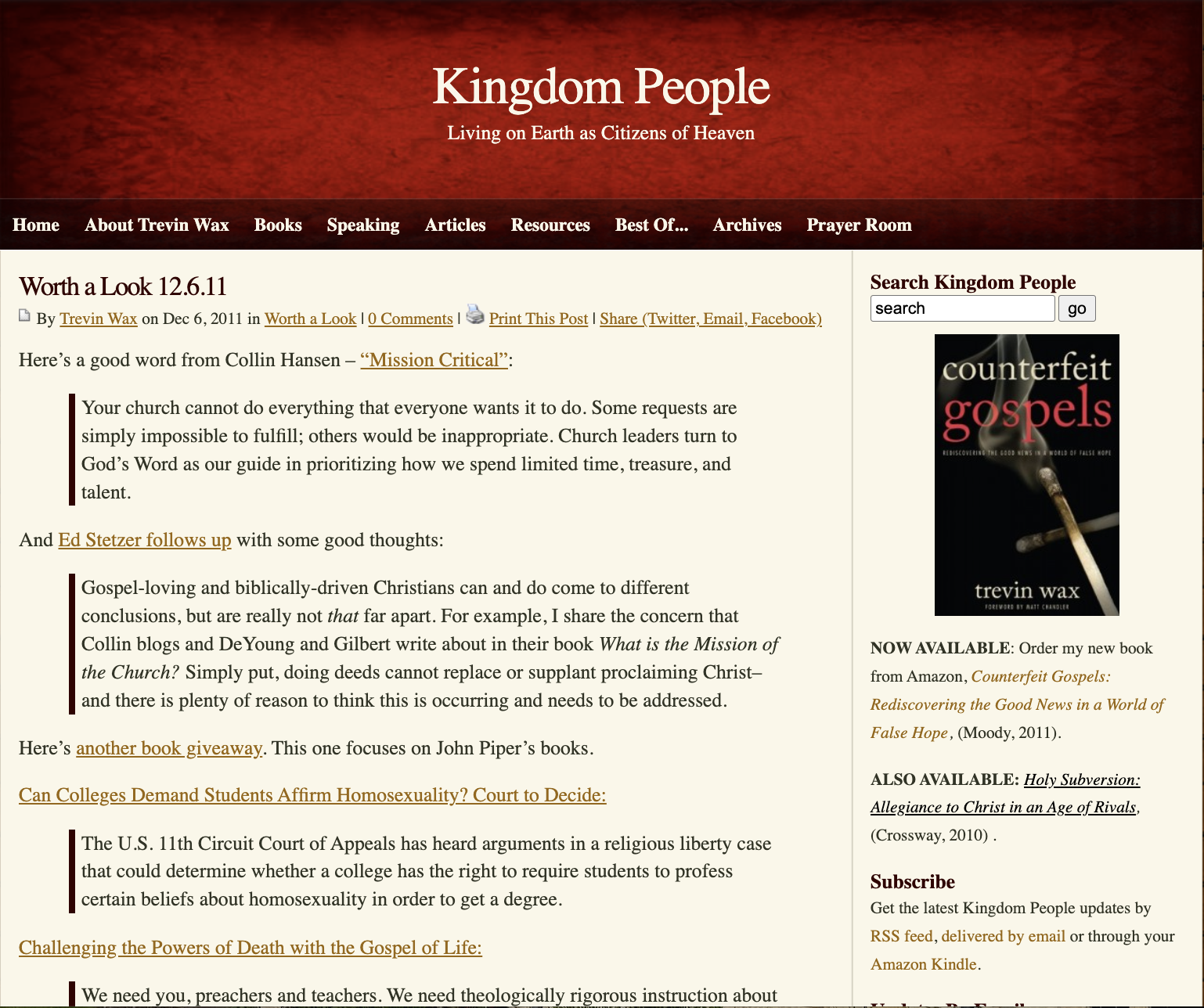
Launch of Kingdom People: October 2006
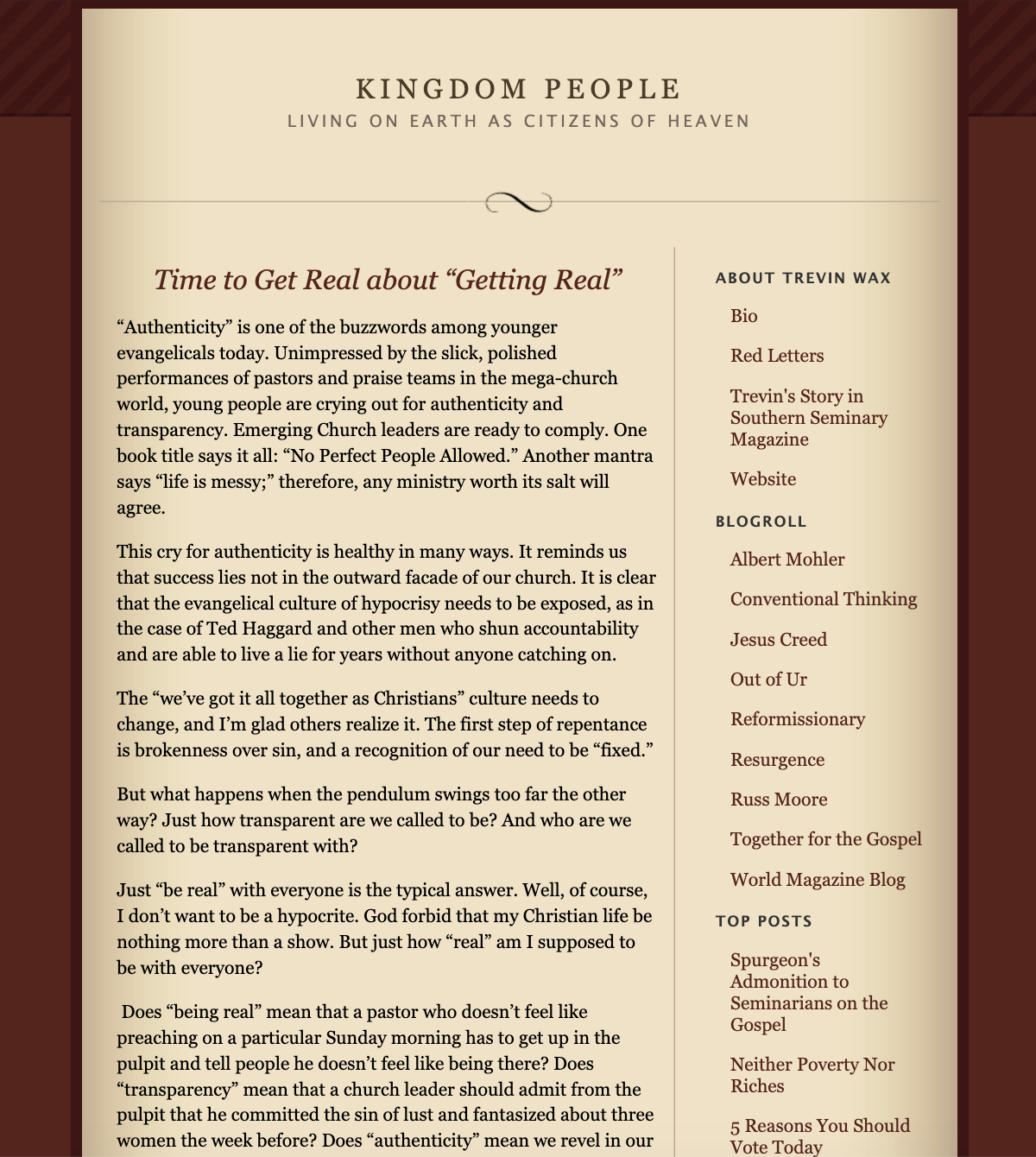
Just a month after that discouraging turn of events, I decided not to wait for an outlet. I should write again, I told myself. I had thoughts in my head and stories in my heart that had to get out. Writing was the only way I knew how to think through and organize the thoughts ping-ponging around in my mind. So I powered up a WordPress blog and committed to posting every day.
On October 22, 2006, I posted for the first time and laid out a pattern for the weeks to come:
- Sundays: a prayer (usually from church history)
- Mondays: a devotional thought
- Tuesdays: a list or annotated guide
- Wednesdays: a book review
- Thursdays: an article based on something I was reading or wrestling with, or an interview with an author (often about the book I’d reviewed the day before)
- Fridays: a link list called “In the Blogosphere”
- Saturdays: a compelling quote I’d come across in my reading
That pattern provided a recognizable shape for Kingdom People for years to come, even when I adapted it from time to time. For a couple years, I devoted a day a week to reflecting on my cross-cultural mission work in Romania. A feature called “Worth a Look”—a daily handful of links with my commentary—debuted in November 2009 and ran until June 2015. “In the Blogosphere” turned into “Trevin’s Seven” in late 2009 and remained a Friday staple until 2021. (Trevin’s Seven continues on as an exclusive for my newsletter subscribers.)
World of Blogging in the Late 2000s
Younger readers might find the variety of posts from the early days of Kingdom People rather strange. But remember, this was before social media took over everything. Facebook was on the rise, but there was no Twitter (X) yet.
Blogging was personal, not professional. It was a catch-all for whatever any writer felt worth sharing—one day a theological issue, the next day a riff on some cultural trend, maybe some commentary on a news story, or a movie to recommend. Blogs were gloriously eclectic. Just before Facebook and Twitter began to soar, blogs slipped into in that liminal space between the old world of the internet and the new world of social media, sometimes taking on the characteristics of both.
Back then, if you wanted to find like-minded people online, you looked where the search engines pointed you, or you bookmarked sites to return to, or you discovered new voices through a blogroll on the sidebar of a site of a writer you enjoyed. The blog world was built up through regular readers, who frequently left comments and debated with each other. On some blogs, the writer was mainly a host or moderator—it was the comments section that drew in readers. But for me, I always prioritized writing.
What mattered most for blogging in those days was consistency—something new on the site every day. That’s how Tim Challies built up a large readership. (We called him the Blogfather.) Every time you clicked onto his website, you were rewarded with something worth checking out. I quickly connected with him and other bloggers, such as Jared Wilson when he was just one of many contributors to a site called The Thinkings, and Michael Spencer, the “Internet Monk.”
Evangelical Blogosphere
It was a fascinating time in 2006 to dive into the river of blogging, because several currents were flowing and overlapping within the evangelical world. It was a time of convergence and divergence. Collin Hansen had just named the nascent gospel-centered movement the “Young, Restless, Reformed” in a cover story for Christianity Today, and the first Together for the Gospel conference had taken place.
Meanwhile, the Emerging Church discussions that flourished in the early 2000s were beginning to wane, as most of the high-profile leaders drifted toward progressive theology and a revisionist sexual ethic. But the earlier evangelistic enthusiasm of the Emerging Church—seen in the influence of the missionary theologian Lesslie Newbigin—had led many to question the reigning “church growth” philosophy. And that desire for a missional identity didn’t go away; it morphed into the missional wing of the rising gospel-centered movement.
What made the moment so interesting was the drawing together of so many voices in one conversation. The lines of division that would eventually harden were there, but they didn’t yet hinder conversations among people with wildly diverging ministry philosophies.
Growth of Kingdom People
It was an exhilarating time to be a young seminary student working out my theological convictions in real time. A friend of mine has been revisiting my older posts, and he tells me it’s my earnestness that stands out, a youthful exuberance at all I’m learning as I hash out new ideas, review new books, interact with authors, and seek to grow closer to Jesus.
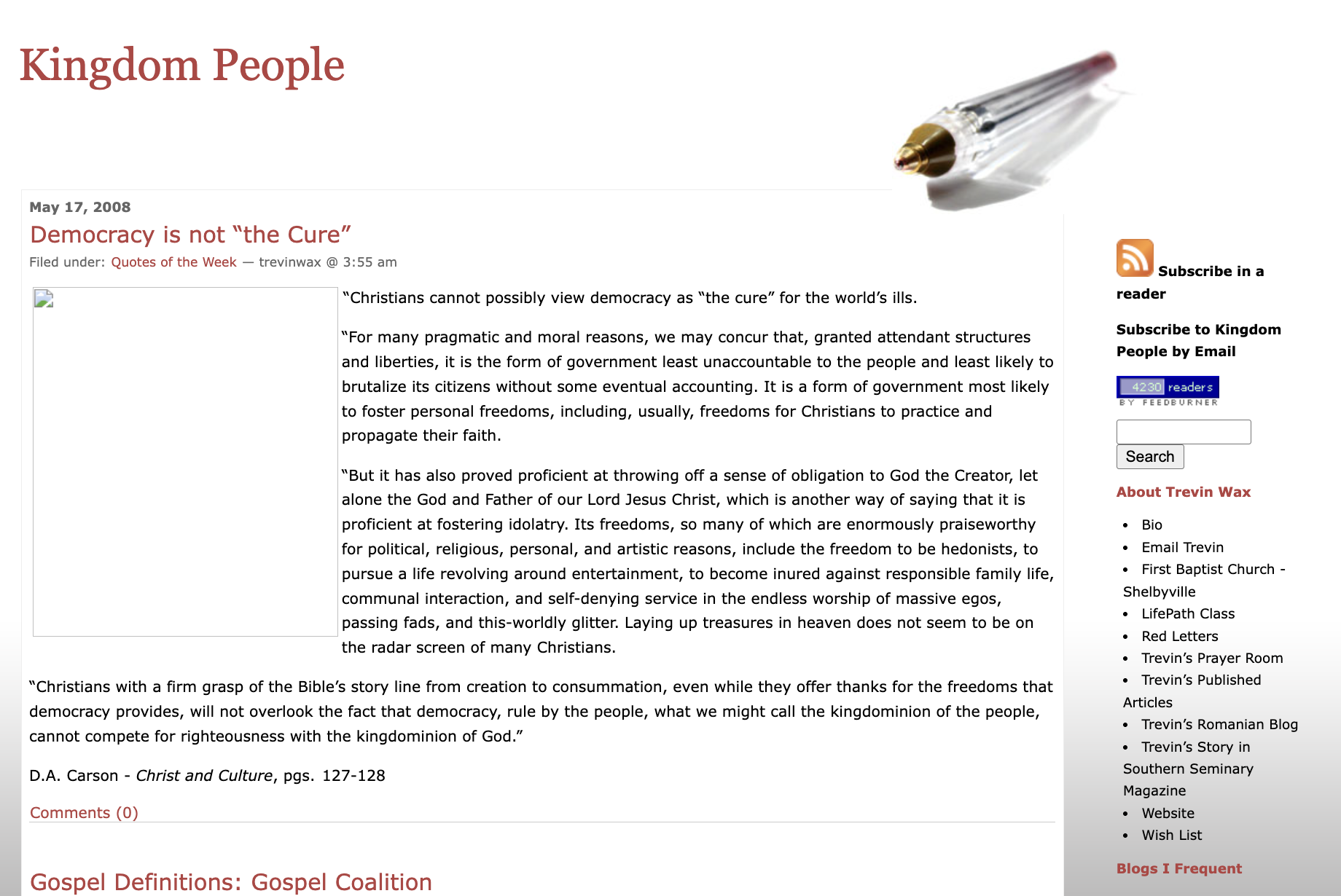
The subscriber count for Kingdom People shot up in late 2007, especially after I had the chance to drive up to Asbury Seminary and sit down with the British theologian N. T. Wright for a wide-ranging conversation that touched on many of the debates over justification taking place within the Reformed world of evangelicalism at the time. Other high-trafficked posts that first year included my takes on various controversies within evangelicalism.
By 2008, the blog was drawing in thousands of readers, and the comments section was active and vibrant. A little community was forming around the blog, and publishers began to take notice. That year, I was asked to pitch some article ideas to Christianity Today. I worked with an editor at InterVarsity Press on a book proposal called Subversive Allegiance. They turned it down in the end, as did every other publisher I sent it to.
But in the summer of 2008, Crossway asked if I would pitch a book to them. I sent the same proposal they’d rejected before, but this time, they saw it as a work of worldview analysis downstream from Francis Schaeffer (whose collected works they published). Holy Subversion: Allegiance to Christ in an Age of Rivals debuted in 2010, when I was just 28 years old, followed a year later by Counterfeit Gospels: Rediscovering the Good News in a World of False Hope from Moody.
Meanwhile, the daily blog just kept going. Day after day. Month after month. A couple moments stand out that strengthened my desire to be a good steward of the platform. The first took place after I published a negative review, having criticized a book because of the author’s stance on an issue that wasn’t central to the overall thesis or thrust. I got an email from the author, who pleaded with me to offer a fairer assessment. He was right, and I was wrong. And I remember realizing then that I wasn’t just a seminarian typing words out there and hitting “publish.” My words were carrying weight.
The second moment involved two conversations in 2008 with intellectual and pastoral mentors. I kept describing the blog as just a side thing—a hobby, not something central to my ministry as an associate pastor at a church in Tennessee. Both men affirmed my desire to keep the local church at the forefront of my attention, but both told me I should stop seeing the blog as “just a side thing.” Many pastors and thoughtful Christians were reading the blog, they said. It would be bad stewardship if I failed to take the blog seriously as an arena for me to deploy my gift in writing.
Kingdom People and Institutional Complexities
The daily blog opened doors for me, not only relationally and in publishing but also professionally. My online presence was one of the reasons Lifeway invited me to join the team and help start a gospel-centered curriculum (which eventually became The Gospel Project). The leaders at Lifeway made blogging part of my job description, trusting it was a win for a steady writer to be on the team—someone constantly engaged in conversation with church leaders, both learning from and influencing pastors.
Yet the move into an institutional role brought a new set of constraints in what I would publish. Not long after I got there, I posted my opinion of a book whose author had adopted a heterodox position. Although Lifeway leaders agreed with me and wound up pulling the book from Lifeway stores, I had jumped the gun and published my perspective without considering the institutional implications, giving little time for processes and procedures to be implemented in such a mammoth organization.
Before, Kingdom People had been a simple WordPress blog, run independently by me. Now, I realized anything I said could become a reflection of the ministry I worked for. I had to learn to think institutionally, to live within certain constraints—to not publish every opinion I might have.
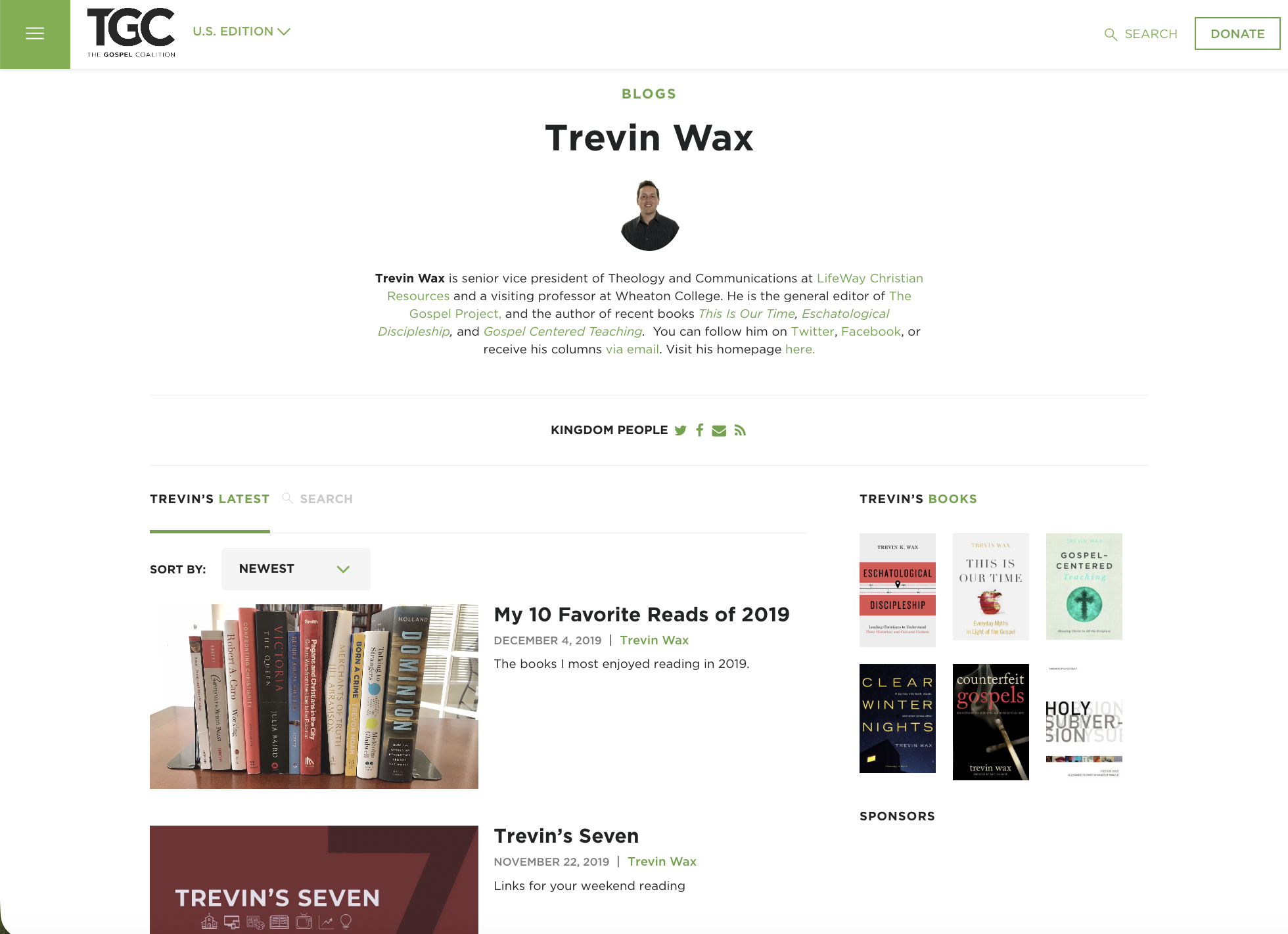
The institutional side became more prevalent in the early 2010s. Blogs began consolidating into “neighborhoods.” Christianity Today started hosting popular bloggers on their site. So did Patheos. I talked with leaders in both those institutions, but settled on The Gospel Coalition as the place where I would feel most at home. So, in January 2012, my blog migrated to TGC, and I eventually settled into a new rhythm—just two columns a week, with a Trevin’s Seven link list on Fridays.
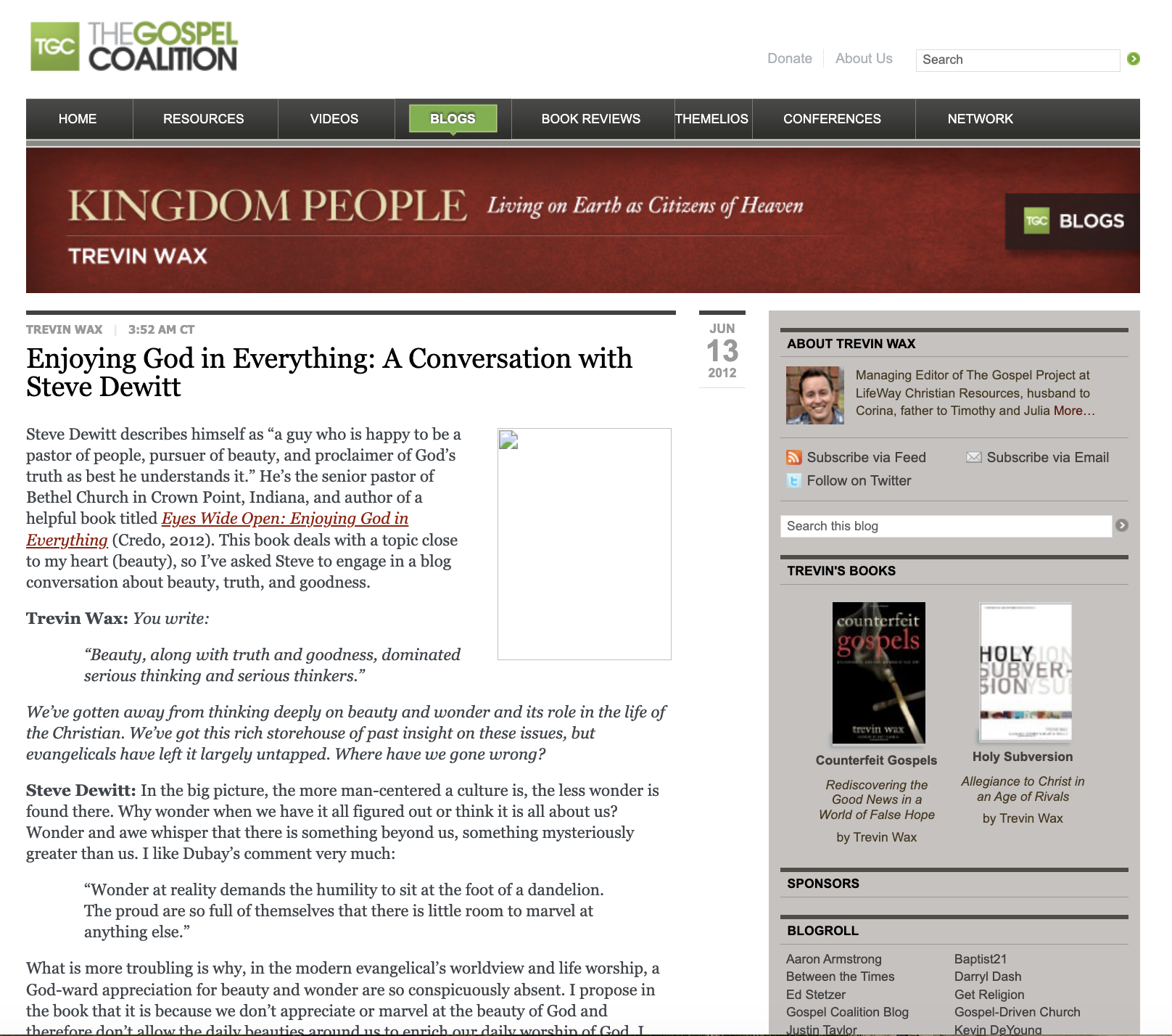
You may notice I just said column. Even though the nomenclature of “blog” and “blogger” persisted, the comments section on TGC blogs went away, and I began seeing myself as a columnist with a devoted TGC page rather than a blogger in the traditional sense.
The early days of blogging had it all—an eclectic mix of interests bouncing around, driven by a blogger’s personality. But once social media soared, all the quick takes, comments, quirky links, inside jokes, and brief reviews of movies or TV shows moved to Facebook, Twitter, and Instagram. Over time, my posts at TGC became more polished, and the deeply personal posts were fewer, though the latter have never fully disappeared, because that early blogging DNA still remains.
Another shift that occurred when Kingdom People was entering its second decade was my decision to scale back the number of hot takes on whatever “the online discourse” demanded. For years, I had weighed in on all manner of events, offering cultural commentary for the moment—often going viral as a result. But as time went on, I began to see my blog/column as a body of work to be built up over time. I hoped to publish insights that would endure longer than the quick takes that amassed clicks.
Today, I’m most encouraged whenever I get a note from a pastor or church leader thanking me for something I posted years ago—an article that popped up when they were researching a particular subject. Writing online has been a wonderful place to work out my thoughts, and those thoughts, once refined, have often found their way into my lectures and books. I cannot begin to measure the full influence of this blog on my teaching, my speaking, and now my ministry through the North American Mission Board.
Writing, on average, 87,000 words a year online is a discipline that demands a voracious amount of reading, just so I have something of interest to write about. The reading has supercharged my speaking and writing. No longer am I the poor seminary student yearning to buy all the books I want to read; now I’m middle-aged with never enough time to get to all the books on my desk. My pile overflows.
Concluding Reflections
In 2009, Meryl Streep and Amy Adams starred in Julie and Julia, a movie about a young blogger trying her hand at every recipe in Julia Child’s most famous cookbook. Julie found a large audience for her blog and went on to write a best-selling book. I remember watching that movie—the story arc resonated with me (alas, without the bestseller!). I, too, felt like something magical had happened.
In the months after I sat down in that little apartment in Louisville and typed out my first post, my writing struck a chord with people, and they responded: pushing and prodding me, sometimes affirming my views, other times chastising me, yet always staying engaged. The blog was first an outlet, then became a channel, weaving its way through and watering every ministry path I’ve taken in the past two decades.
Since October 2006, I’ve published more than 1.8 million words online. Proverbs 10:19 surely applies to me: “When there are many words, sin is unavoidable.” But I trust the Lord to be patient with my shortcomings and errors—some of which, in hindsight, I can now spot. And I am thankful for readers who have granted me their most precious commodity—their attention. What a joy to write! To consider afresh the awesome privilege of being the people of God’s kingdom, called to live on earth as citizens of the world to come.
If you would like my future articles sent to your email once a week, as well as a curated list of books, podcasts, and helpful links I find online, enter your address.