



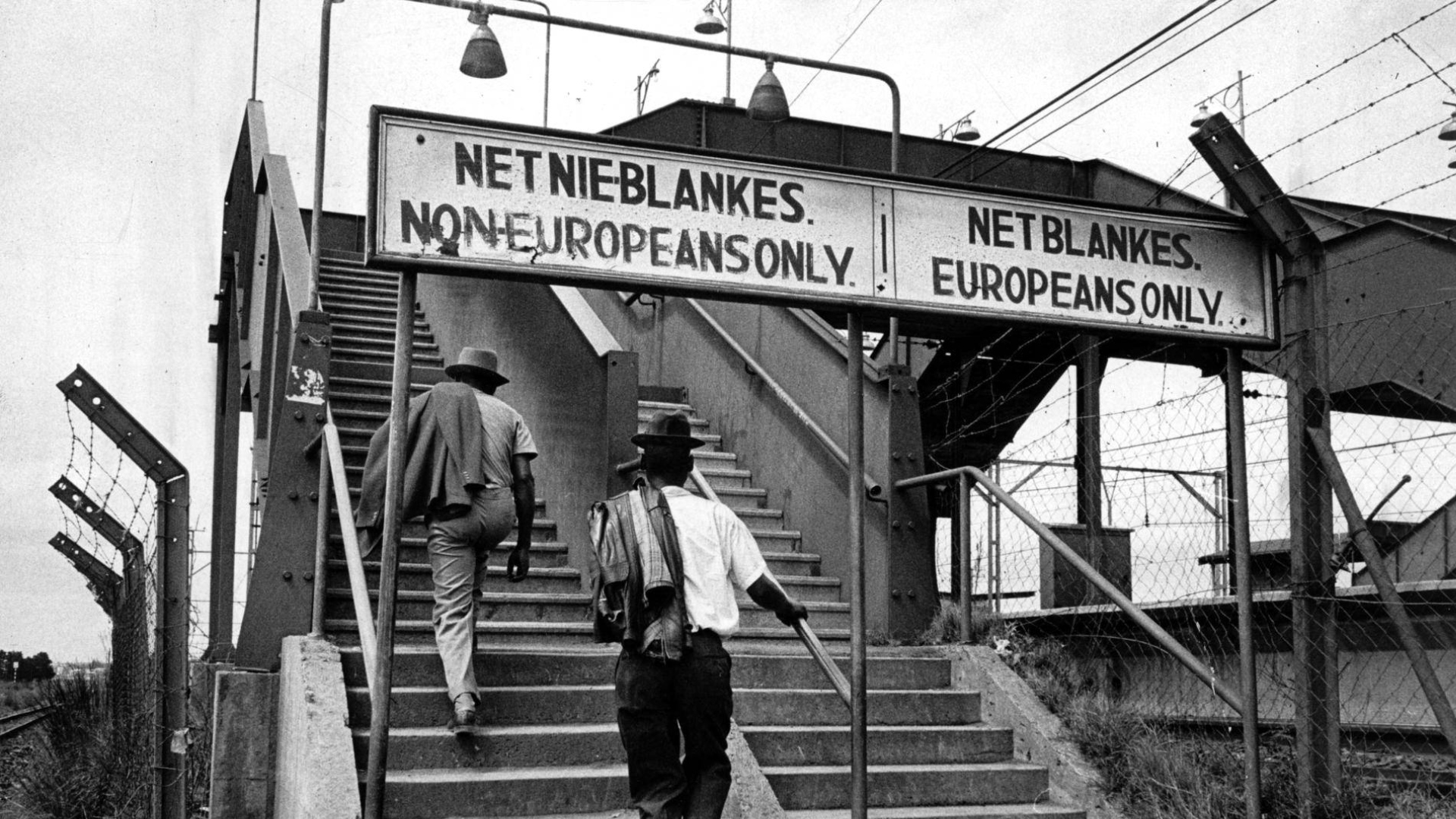
During a trip to South Africa last year, I visited the Apartheid Museum in Johannesburg. In one section, a wall lists the various laws under apartheid. Today, it seems unimaginable that such laws ever existed.
These laws, passed during the 1950s, enforced race-based discrimination in all sectors of South African life. Racial groups were assigned separate residential areas. Roughly 80 percent of South Africa’s land was set aside for the white minority population. Millions of black South Africans were forcibly removed from their homes—regardless of how long they had lived there or whether they owned them—and required to relocate to areas called townships.
Almost all public facilities such as parks, buses, trains, toilets, swimming pools, and beaches became segregated spaces. Black South Africans faced restrictions on where they could travel, work, and socialize. New state-run schools were designed to train black children for low-skilled menial labor.
Alongside the wall was a video playing of Hendrik Verwoerd giving a speech in 1958. Verwoerd, called the “father of apartheid,” was prime minister of South Africa from 1958 to 1966. In this speech, Verwoerd justifies apartheid. I was struck by how rational and even reasonable he came across in the speech. He wasn’t talking about the inferiority of the black race compared to the white race. Instead, he argued that people weren’t fully understanding apartheid. It was a policy of good neighborliness rather than a system of discrimination:
Our policy is one, which is called by an Afrikaans word “Apartheid.” And I’m afraid that has been misunderstood so often. It could just as easily, and, perhaps, much better be described as a policy of good neighborliness. Accepting that there are differences between people, and that while these differences exist, and you have to acknowledge them, at the same time you can live together, aid one another, but that can best be done when you act as good neighbors always do.
Apartheid, he argued, enabled white Afrikaners and the black Africans to live how they want, within their cultural traditions, in a way mutually beneficial to all. Apartheid was actually a means for people to respect one another. Verwoerd even suggested that apartheid was an application of the Christian principle of love of one’s neighbor.
Many people rejected this reasoning. However, many others believed and accepted it—certainly enough people with the means and power to ensure apartheid was enforced for decades until its dismantling in 1994 (still in recent memory for many today).
This raises a question: How could this kind of racialized argument be rationalized and justified as loving our neighbors?
Modernity’s Untethering of Morality
One explanation, at least ideologically speaking, can be traced back to the Enlightenment. Before this, societies operated with a shared moral order. Each society recognized some things as objectively good and right and other things as objectively evil and wrong, apart from individual human reasoning or preferences.
How could this kind of racialized argument be rationalized and justified as loving as our neighbors?
David Brooks, reflecting on the work of philosopher Alasdair MacIntyre, notes how the Enlightenment dismantled the inherited moral order and established the idea of a “neutral” public order. Morality was to be determined by human reason and set according to personal choice and preference.
As the world underwent the scientific and industrial revolutions, it made sense to see human reasoning and rational thought as the surefire road map to human flourishing and a stable society. Auguste Comte, a 19th-century French philosopher, posited three successive stages of development for human society: a theological stage, a metaphysical stage, and a final end stage—the modern, “positive” stage based on scientific and rational thinking. This final stage would need not a belief system based on God but a “religion of humanity.”
Historian J. B. Bury, in his 1920 book The Idea of Progress, wrote about how providence was an idea that corresponds to a less advanced stage of civilization. Progress, however, has replaced providence, and has come about “with the growth of modern science, with the growth of rationalism, and with the struggle for political and religious liberty.”
However, events like the two world wars tested and unraveled these expectations. They showed how easily and readily societies could use scientific advancement to harm and attempt to destroy one another, how easily a “rational” world order could be upended—and in some places like Nazi Germany, reconfigured to justify systemic genocide.
These historical examples show what happens when morality is no longer undergirded by a definitive moral standard. As Brooks contends, morality can be redefined in all sorts of supposedly reasonable and rational ways, which leads to almost anything being accepted and justified:
The Enlightenment project failed, [MacIntyre] argued, because it produced rationalistic systems of morals too thin and abstract to give meaning to actual lives. It destroyed coherent moral ecologies and left autonomous individuals naked and alone. Furthermore, it devalued the very faculties people had long used to find meaning. Reason and science are great at telling you how to do things, but not at answering the fundamental questions: Why are we here? What is the ultimate purpose of my life? What is right and what is wrong? . . .
One of the problems with living in a society with no shared moral order is that we have no way to settle arguments. We have no objective standard by which to determine that one view is right and another view is wrong.
This is the same context by which a “moral” case is later made in 20th-century South Africa for race-based discrimination and oppression. These are no longer a priori defined as wrong but are reasonably justified as good, as a way to “love your neighbor.”
When human rationalism, reasonable argument, and individual preference ground our morality, we’ll always struggle to clearly identify right from wrong. What’s wrong in one place or era can in another place become characterized as a form of doing what’s good and right for oneself, one’s community, or one’s country.
A moral standard—one that exists outside us and isn’t subject to our intellectual rationalization or personal musings—allows us to know when something is simply wrong, full stop. It’s how we can immediately say that apartheid is wrong because the kind of race-based discrimination it promotes is always wrong. It’s why “love of neighbor” can never be used to justify a system like apartheid.
Anchor Our World Needs
While South Africa did eventually stop its practice of apartheid, our modern secular world is still untethered. We can see it in the United States, where what’s right and wrong on how we approach issues like sexuality, immigration, welfare for the poor, abortion, or military conflict depend on which party is in power or who resides in the Oval Office. This moral whiplash most often leads to immorality being excused and mistreatment of the poor and vulnerable being regularly ignored.
Our secular world desperately needs an objective standard of right and wrong, a center that doesn’t shift based on what any single individual, community, or institution says is right, good, and reasonable. It needs a moral order rooted in the unchanging values of goodness, justice, and love. This, of course, is what Christianity offers.
The Christian message tells the historical story about how Jesus, the Son of God, was born on this earth, lived, died on the cross, and rose again. This story gives us the anchoring we need for values such as love, justice, grace, forgiveness, hope, and redemption. This story best equips us to clearly and unequivocally say what things are evil, wrong, and sinful and what things are good, true, and beautiful. This story rips apart any rationalization for a system like apartheid and clearly states it to be fully racist and therefore wrong.
Christianity not only gives us a set of moral lenses; it also teaches us about the kind of tone and posture followers of Jesus must possess to exemplify the kingdom of God.
Christianity not only gives us a set of moral lenses; it also teaches us about the kind of tone and posture Jesus’s followers must possess to demonstrate our citizenship in the kingdom of God. This Christlike posture reshapes how we engage with hot-button issues, laws, and policies.
For example, while Christians will advocate for a range of different policies in the immigration debate, we can and should agree from the outset that our shared belief that humans are God’s image-bearers gives us no rationalization for the mistreatment or abuse of immigrants. Our conviction about the image of God is how we can, from the start, dismantle arguments for indiscriminate abortion on demand. And this conviction leads us to create social structures, in the church and in the world, that provide opportunities for forgiveness, for repentance and restitution, and for restoration.
The Christian story—which begins at creation, moves through humanity’s fall and its redemption at the cross and the empty tomb, and awaits the new creation—is the only cornerstone for a moral foundation and ethical compass that ensures blessing and flourishing for all people. It’s the only story capable of establishing a true moral order that can and will last forever.
Join The Keller Center mailing list
The Keller Center for Cultural Apologetics helps Christians share the truth, goodness, and beauty of the gospel as the only hope that fulfills our deepest longings. We want to train Christians—everyone from pastors to parents to professors—to boldly share the good news of Jesus Christ in a way that clearly communicates to this secular age.
Click the button below to sign up for updates and announcements from The Keller Center.