
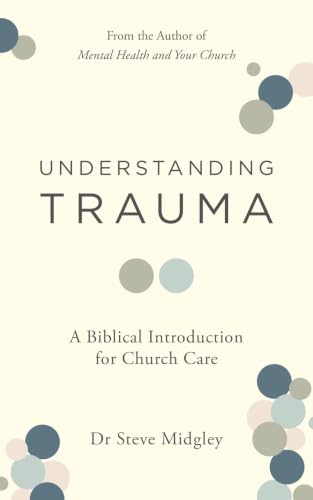
Understanding Trauma: A Biblical Handbook for Church Care
Written by Steve Midgley Reviewed By Karl B. HoodSteve Midgley’s Understanding Trauma is one of two significant books on biblically based Christian counseling approaches to trauma released in 2025 (the other, Darby Strickland’s When It’s Trauma, is reviewed later in this issue of Themelios). From my perspective as someone who has worked with victims of trauma over decades in a range of roles—medical practitioner, minister and elder, and professional Christian counselor—and who is now working on a DPhil on healing responses to trauma in the Psalms, the two books make numerous helpful contributions to understanding and practice and complement each other well.
Understanding Trauma is a local-church manual on pastoral care for both pastors and the church family of those who have been harmed by traumatic experiences. Midgley writes as a minister of the Word who is also medically and psychologically trained. He addresses what whole churches need to know about caring for one another, even when the problem is trauma. He has over four decades of experience to draw upon—initially as a Cambridge-educated medical doctor, then from his training in psychiatry, and finally as senior pastor for many years of a healthy reformed evangelical church. Here, where Midgley still serves as an assistant minister, the pastors, like the biblical-era shepherds from which they derive their name, care for the struggling individual sheep in their flock as well as manage overall flock health, and the whole church strives to practice every-member ministry in which the word of Christ dwells richly.
The book is divided into three main sections of approximately equal length.
Section 1, “Seeing Trauma in Scripture and Life,” has chapters titled “Trauma in the Bible”; “What Is Trauma?”; “Encountering Trauma”; “Trauma and Church”; and “Jesus and Trauma.” This section provides a good summary of the biblical background of an area that is very well described in Scripture, without the word for physical wounds (trauma) that we now use. Midgley presents eight local-church case studies of traumatized people that give a good sense of what is going on for them as individuals and how that may appear to others.
Section 2, “Contemporary Thinking and Biblical Perspectives,” covers how trauma is understood today; trauma and memory; trauma and the body; and trauma and relationships. This section helpfully summarizes current thinking about trauma, explaining and welcoming key insights and theories, while appropriately cautioning that there is much more to learn and that some theories will inevitably change. Midgley aptly describes how theories can be helpful but sometimes misapplied. The chapter on the impact of trauma on relationships, including in the local church, and the help that God has designed the local church community to bring provides a practical theological underpinning for the final section.
Section 3, “Responding with Compassion in the Local Church,” includes welcoming thoughtfully; conversations about trauma; trauma and lament; trauma and beauty; trauma and the hope of Jesus Christ; and churches that care well. Here we see how to help with detailed concrete examples. The processes of listening, understanding, conversing, and connecting with people and the Lord are well explained. Scripture is used well throughout to inform and guide all of this. Given the ministry realities in many churches and the complexity of many people’s struggles and circumstances, I share Midgley’s concern about churches going beyond their gifts, training, experience, and capacity. My hope is that as pastors and congregations are rediscovering biblical pastoral care and counseling, and getting themselves better equipped for it (including people with suitable gifts becoming well-trained and experienced in counseling for trauma), more local churches will be able to do what is needed in the area of talking and relationships (but perhaps not in medicine/psychiatry).
While Midgley expresses some caution about churches attempting to do everything that can be done for trauma, he is insistent on demonstrating, with concrete examples, just how much significant, transformative, life-changing care can take place in a reasonably healthy church. He has a vision for, and experience of, a church that can offer so much more than merely supportive “tea and sympathy”—as a psychiatrist once called what he imagined I, as a counseling pastor at the time, would provide to one of his complex PTSD patients. Of course, that psychiatrist’s assessment was partly based on longstanding gaps in pastoral care at many levels in most churches—which is why Midgley needs to write the books he does.
What Midgley effectively shows us is that the apostle Paul’s urging in 1 Thessalonians 5:14 for the whole church to encourage the fainthearted and help the weak—written, like the rest of the Bible, in the context of pervasive trauma (though without modern DSM-5 categories, or use of the word “trauma”)—does not cease to apply to us today just because we have recently rediscovered that a person’s disorderliness, weakness, and faintheartedness may be caused, at least in part, by highly distressing situations. Nor does understanding that their ongoing trauma syndrome is embodied as well as spiritual make the help and encouragement provided by the church less important.
Midgley is appreciative of much of the modern research into the effects of trauma and what can help heal it, as well as the expertise that comes from training and experience. Yet he is unfazed by the tendency to see mental health professionals as having the sole jurisdiction and practice of trauma care. He shows what truly patient and encouraging church-based care looks like when a struggle is long drawn out, as it often is when a traumatic experience has harmed someone.
I can add, personally, from many years of involvement in the mental health system and my local church family, that I think Midgley is right to give such a prominent place to the church. A reasonably healthy church—where sound theology and Christian living is prayerfully lived out so that the love and word of Christ abounds in community—can help the traumatized in ways that nothing else can, while still helping in many ways that are roughly analogous to the best of care offered outside the church (modern medication management excepted).
I read the pre-publication version of Midgley’s book with a critical eye, to see if I could offer a whole-hearted endorsement. I could. Having no critique to make within the intended scope of the book, I will instead pick up on an aspect of the implementation of Midgley’s vision for our churches. If churches that use church health “metrics” want to implement what he has outlined, it will be strategic to include care of the traumatized (and others who are “weak” or “fainthearted”) in the metrics. Otherwise, our attention may be diverted away from what Midgley and the apostle Paul urge. I doubt we can reliably measure the amount of work done in the area or assess its effects with a single number or percentage, but perhaps there could be a hybrid qualitative-quantitative measure. How many traumatized or struggling people do we know who are receiving good, relational, Word-based, and practical care from pastors/shepherds and others in their church? How many are finding blessing? How many seem stuck or are even going backwards? What trends can we discern as we help and encourage as a church? What constructive leadership discussions, pastoral strategies, and public and private ministry of the Word do the metrics stimulate?
Understanding Trauma is a great book that meets many present needs. If followed, it will go a long way towards filling gaps in current pastoral care practices.
Karl B. Hood
Presbyterian Theological College, Melbourne, Victoria, Australia
Other Reviews in this Issue