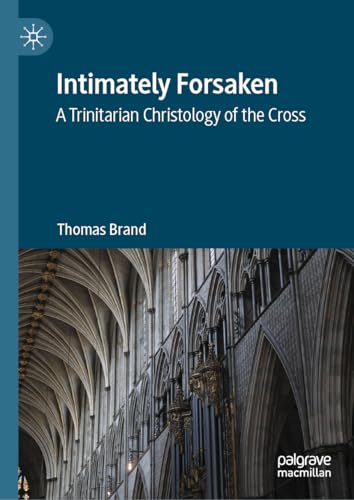

Intimately Forsaken: A Trinitarian Christology of the Cross
Written by Thomas Brand Reviewed By Moses J. HooleThe lament of Jesus from the cross, as documented in Matthew 27:46 and Mark 15:34 (“My God, my God, why have you forsaken me?”), represents one of the most theologically challenging statements within the biblical text. In the aftermath of the two World Wars, pastoral and theological impulses to render God more immediately relatable produced doctrinally distorted interpretations of this cry, some positing an ontological rupture within the Triune God. In Intimately Forsaken, a revised version of his doctoral thesis, Thomas Brand offers an orthodox alternative by developing, as the subtitle indicates, a Trinitarian Christology of the cross. Employing the architectural metaphor of a cathedral, Brand contends that the theological weight of Christ’s cry must rest upon four pillars: sound exegesis, orthodox Christology, classical theism, and a robust doctrine of the Trinity (p. 3). In doing so, Brand leads the reader to the foot of a triniform cross while guarding against the projection of its cruciform shadow into the inner life of God.
As the first pillar, Brand offers an exegetically grounded definition of “forsakenness” within the crucifixion narratives. Following Cyril of Alexandria’s reading of Psalm 22:1, Brand interprets Christ’s forsakenness as covenantal and representative: as the second Adam, Christ bears the covenant curse for those united to him by faith (pp. 15–16). Analyzing the exegetical triangle of Mark 15:34, Acts 2:31, and Psalm 16:10, Brand construes “forsakenness” as Christ being “left undefended” to God’s judgment against sin (pp. 19–21) rather than a rupture within the Trinity or a perichoretic cessation.
The second pillar examines the orthodox doctrine of the hypostatic union and its direct corollary, the communicatio idiomatum. Brand expounds Cyril’s asymmetric Christological predication (pp. 28–39) and traces its development through John of Damascus (pp. 58–65) to Thomas Aquinas (pp. 65–67), showing how this tradition is sustained against heterodox readings. He contends that this patristic consensus, as inherited by the Reformed tradition, predicates the properties of both natures of the Son while rejecting the Lutheran communicatio naturarum, or the cross-predication of attributes (p. 67). Brand offers a particularly incisive critique of Martin Luther, contending that Luther “departed from the bounds of Chalcedon” (p. 42) by ascribing divine predicates to Christ’s human nature and vice versa (pp. 42–51). Although Brand acknowledges patristic caution concerning the communicatio idiomatum and the cry of dereliction, he argues that his governing maxim, though novel, remains orthodox (p. 62). This reviewer notes that this novelty is methodological rather than dogmatic.
In the third pillar, Brand defends the metaphysics of classical theism by affirming divine simplicity, immutability, and impassibility. He critiques what he terms “inferential theology,” exemplified by Jürgen Moltmann and Bruce McCormack, which reconstructs God’s nature from the economic event of the cross (p. 76) and reflects Hegel’s “history of God” (p. 85). Against this, Brand argues via Aquinas that God’s existence as actus purus precludes suffering in the divine nature while providing the metaphysical conditions for the incarnation (p. 99).
The fourth and final pillar turns to Trinitarian distinctions. Drawing on Aquinas (pp. 110–18) and Turretin (pp. 120–21), Brand defines the divine persons as subsistent relations, distinct from the divine essence only by a modal distinction (p. 133). This framework, he asserts, safeguards divine simplicity against the fragmentations implicit in Social Trinitarianism (pp. 137–46).
Having established these pillars, Brand articulates his constructive proposal. Paralleling Cyril’s paradox that Christ “suffered impassibly,” he introduces the phrase “intimately forsaken” (p. 152). He argues that the Son was truly left undefended by the Father in his human nature while remaining, in his divine nature, in unbroken perichoretic communion sustained by the Spirit (p. 160–62). Upholding the principle opera Trinitatis ad extra sunt indivisa, Brand asserts that the Father and Spirit participate fully in the undivided work of the cross without sharing in the Son’s suffering, where the Holy Spirit serves as the bond of love between the Father and the Son even in the darkness of Golgotha (pp. 171–74).
The chapter culminates in a defense of penal substitutionary atonement that avoids Moltmann’s “God against God” rupture (pp. 180–81). Acknowledging the lack of a conciliar definition of redemption comparable to Nicaea or Chalcedon, Brand appeals to the church fathers (pp. 174–75) to show a substantive and consistent soteriological agreement within the tradition (p. 175). Penal substitution thus emerges as the undivided work of the Trinity: the Son, sustained by the Spirit, voluntarily bears the penalty of sin in his humanity while remaining intimately united to the Father in his divinity (p. 184).
This reviewer concludes that Brand’s architectural vision does not merely aspire to coherence—it holds. Brand persuasively demonstrates that one need not posit a passible divine nature to affirm the full gravity of the cross. It is precisely the impassible God who, by assuming a passible human nature, truly suffers for humanity’s redemption. Intimately Forsaken is demanding and technically rigorous, synthesizing historical theology, analytic theology, and Reformed catholic dogmatics. Proponents of Social Trinitarianism and Lutheran Christology will find their assumptions sharply challenged, as will critics of penal substitutionary atonement. In this way, Brand confronts neo-orthodox reconstructions of God and Eastern Orthodox objections to penal substitution—ironically on patristic ground, a foundation the latter claim as home turf. The result is a formidable contribution to the ongoing retrieval of classical theism, alongside the works of James Dolezal, Steven Duby, and others. If Brand’s aim is to counter passibilist influence beyond the academy, however, a more accessible and affordable articulation of his proposal is needed for the benefit of both pulpit and pew.
Moses J. Hoole
University of Edinburgh, Edinburgh, Scotland, UK
Other Reviews in this Issue