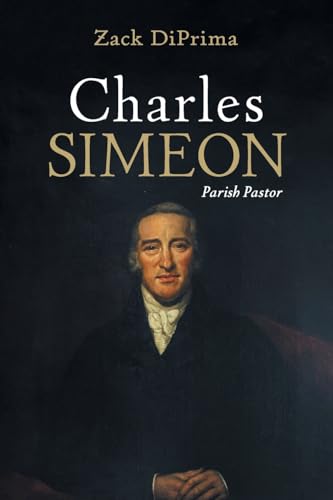

Charles Simeon: Parish Pastor
Written by Zack DiPrima Reviewed By Leland BrownLike many renowned pastors of history, Charles Simeon is best known today for his preaching. A prominent evangelical organization devoted to training pastors for preaching even bears his name, the Charles Simeon Trust, whose workshops regularly quote Simeon’s preaching adage: “My endeavor is to bring out of Scripture what is there, and not to thrust in what I think might be there” (Horae Homileticae [London: Holdsworth and Ball, 1832], 1:xxi). But who was the pastor behind this towering preacher, and how did he understand and practice ministry within his particular tradition? This overlooked and fascinating subject is the concern of Zack DiPrima’s Charles Simeon: Parish Pastor.
This study has great historical and practical value. Aside from his pulpit prowess, Simeon as a pastor has been left largely untouched. Simeon’s spirituality has been examined, his “originality” and commitment to the Scriptures above theological systems is discussed, and his story of faithful ministry in the early opposition he encountered at Cambridge is fairly well known. But in addition to looking at him as a preacher, DiPrima examines Simeon through several distinct lenses: Simeon as a ministerial mentor, devoted Anglican, pious exemplar, and pastor of a parish. These features flesh out Simeon as a historical figure and, for the interested pastor, are full of potential insights for ministry.
DiPrima begins by setting the course for the study, which he says is focused on Simeon’s “pastoral theology”: his theologically informed perspective on the pastorate and the distinct approaches to ministry he embraced. Chapter 1, “Ministerial Mentor,” sets Simeon in the context of a few key figures that influenced him, demonstrates the way Simeon intentionally leveraged his position to train and place future ministers, and makes a powerful argument for Simeon’s global influence through mentorship. The next chapter describes Simeon as a devoted evangelical Anglican, which in his day made him a maverick—a maverick, DiPrima argues, whose Anglican commitment enabled him to be the key shaper of Anglican evangelicalism.
Chapter 4 delves into Simeon’s personal piety, and here readers will especially be served by DiPrima’s retrieval of Simeon’s godly example. Notable in this chapter is Simeon’s repeated insistence on a pastor’s tender affections for and gentleness toward his people. Next, DiPrima describes Simeon’s parish pastoral practice, highlighting Simeon’s use of societies to effectively care for a large congregation where personal visits to every member were nigh impossible. Here, one sees Simeon’s commitment to core convictions about ministry with a penchant for originality. Finally, “preaching paragon” examines the most well-known feature of Simeon’s ministry. DiPrima argues that Simeon’s preaching, and especially his impartation of convictions to future preachers, was the capstone of Simeon’s influence and legacy. Indeed, as DiPrima shows, even Spurgeon, J. I. Packer, and John Stott were influenced by his preaching philosophy and prowess.
Parish Pastor occupies the niche genre of “published dissertation I think you’d enjoy.” Though the work is academic and centers on demonstrating Simeon’s historical influence through his pastoral ministry, it is also accessible and engaging. First of all, its subject is one of the most interesting and singular early evangelical pastors. Simeon was nothing if not his own man, and the distinct ways he practiced ministry highlighted by DiPrima are thought-provoking. Moreover, the writing is engaging. Most of DiPrima’s careful historical analysis situates Simeon in the fascinating context of early Anglican evangelicalism, where he is surrounded by remarkable and sometimes eccentric figures. Occasionally, DiPrima’s situating of Simeon bears the thoroughness of a dissertation, but by and large it is warranted, illuminating, and interesting.
Diprima’s angle for the study—pastoral theology—also bears comment and commendation. Pastoral theology in history is a neglected but growing field; it occupies a middle space between biography and historical theology. Methodologically, pastoral theology draws from a figure’s stated views (in this case, Simeon’s sermons and reflections) about the nature and practice of ministry, but it also discerns a philosophy of ministry through accounts of how one practiced ministry (e.g., Simeon’s dinner parties for ministers and use of societies to care for his parish). DiPrima’s study navigates this balance well and adds to it historical testimony about Simeon’s influence on subsequent generations of leaders. There are, of course, limits to a study of this nature. The massive amount of material in Simeon’s Horae Homiletica may bear further insights into Simeon’s ministry. But Parish Pastor will be a starting place for future Simeon scholars interested in this topic.
Perhaps most helpful about this angle is how it shows that Simeon was not just a great preacher or holy man, but a wise and entrepreneurial pastor. Most fascinating was how Parish Pastor highlights the interplay between Simeon’s committed churchmanship and his quietly innovative ministry practices outside of corporate worship. As DiPrima points out, Simeon combined a love of Anglicanism and commitment to its liturgy with a variety of innovative ministry practices, such as dinner parties for aspiring pastors and societies organized to account for every parishioner. This was a unique combination among early evangelicals. But as DiPrima argues, this is precisely what made Simeon so decisively influential for future ministers. To quote Spurgeon, Simeon had an “all-round” ministry that was more than just preaching. It also involved training the next generation, embracing and wisely navigating one’s tradition, and personally caring for the sheep for whom Christ died.
However, as Parish Pastor concludes, Simeon’s chief influence was indeed through his preaching. Again, this study fleshes out Simeon’s preaching beyond what is well known—such as his commitment to the power of preaching, authorial intent as governing interpretation, and reticence about systematic theology dominating interpretation of biblical texts. But DiPrima also covers new ground, especially in Simeon’s homiletic practice: his “skeleton” outlines, oral rehearsal, extemporaneous method of delivery, and insistence on the various stylistic qualities of good preaching. In these convictions and practices, Simeon was both a model and mentor to future generations of evangelical preachers.
If you want a careful historical study of one of early evangelicalism’s most interesting and influential figures, I heartily recommend Parish Pastor. For leaders looking for wisdom in ministry, its picture of a rooted but entrepreneurial pastor provides much material for reflection and application.
Leland Brown
Leland Brown is a pastor at East Cooper Baptist Church in Mount Pleasant, South Carolina and a PhD student at the Southern Baptist Theological Seminary.
Other Reviews in this Issue