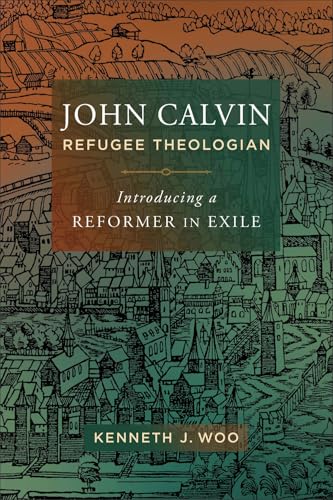

John Calvin, Refugee Theologian: Introducing a Reformer in Exile
Written by Kenneth J. Woo Reviewed By Kenneth StewartIf one follows the field of Calvin studies today, one notes the emergence of a generation of scholars rooted either in Southeast Asia or Latin America who are publishing material at a high standard. This is observable, for instance, in the recent John Calvin in Context (ed. R. Ward Holder [Cambridge: Cambridge University Press, 2020]) and Oxford Handbook of Calvin and Calvinism (ed. Bruce Gordon and Carl E. Trueman [Oxford: Oxford University Press, 2021]). John Calvin (1509–1564), a Reformer in an age of tyrannical kings and emperors, is proving to have a high degree of relevance to global cultural and political situations. What is observable beyond Europe and North America is also observable within European and North American contexts. The volume under review is the third on Calvin studies to have recently passed through the reviewer’s hands, representing the efforts of Asian American or Latino American scholars. The future of Calvin studies is therefore bright. It has gone global.
Kenneth Woo, a graduate of Westminster Seminary, Philadelphia, and Duke Divinity School, now a church historian at Pittsburgh Seminary, has a firm grasp of his subject and a deep sympathy with the Genevan Reformer and his teaching. A third-generation American of Chinese descent, he has found a resonance between this French native of Noyon—uprooted to Switzerland for his own safety—and his own family’s story of coming to America in a time of peril. With this affinity acknowledged, Woo has gone on to survey the career and writings of Calvin with eyes alert to the many allusions the Reformer made to his experience of being a refugee and knowing the pain of exile.
He is not the first to raise this issue. In the book’s introduction, he kindly acknowledges (pp. xix and xxiii) that two historians—the late Heiko Oberman (d. 2001), as well as Nicholas Terpstra—have gone before him in highlighting the significance of mass migration of religious refugees in the sixteenth century. But it is Woo who has taken on the demanding task of tracing the thread of Calvin’s experience of exile in his theological writing, his biblical commentaries, his correspondence, his preaching, and his polemical writing.
But what kind of a book emerges from this tracing of the ‘exile thread’ in Calvin’s life and ministry? Not a biography. I think it is safe to say that Woo takes for granted that his reader, having read a standard biography, already has a good grounding in the main contours and controversies of Calvin’s career. Nor is the book a theological biography: that would require a much larger volume than this. I find the subtitle very apt: Introducing a Reformer in Exile. Woo wants his reader to take a closer look at the Calvin we think we already know. It is as though the frames of a familiar film are now to be viewed in slow-motion. And in those slower-moving frames, we are able to see scars, to sense injury, and to take note of indignation, all of which are traceable to his at-first temporary (1535) and then-permanent flight from France in 1536. From this, there was to be no return. With that experience scarcely processed, Calvin, with colleague Guillaume Farel, experienced exile again when, after only two years, they were banished: Calvin left Geneva for Strasburg. Woo guides us to see the traces of these upheavals in what Calvin preaches, argues, and writes. The point is not to bring us to shed a tear for Calvin but to see him as more than one-dimensional. This is a man with a past, a man with a memory. Every reader of this book will go away more empathetic. Every reader of Calvin will read with greater attentiveness.
It needs to be said that tracing the refugee theme in Calvin’s career makes for a more engaging story in some portions of this book than in others. Chapters 1 (his personal history) and 2 (his diverse audiences) proved gripping. Chapter 3 (which traced the refugee theme through the successive expanded editions of the Institutes) was especially informative. Chapters 7–8 (which dealt with his polemical writings and criticisms of the secret believers he tagged as ‘Nicodemites’) made for engaging reading.
But let us return to Woo’s starting point. There, he acknowledged that he had been alerted to the issue of refugees in the Reformation era by writers who went before him. The reader who is generally aware of Reformation history will perhaps recall that a good number of Calvin’s contemporary Reformers had life experiences that closely corresponded to his. John Knox (d.1572) had already been banished from Scotland, endured French imprisonment, then needed to flee Edwardian England, and received the cold shoulder in Frankfurt before settling in Calvin’s Geneva. Italian Protestants Peter Martyr Vermigli (d.1562) and Girolamo Zanchi (d.1590) were similarly exiles from their homeland (Vermigli eventually needing to flee from Oxford in 1553, just as he had fled Italy). Bucer of Strasburg, who befriended Calvin in 1538, himself needed to flee that city and died in Cambridge, England, in 1551. Polish Reformer Jan á Lasko (d.1560) was already a refugee when at Emden in the Holy Roman Empire. He arrived in London in 1548, but by 1553 it was no longer a safe place for him. In this wider context, Calvin, a fellow refugee, had relatively greater stability than many of his contemporaries.
If we do not keep this wider context in mind, Woo’s book can have the unwitting effect of further strengthening a predisposition we already carry with us: a fixation on Calvin to the neglect of his contemporaries. It is the superabundance of Calvin’s republished writings since the Victorian period (in comparison with the writings of his contemporaries) that makes a study like John Calvin, Refugee Theologian possible. The sober truth is that the observations made by Woo about the Reformer of Geneva might well be replicated by the examination of the accessible literary remains of many of his contemporaries. But theirs are the under-told stories.
Kenneth Woo has opened a pathway in an exemplary way. There are numerous fellow-Reformers whose experiences of exile still call for investigation.
Kenneth Stewart
Covenant College
Lookout Mountain, Georgia, USA
Other Reviews in this Issue