
Towards a Clearer Understanding of Jonathan Edwards’s Biblical Typology: A Case Study in the “Blank Bible”
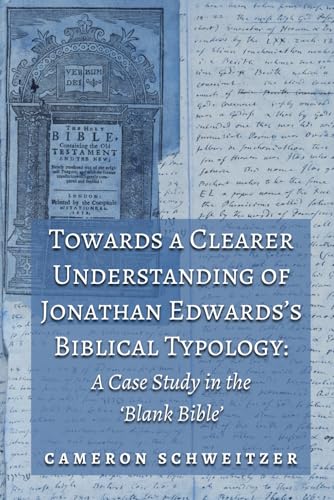
Written by Cameron Schweitzer Reviewed By John L. Inman, IIIThe fifth in the Jonathan Edwards Society’s Treatises on Jonathan Edwards series, Cameron Schweitzer’s work focuses on Edwards’s typology as found in his “Blank Bible.” Other works in this series include works by S. Mark Hamilton, Adam G. Cavalier, John S. Banks, and David Luke. The “Blank Bible” was a Bible Edwards had marked with insights he had gleaned from Scripture in blank spaces built into this particular printing of the Bible. For this work, Schweitzer limited his scope to the examples of types found and expounded upon by Edwards in the “Blank Bible” with cross-references to Edwards’s “Notes on Scripture” as seen in the Works of Jonathan Edwards Yale series (Vols. 15 and 24, edited by Stephen J. Stein in 1998 and 2006, respectively). Cameron Schweitzer serves at Gateway Seminary as the director of the San Francisco campus and associate professor of historical theology. He graduated with his PhD from Gateway in 2022. He has written previous chapters for the Jonathan Edwards Miscellanies Companion (vols. 2 and 3) and contributed an article on Edwards’s exegetical typology in Themelios 50.3 (2025).
Schweitzer’s purpose is to challenge the two strands (implied or explicitly stated) in scholarship of Edwards’s typology. First is the “conservative” approach that limits typology only to Christ specifically, or the New Testament generally. Second are those in the “Miller-Lowance line” named after Perry Miller and Mason Lowance (also advocated by Ava Chamberlain and Thomas Davies). Schweitzer rebuts the Miller-Lowance stance with Douglas Sweeney, Stephen Nichols, and Robert Brown, while also challenging the “wholly” christological view of Edwards’s typology (in contrast to Glenn Kreider, Miller, and Nichols). In his thorough categorization and evaluation of Edwards’s typology in the “Blank Bible,” Schweitzer shows evidence of Edwards’s use of types and antitypes found in the Old Testament and in the New Testament, and of Old Testament types that “culminate in eschatological realities” (p. 190). All this shows that Edwards’s typology is not strictly “conservative” or christological.
Schweitzer thoroughly categorizes the multitude of ways Edwards examined and postulated on types found in his “Blank Bible.” While Schweitzer begins the categories of types with those which would fit in the Miller-Lowance conservative and/or Christological categories, he moves on to show nine other various overarching types found in Edwards’s “Blank Bible.” These include christological, soteriological (the cross), soteriological (ascension, exaltation, etc.), ecclesiological, “intra” Old Testamental, New Testamental, eschatological, natural, spiritualistic, and other various types categorized under “miscellaneous.” Along with these chapters, Schweitzer also provides helpful categorical tables in canonical order.
Schweitzer’s work also provides a great example of Edwards’s hermeneutics as seen through his notes. What should be of interest to Edwards scholars is the vast array of avenues one can explore by examining a type (or a thread of types), as Schweitzer does in Edwards’s “Blank Bible,” and how to subsequently analyze this typology in the formulation of these types in Edwards’s sermons and theological writings. Having written on Edwards’s sermons, this reviewer saw several examples (“Christ the ‘Rock of Defense,’” p. 45; “The Shepherd of God’s Flock,” p. 48; “The Nile and Christ’s Divinity,” p. 202) where, from his research, he could connect with Edwards’s hermeneutics, homiletics, and theology in further research. Because of these exciting potentialities, Schweitzer has offered Edwards studies an invaluable resource and springboard for further Edwardsian study.
An example given by Schweitzer emphasizes his point of showing an intra-Old Testament type with Jacob’s “troublesome life,” including his flight from his family and later “banishment from Canaan,” as typified through his “halted thigh” in wrestling with the Angel of the Lord (pp. 125-26). This is shown as an example by Schweitzer of how Edwards’s types did not conservatively only point to Christ and the New Testament but typified examples with one another in the Old Testament, or even in a biblical character’s life. These kinds of insights can be a springboard for further research into Edwards and his use of types. For example, Schweitzer’s insight prompted this reviewer to examine Edwards’s sermon on this text, the sermon “Blessed Struggle” found in Sermons and Discourses 1734–1738 (Works of Jonathan Edwards 19), where Edwards preached on Jacob’s wrestling with the Angel of the Lord and identified it as a type of the steadfastness one needs to have in prayer through trials. Here, Edwards sees the physical wrestling as a type of “persevering prayer” and the wounded thigh as a “trial of his constancy.” The above comparison illustrates the benefit of Schweitzer’s research in showing Edwards is not wholly “conservative” or christological. Schweitzer’s catalog of examples will advance further study of Edwards’s use (or changing) of types later in his sermons or theological writings.
For his own work, Schweitzer has successfully redefined how Edwards’s typology should be reflective of his commitments to biblical typology, advancing towards a “God-ordained teleological and/or eschatological fulfillment” (p. 266). Schweitzer shows the ways in which Edwards biblically moved beyond “conservative” or christological typology by tethering biblical types to the reality of redemptive history.
John L. Inman, III
Midwestern Baptist Theological Seminary, Kansas City, Missouri, USA
Other Reviews in this Issue