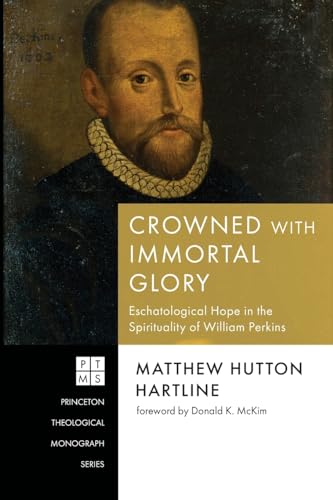

Crowned with Immortal Glory: Eschatological Hope in the Spirituality of William Perkins
Written by Matthew Hutton Hartline Reviewed By Eric BeachWithin England, Europe, and New England, William Perkins (1558–1602) was one of the most influential English Protestants during the late sixteenth and early seventeenth century. Known today in certain circles as “the father of English Puritanism,” some readers may be surprised to learn that by the mid-1800s Perkins’s works had faded from prominence in England and America. While the study of Perkins has experienced a renaissance in the past few decades, scholars have largely neglected his eschatology and have instead focused on topics like preaching, predestination, and covenant theology. This lacuna is not because death, heaven, and eschatological themes played a small role in his corpus. Instead, as Matthew Hartline convincingly shows in Crowned with Immortal Glory, these topics appeared over and over again in the books, sermons, and spirituality of William Perkins.
The book is a publication of Hartline’s 2022 doctoral dissertation entitled “Crowned with Immortal Glory: Eschatological Hope in the Spirituality of William Perkins,” completed at Southern Seminary under the supervision of J. Stephen Yuille. Hartline currently serves as a pastor at First Baptist Church in Cobden, Illinois. Crowned with Immortal Glory has three overarching ends: (1) to define Perkins’s eschatological hope; (2) to demonstrate how this hope flows from vital theological loci like creation, covenants, soteriology, and the incarnation; (3) and to delineate how this eschatological hope shapes Perkins’s view of Christian spirituality and ministry (p. 6). Through this flow, the author is “chiefly concerned” to recover Perkins’s view of biblical spirituality (p. 8).
Broadly speaking, the book unfolds chronologically in five steps: (1) overview of Perkins’s eschatology: this includes exploring Perkins’s views on traditional topics like the millennium and beatific vision; (2) elucidation of Perkins’s ordo salutis: this exposition connects eschatology with soteriology, covenant theology, and union with Christ; (3) discussion of Perkins’s doctrine of glorification; (4) unpacking Perkins’s teaching about the resurrection; and (5) connecting Perkins’s eschatological thought with his teaching on Christian piety and ministry.
Hartline’s book has many strengths. I want to highlight three. First, Hartline’s monograph is one of the closest readings of Perkins’s corpus I have encountered in more than a decade of reading scholarship on Perkins. This fact is especially noteworthy given the relatively brief 150-page length of Crowned with Immortal Glory. On almost every page, Hartline quotes or references around a half-dozen pericopes in Perkins’s vast corpus of more than two million words. Further, unlike a decent tranche of scholarship on Perkins, Hartline’s work draws from all over Perkins’s corpus and not just from a few select tracts within Perkins’s roughly few dozen publications. As a result, Hartline immerses readers in Perkins’s thoughts.
Second, while scholars have paid peripheral attention to Perkins’s eschatology, they have not focused at length on it. As such, Hartline’s work aptly fills an important gap in the study of Perkins. Third, Hartline’s book manages to connect a relatively understudied theme—namely, eschatology—to heavily studied themes—namely, soteriology and covenants—in such a way that Hartline sheds fresh light on the latter. This is no small matter given the volume of scholarly writing on Perkins’s soteriology and covenantal theology.
As this book is a published doctoral dissertation, I should mention two observations before concluding this review. First, the book largely avoids engaging in broader scholarly debates about Perkins, his contemporaries, or the broader Puritan movement. One notable exception is Hartline’s discussion of Perkins and the covenant of works (pp. 35–36). Nonetheless, the introductory summary of research is less than one full page (pp. 5–6). Many chapters have at most five secondary sources. The author’s thesis and his exposition of Perkins’s thinking largely appears in a vacuum. While Hartline is often exploring mostly unchartered territory in scholarship on Perkins, the book’s general lack of engagement with secondary sources is noteworthy for a doctoral dissertation. Second, apart from five brief pages of biography about Perkins in the introductory chapter, the book almost entirely neglects Perkins’s historical context (pp. 1–5). The author avoids elucidating relevant context about life in 1590s Cambridge, such as the terrors of plagues, infant mortality, death during childbirth, and fears of Roman Catholic invasions. These factors loomed in the background—and sometimes in the foreground—of Perkins’s discussion of eschatological matters.
In conclusion, if you are a historian looking to understand Perkins’s thought within its original context or a scholar looking for an argument set in the context of broader academic debates, then you will likely come away from Hartline’s book wishing for more. However, for theologians looking for a detailed exposition of Perkins’s eschatological thought, Hartline’s book is a precise and well-researched monograph. Likewise, for pastors, interested laity, and those seeking to grow spiritually from Perkins’s thinking about eternal matters, Hartline’s book serves as an accurate, detailed, and invaluable guide.
Eric Beach
Trinity Baptist Church
Chapel Hill, North Carolina, USA
Other Reviews in this Issue