
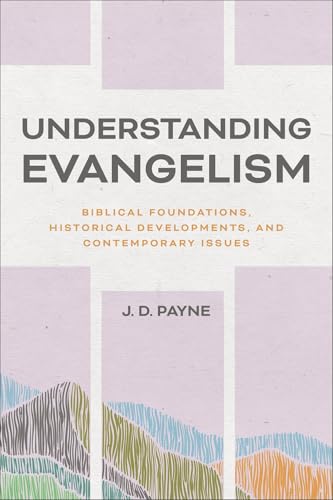
Understanding Evangelism: Biblical Foundations, Historical Developments, and Contemporary Issues
Written by J. D. Payne Reviewed By Samuel PirrottaFew books on evangelism treat the subject with both academic rigor and biblical fidelity. Most tend to be overly practical and methods-driven. Yet Christian practice must always rest on the indicatives of the faith. J. D. Payne offers a much-needed contribution to the landscape of evangelism literature—one that faithfully engages theology, history, and practice. Payne intends the book to serve both as a seminary textbook for training future church leaders and as a resource for pastors.
Payne’s book includes twenty-three chapters, a conclusion, two evangelistic case studies, a bibliography, and three indices. Part 1 addresses introductory issues, including the definition of evangelism, the content of the gospel, the global status of world evangelization, and the motives and ethics of evangelism. Payne emphasizes that evangelism is the verbal proclamation of the gospel to the unregenerate, thus primarily practiced outside the gathered church (p. 14). He pushes back against definitions that measure evangelism by results or that broaden the term to include other ecclesial functions. Evangelism is not everything (p. 21).
Part 2 focuses on the biblical and theological foundations of evangelism. Payne traces the mission of God in the Old Testament, explains how evangelism fits within the various elements of the Great Commission, examines the evangelistic examples of Jesus and the disciples, and discusses key doctrines such as God’s sovereignty, election, atonement, repentance, faith, and conversion.
Part 3 provides a historical overview of evangelism from the first century to the present, highlighting influential evangelists and missionaries as well as major evangelistic gatherings of the twentieth and twenty-first centuries. These chapters effectively demonstrate the diversity of approaches and theological convictions that have shaped the church’s evangelistic efforts.
Part 4 engages issues of culture, context, worldview, and apologetics. Payne argues that while the gospel itself is unchanging, the media and contexts through which it is proclaimed are not (p. 191). Christians must therefore be students of culture if they hope to communicate the gospel faithfully and effectively. He rightly distinguishes apologetics from evangelism, describing it not as evangelism itself but as a segue to the gospel (p. 208).
In part 5, Payne turns to practical matters, addressing the use of personal testimonies and the sinner’s prayer, the importance of pastoral leadership in cultivating an evangelistic church, evangelizing children, and overcoming personal hindrances—such as the misconception that only those with the gift of evangelism are called to evangelize (p. 248). He concludes by offering guidance on how to initiate, carry out, and conclude an evangelistic conversation.
There is much to commend here. Payne clearly has his finger on the pulse of global evangelism, both historically and in the present. His overview of twentieth century global evangelistic gatherings is worth the price of the book. For my personal study, I have wanted to find a concise treatment of these gatherings, and Payne has provided it. Moreover, Payne avoids advocating a single evangelistic method, a restraint for which he should be commended. A book advocating a specific method is less helpful for a seminary course on evangelism for the very reason that it limits scope.
The book’s greatest strength is its scope—covering definitions, theology, history, individuals, and practical matters—however, that breadth inevitably limits depth. This is not a fatal flaw, given Payne’s stated aim. He leaves room for instructors to expand upon key topics and fill in exegetical or theological gaps. He accomplishes his stated goal of producing a textbook for seminary students. Without question, this will be my go-to text when teaching evangelism in the future.
Most of my critiques arise in part 2. Although Payne references a wide array of biblical texts, he rarely engages in sustained exegetical analysis. His treatment of the five Great Commission texts in chapter 7 is underdeveloped. For an academic book, one would expect at least some discussion of the classification of the Greek participles in Matthew 28:19–20 in relation to the imperative “make disciples.” Similarly, when discussing the evangelistic methods of Jesus and the apostles, Payne does not engage 1 Corinthians 9:19–23—an omission that is difficult to justify. Likewise, his discussion of conversion, repentance, and faith would have benefited from an exegetical treatment of Romans 10:9–17.
Finally, although Payne writes from a Calvinistic perspective, he appears overly inclusive of Wesleyan-Arminian positions, presenting competing views within each doctrinal section. The strength of this approach is its potential to broaden the book’s readership. The weakness is that it can create the impression that mutually exclusive positions rest on equal biblical footing. The doctrinal chapters often read as summaries of various views. I would have preferred that Payne lean more fully into the Reformed position and use the additional space to strengthen his arguments through deeper exegesis and theological reasoning, particularly by drawing out the implications for evangelistic practice. Tell the Truth by Will Metzger and Evangelism and the Sovereignty of God by J. I. Packer are great examples of evangelism books that root their arguments in Reformed theology. Interestingly, when Payne turns to practical matters, his counsel clearly presupposes Calvinism.
In the end, Payne delivers what he promises. I anticipate that many evangelism professors will adopt Understanding Evangelism for their courses in the years ahead.
Samuel Pirrotta
Samuel Pirrotta, Midwestern Baptist Theological Seminary, Kansas City, Missouri, USA
Other Articles in this Issue
Main-Point-Driven: A Clear Methodology for Implementing the Christ-Centered Hermeneutic
by Dan AllenThis article addresses the need for a clear methodology for implementing the Christ-centered interpretation...
LaMaster considers Elizabeth Castelli’s contention that Paul’s use of imitative language reinforces power in authority relationships...
Cameron Schweitzer argues that Drew Hunter’s earlier work on Jonathan Edwards’s understanding of typology is too narrowly christological...
This essay argues that evangelical retrieval of the Christian tradition finds a particularly fruitful interlocutor in Athanasius of Alexandria, whose “ruled readings” of Scripture and trinitarian exegesis model a canonically-coherent theological hermeneutic...
Wisdom and Folly in Laodicea: Revelation’s Message to the Laodiceans as Wisdom Discourse
by Joel MacInnesThis article examines Christ’s message to Laodicea as “wisdom discourse,” arguing that it employs “wisdom forms,” “allusions to wisdom literature,” and addresses “wisdom concerns...
Other Reviews in this Issue