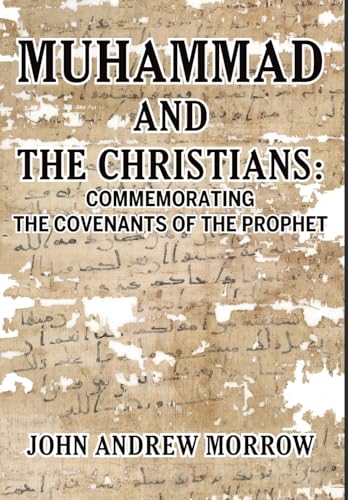

Muhammad and the Christians: Commemorating the Covenants of the Prophet
Written by John Andrew Morrow Reviewed By Hal Morgan NixIn the aftermath of 9/11, many Muslim publications appeared denouncing the violent expressions of Islam as false representations of the religion’s true nature. One writer has been particularly outspoken, not only in his denunciation of radical Islam but in elevating a source he contends demonstrates Islam’s peacefulness, tolerance, and pluralism. The source, the Covenants of Muhammad, presents enduring agreements Muhammad reportedly issued to various religious groups, particularly Christians. Since his influential 2013 book, The Covenants of the Prophet Muhammad with the Christians of the World, Canadian Native American Professor John Andrew Morrow (i.e., Imam Ilyas ‘Abd al-‘Alim Islam) has spawned significant interest in the topic, evidenced by the number of times the book was referenced in a ten-year span (over one thousand). Not only has Morrow’s work ushered in other authors devoted to research on the covenants, but he has continued his own efforts, having written numerous articles and books, including his 2025 book, Muhammad and the Christians: Commemorating the Covenants of the Prophet Muhammad, which is the focus of this review.
Morrow directs readers unfamiliar with the covenants to previous works that engage more directly with questions regarding their history and offer apologetic defenses of them (pp. xxv–xxvi). Nevertheless, the book aims to be concise and accessible, building on prior work by him and others on the covenants to take a “deeper dive into certain topics” (pp. xxv, xxxiii). The topics covered have the overarching goal of demonstrating what “Islam could have been and should have been” if Muslims had “faithfully followed the Qur’an and the covenants” (p. xxxv).
Chapter 1 aims to demonstrate that the tenor and content of the covenants are consistent with the Qur’an. The chapter compares several Qur’anic passages with those in the covenants to show that the texts align. In chapter 2, Morrow explores various possibilities for explaining the relationship among Muhammad, the eagle, and Mt. Sinai. After posing several tenuous theories aimed at discerning the legend’s origins, he nevertheless contends that the historicity of Muhammad’s visit to St. Catherine’s Monastery does not determine the validity of the covenant (pp. xxxiii, 70).
Chapter 3 seeks to show that the covenant housed at Cambridge University resembles the Najran Covenant, reportedly discovered in 878/879, as described in a Church of the East history book compiled in the tenth or eleventh centuries, the Chronicle of Seert. The similarities between the two documents connect Sionita’s seventeenth-century copy to the ninth century. Chapter 4, examines a covenant dated to 1934 written in Arabic with Syriac script (i.e., Garshuni), explores the possibility that Muhammad corresponded with Christians in Syriac, and contains a lengthy section addressing objections to the covenant’s authenticity (pp. 103–20).
Chapter 5 examines the artistic symbolism found in numerous covenants and explains their significance, particularly the image of Muhammad’s hand, which he allegedly imprinted on the covenant as his authorization (pp. xxxiv, 132–42). Chapter 6 analyzes the competing narratives of Muhammad’s encounter with the Najrani Christians as presented in Muslim and Christian sources. Morrow offers various possible explanations for why the account in the Christian source should be trusted over that in the Islamic sources (p. 183).
The last chapter, “Were the Covenants Ever Negated?” compares an Islamic treaty template created by Imam al-Shafi‘i (d. 820) with the covenants. While noting the significant differences between them, Morrow argues that the similarities are due to the former’s reliance on the latter (p. 207). Explaining these differences, he suggests that “Imam al-Shafi‘i, for reasons of his own,” diluted the original rights and protections given by Muhammad to align with the “social dynamics” of al-Shafi‘i’s era (p. 211). Despite “sporadic efforts” to dilute or alter the covenants, Morrow states that “their existence could never be controverted” (p. 211). Finally, the General Conclusions chapter details the covenants’ social impact and concludes by highlighting the hopeful role of the covenants in curing the “deadly disease at the heart of Islam” [i.e., radical Islam] (p. 220).
People engaged in Christian-Muslim relations (e.g., missions, apologetics, evangelism), especially in the West, may encounter Morrow’s work. He and other proponents of the covenants present a pluralistically tolerant form of Islam agreeable to Western societies. Therefore, it is helpful to be aware of two common features of his work: a polemical tenor toward those who doubt the covenants’ authenticity and his suspect methodology employed as an apologetic defense of them.
Hope in the covenants’ ability to excise radical expressions of Islam perhaps explains the polemical tenor leveled against those who doubt the documents’ authenticity. Addressing the “doubters,” Morrow describes them as “almost invariably Islamists or Islamophobes” who “share the same violent and intolerant vision of Islam and reinforce each other’s narrative” (pp. xxvi, 131). He complains that they raise the same issues ad nauseam (p. xxvi). These issues include: 1) the covenants’ absence from the Islamic traditions, and 2) the first appearance of one occurring in a Christian source at least 250 years after Muhammad died. Regarding the first issue, Morrow has asserted that the traditions do indeed contain “a copy of a treaty with the monastery at Saint Catherine” (Morrow, The Covenants of the Prophet Muhammad with the Christians of the World, p. 69). The Islamic source he connects the treaty to is Ibn Sa’d (d. 845). However, Morrow notes that Ibn Sa’d’s account is a “far shorter” version than the covenant and that his account is a secondary source that cites the primary source (i.e., the covenant).
Some people have attempted to locate Ibn Sa’d’s reference to the treaty, yet have failed to do so, with one reviewer commenting that the citation is unsubstantiated. In response to this observation, Morrow states that scholars attempting to find the citation of the treaty with the monks of St. Catherine’s “should have searched for the substance of the treaty, which is easy to locate” as, he asserts, the treaties found in Muslim and non-Muslim sources “all share the same core components” (Morrow, Islam and the People of the Book, vol. 1, pp. 27–28). It is this line of argument (i.e., substantive overlap) that enables Morrow to arrive at his conclusion in chapter 7 regarding the similarities between Imam al-Shafi‘i’s treaty template and the Najran Covenant. Although al-Shafi‘i’s template predates the covenant, Morrow attributes the similarities to the former’s dependence on the latter (pp. 210–11).
In his publications, Morrow consistently highlights a noteworthy point: Islam appears to have been more religiously tolerant in its early decades. Scholars have observed this point in some seventh- and eighth-century non-Muslim accounts (e.g., Isho’yahb III and John Bar Penkaye). Nevertheless, Morrow’s assertion that Christians had no reason to remind Muslim rulers of the covenants during the first two Islamic centuries because they were allegedly upheld (Morrow, Islam and the People of the Book, vol. 1, 402)—thus explaining their textual absence—is erroneous, evidenced by other Christian sources from this period.
To the doubters, Morrow asks, “What kind of a person opposes the principles found in the covenants of the Prophet?” and wonders, “Rather than promote the protection of Christians, would critics prefer Muslim scholars to promote their persecution, enslavement, and murder?” (pp. 32–33). By dividing the stances toward the covenants as promoters of peace on the one side and as Islamists and Islamophobes on the other, Morrow may simply be responding to his lived experience. Nevertheless, expressing doubt about the covenants’ authenticity does not equate to hatred of Muslims nor the view that Muslim scholars’ only option is to promote violence against Christians.
We can embrace the principle of peaceful coexistence embodied in the covenants; however, implementing the covenants themselves may pose challenges. The covenants are predicated on non-Muslims seeking protection from Muhammad and subsequent Muslim authorities. According to the covenants, the linchpin guaranteeing non-Muslims protection is a tax paid to Muslims (clergy and monks are tax-exempt). Thus, one particular challenge concerns the geographic implementation of the covenants. This may not be a challenge in Muslim-governed countries, as taxes are paid to Muslim authorities. However, implementing the covenants, not merely their principles, in countries where Muslims are not the authorities may be more difficult.
The covenants do not appear to be wholesale forgeries, meaning they were created entirely from scratch. They build on previous sources, thereby providing insight into early Islam. However, the stipulations they contain point to social and religious issues Christians faced long after Muhammad died. There is growing support for the authenticity of the covenants, but this support builds on tenuous arguments. Substantive overlap, however minimal, with earlier sources is taken as evidence of the covenants’ ancient and authentic nature. Although there are exceptions, Morrow frequently resorts to personal ad hominem attacks against those who do not share his conviction about the covenants. Peaceful coexistence and an excision of radical Islam are hopes we can all share. Still, the questionable nature of the covenants raises concern among some about placing hope in them to achieve these desired outcomes.
Hal Morgan Nix
The Southern Baptist Theological Seminary
Louisville, Kentucky, USA
Other Articles in this Issue
Main-Point-Driven: A Clear Methodology for Implementing the Christ-Centered Hermeneutic
by Dan AllenThis article addresses the need for a clear methodology for implementing the Christ-centered interpretation...
LaMaster considers Elizabeth Castelli’s contention that Paul’s use of imitative language reinforces power in authority relationships...
Cameron Schweitzer argues that Drew Hunter’s earlier work on Jonathan Edwards’s understanding of typology is too narrowly christological...
This essay argues that evangelical retrieval of the Christian tradition finds a particularly fruitful interlocutor in Athanasius of Alexandria, whose “ruled readings” of Scripture and trinitarian exegesis model a canonically-coherent theological hermeneutic...
Wisdom and Folly in Laodicea: Revelation’s Message to the Laodiceans as Wisdom Discourse
by Joel MacInnesThis article examines Christ’s message to Laodicea as “wisdom discourse,” arguing that it employs “wisdom forms,” “allusions to wisdom literature,” and addresses “wisdom concerns...
Other Reviews in this Issue