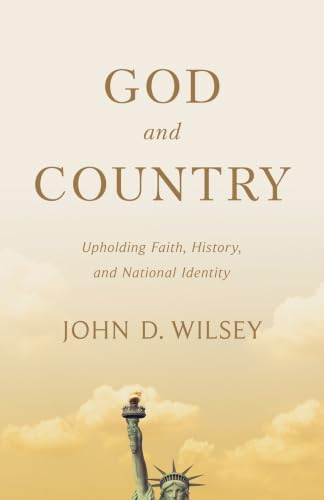

God and Country: Upholding Faith, History, and National Identity
Written by John D. Wilsey Reviewed By Caleb W. SouthernIs it possible for a twenty-first-century person to be both a committed Christian and a proud American? In God and Country, John D. Wilsey tackles the complex and entangled concepts of history, faith, and patriotism as he formulates his answer to this question. In the current cultural climate, when almost any expressed appreciation for America by a Christian is labeled as “Christian nationalism,” Wilsey courageously defends the possibility of Christian patriotism. The key is for this patriotism to be rightly ordered and rooted in gratitude. At once enlightening and puzzling, frustrating and uplifting, Wilsey’s God and Country is an admirable if inconsistent attempt to defend historical study as a means of rightly ordering our national patriotism. This short book ultimately tries to accomplish too much in too little space, leaving the reader looking for more despite the insightfulness of much of its content.
John Wilsey, professor of church history and philosophy and chair of the department of church history at The Southern Baptist Theological Seminary, makes two arguments in his book God and Country: first, that “history is deeply relevant” for Christians, and second, “that good historical, biblical, and theological thinking are necessary” for healthy patriotism (p. 6). Wilsey calls patriotism a “virtue,” seeing it as a form of “love for others” or “neighbor-love.” Wilsey defines history as “the way we make sense of the past” (p. 8, emphasis in original). His definition emphasizes the interpretative role played by the historian. The historical study is not relativistic because history is “the pursuit of truth in the past for the purposes of the present” (p. 11). These definitions illuminate at least three elements to Wilsey’s conception of history: (1) history relies on evidence and documentation; (2) history involves truth and understanding; and (3) history is about interpretation and meaning-making. Because history involves truth and moral judgments, historical inquiry requires a virtuous inquirer. Wilsey argues that the “exercise of virtue” is necessary for historical thinking so that we can learn our “place in time” and learn how to “cultivate a rightly ordered love of country” (p. 11).
Wilsey turns to Scripture to defend the study of history. Christianity is inherently historical, and God has revealed himself “in historical language” (p. 34) through the Bible. This means that “the option of considering history as irrelevant is not open to the Christian” (p. 25). History is complementary to faith, as a means of “establish[ing] us deeper in the truth” (p. 33). The study of extra-biblical history, such as American history, is a means of acquiring wisdom (p. 41).
Following the biblical rationale, Wilsey examines the five Cs of historical thinking: Change, Context, Causality, Contingency, and Complexity. Wilsey’s treatment of each “C” helps the reader understand better the questions historians bring to the past and the limits within which they work. The final “C,” complexity, may be the most important for Wilsey’s argument. Simplifying history is usually the first step toward forcing the past to meet our own agendas. Strangely, history’s formative power is not heavily emphasized in connection with the five Cs of historical thinking, even though the person who habitually practices thinking historically has the power to form a person in wisdom.
An unexpected and important contribution in God and Country is Wilsey’s argument that the historian must bring theological and classical virtues to the study of history to “do” history well. The central virtue is love, which is “absolutely necessary for the serious historical thinker” (p. 95). Reproducing 1 Corinthians 13, Wilsey examines different aspects of love—patience, kindness, contentment, humility, selflessness, truth—and how they influence historical inquiry. Frequently, history is reduced to a conflict between good and evil, what Wilsey calls the Star Wars approach to history (pp. 111–14). Instead, through virtues like wisdom, justice, courage, and temperance, we can approach the past “with charity” and “be in a position to cultivate mature and rightly ordered love for our country” (p. 132). Less clear, though, is how the historian is supposed to bring wisdom as a virtue to historical study if historical study is a key means of gaining wisdom.
Finally, in the book’s last chapter Wilsey argues that patriotism “is rightly ordered love of country that comes from gratitude and joy in the good gifts God has freely given by His grace” (p. 143). Patriotism is not merely abstract or theoretical; instead, loving both God and our country entails loving the very real people in our immediate contexts, beginning with “the members of our households” (p. 141). The virtue of gratitude is “at the heart of rightly ordered patriotism” and “is the way of Christ” (pp. 148, 155). It is surprising that gratitude did not frequently appear in previous discussions on the virtues (and it does not have an index entry). Wilsey provides a summary of two kinds of exceptionalism that he defined in detail in an earlier work: American Exceptionalism and Civil Religion: Reassessing the History of an Idea (IVP Academic, 2015). Closed exceptionalism “amounts to national idolatry,” whereas open exceptionalism entails grateful recognition “that ours is a great country because of its unique contribution to human freedom” (p. 147).
As a general introduction to historical study, God and Country is full of genuine insight. Unfortunately, the book suffers from poor organization and incomplete argumentation. The book’s three major subjects—the five Cs of historical thinking, virtues, and patriotism/nationalism—are not intuitively related to one another. For instance, the role of virtue in historical inquiry is one of the work’s strongest features, but more clarity is needed on how virtue contributes to the overall argument regarding patriotism and American identity. Important concepts like gratitude and tradition appear in the last chapter with little to no prior introduction. Additionally, this book does not make a strong or memorable contribution to the current debate surrounding Christian nationalism, as the reader would expect based on the book’s marketing. The book claims to address the question, “Is nationalism always a threat to Christian faith?” (back cover). The problem is that the concept of nationalism rarely appears in the book (there are only three entries in the index). Nationalism is never defined, and patriotism is never compared with or distinguished from nationalism. The book’s major argument is contained in the last chapter, but the last chapter’s relationship to the previous four is tenuous.
Nonetheless, Wilsey’s thoughtful and careful explanations of the nuances involved in historical thinking and understanding are a helpful corrective in our age, which witnesses the polarized weaponization of history. The challenge faced by American historians is one of disposition more than content. Everyone agrees that historical events are important, but no one agrees on why they are important or what lessons they impart for the present. In God and Country, Wilsey is defending an increasingly rare approach to history: one that seeks wisdom from the past through humility and gratitude. Wilsey suggests that a recovery of grateful receptivity in historical inquiry is our best means to “uphold” faith, history, and national identity.
Caleb W. Southern
Southern Wesleyan University
Other Articles in this Issue
Main-Point-Driven: A Clear Methodology for Implementing the Christ-Centered Hermeneutic
by Dan AllenThis article addresses the need for a clear methodology for implementing the Christ-centered interpretation...
LaMaster considers Elizabeth Castelli’s contention that Paul’s use of imitative language reinforces power in authority relationships...
Cameron Schweitzer argues that Drew Hunter’s earlier work on Jonathan Edwards’s understanding of typology is too narrowly christological...
This essay argues that evangelical retrieval of the Christian tradition finds a particularly fruitful interlocutor in Athanasius of Alexandria, whose “ruled readings” of Scripture and trinitarian exegesis model a canonically-coherent theological hermeneutic...
Wisdom and Folly in Laodicea: Revelation’s Message to the Laodiceans as Wisdom Discourse
by Joel MacInnesThis article examines Christ’s message to Laodicea as “wisdom discourse,” arguing that it employs “wisdom forms,” “allusions to wisdom literature,” and addresses “wisdom concerns...
Other Reviews in this Issue