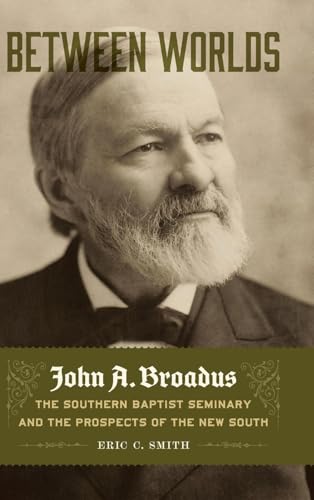

Between Worlds: John A. Broadus, The Southern Baptist Seminary, and The Prospects of the New South
Written by Eric C. Smith Reviewed By Dylan BaxterJohn Albert Broadus (1827–1895) stood in the nineteenth century as a towering Southern Baptist leader. Indeed, he served as a founding faculty member and the second president of The Southern Baptist Theological Seminary, and was the author of many influential works, including A Treatise on the Preparation and Delivery of Sermons. Yet, like many figures of the nineteenth century, Broadus’s legacy is tainted by slavery. Eric C. Smith, a church historian who teaches at Broadus’s former institution, Southern Seminary, presents the first critical biography of this complex, prodigious figure.
Between Worlds generally follows a chronological approach, stopping to consider the conflicting themes of Broadus’s life along the way. Broadus displayed the tension between personal ambition and piety. From his youth, he longed to make something of himself. Yet these aspirations for greatness were redirected through his conversion and call to ministry. After rising to denominational fame as a Virginia pastor, Broadus moved to Greenville, South Carolina, to join the founding faculty of Southern Seminary in 1859. With the seminary opening at the height of the sectional crisis, Broadus opposed both abolitionism and secession, recognizing, along with James P. Boyce, that secession meant war, and war meant an end to slavery. The Civil War indeed followed South Carolina’s secession, leading to the seminary’s temporary closure. After the seminary reopened, Broadus labored to ensure the school’s survival. He married his personal ambition to the school, not taking a paycheck for months, fundraising in the north, and galvanizing a beleaguered faculty. His resolve was immortalized into Southern Seminary lore when he implored the other founders, “Suppose we quietly agree that the Seminary may die, but we’ll die first” (p. 99). The school began to flourish after its move to Louisville, Kentucky, attracting aspiring Baptist ministers from around the nation.
The final decades of Broadus’s life continued to present a man navigating between worlds. Indeed, Broadus was beloved in both North and South, in the countryside and the city, among the common and the elite. Yet, moving between worlds was not without challenge. He committed himself to the highest levels of scholarly rigor while maintaining an unwavering orthodoxy; many of his pupils, most notably Crawford Toy, failed to hold such commitments together. As theological institutions in the North followed the liberalizing trends of German higher criticism, Broadus managed to position Southern Seminary to pursue excellence in scholarship and research while upholding a commitment to the historic Christian orthodoxy. Broadus’s graceful navigation of conflicting worlds enabled him to be a peacemaker and consensus holder among Southern Baptists as the seminary’s second president.
Readers will find no hagiography here. Instead, Smith’s telling of Broadus’s life is a model critical biography. Certainly, Smith is sympathetic to Broadus, but it is a significant achievement to write a biography that is both sympathetic and critical. He skillfully interprets Broadus’s actions through the lens of contemporary academic research. In the tumult of the last decade, modern evangelicals have grappled with how to wisely approach figures from the antebellum past who were stained by the sin of slavery. In a spectrum of approaches, some sought to cancel those figures while others aimed to overlook their participation in the peculiar institution and preserve their legacies. Smith comments that his aim is “neither to praise Broadus nor to bury him” but instead “to simply arrive at a better understanding of this major figure from the past (p. 8). Smith’s approach is refreshing. Between Worlds is not an apologetic for Broadus. Examining Broadus’s plantation childhood, Smith situates him in the context of Southern planter paternalism, the notion that antebellum white Southerners believed it to be their fatherly Christian duty to ensure the well-being of the “childlike” slaves, free blacks, and uneducated whites. Smith traces Broadus’s paternalism beyond the Reconstruction years and into the final decade of his life.
And yet, much of modern Southern Baptist life is shaped by the legacy of Broadus. Charles Spurgeon praised John Broadus as “the greatest of living preachers” (p. 110). His Treatise on the Preparation and Delivery of Sermons is still the best-selling preaching manual of all time. Indeed, Broadus stands as the father of modern expository preaching due to the incredible success of his Treatise, which has even influenced modern evangelicalism. Southern Seminary’s commitment to academic rigor and Christian orthodoxy was championed by Broadus. Ultimately, Smith presents Broadus as a figure whose legacy also rests between worlds: the wickedness of slavery and unquestionable racism on one hand and godly scholarship and unflinching orthodoxy on the other.
While readers with connections to Southern Seminary will enjoy this biography, Between Worlds deserves to be read widely. Smith provides readers with a model of charitable, honest historiography. Many other monumental figures from the nineteenth century deserve similar treatment.
Dylan Baxter
Dylan Baxter serves at Church at The Mill, Moore, South Carolina, USA.
Other Articles in this Issue
Main-Point-Driven: A Clear Methodology for Implementing the Christ-Centered Hermeneutic
by Dan AllenThis article addresses the need for a clear methodology for implementing the Christ-centered interpretation...
LaMaster considers Elizabeth Castelli’s contention that Paul’s use of imitative language reinforces power in authority relationships...
Cameron Schweitzer argues that Drew Hunter’s earlier work on Jonathan Edwards’s understanding of typology is too narrowly christological...
This essay argues that evangelical retrieval of the Christian tradition finds a particularly fruitful interlocutor in Athanasius of Alexandria, whose “ruled readings” of Scripture and trinitarian exegesis model a canonically-coherent theological hermeneutic...
Wisdom and Folly in Laodicea: Revelation’s Message to the Laodiceans as Wisdom Discourse
by Joel MacInnesThis article examines Christ’s message to Laodicea as “wisdom discourse,” arguing that it employs “wisdom forms,” “allusions to wisdom literature,” and addresses “wisdom concerns...
Other Reviews in this Issue