
Volume 51 - Issue 2
Main-Point-Driven: A Clear Methodology for Implementing the Christ-Centered Hermeneutic
By Dan AllenAbstract
This article addresses the need for a clear methodology for implementing the Christ-centered interpretation. Without a consistent process to guard and guide interpreters, illegitimate connections to Jesus are to be expected. Therefore, the Main-Point-Driven methodology provides readers with confidence to discern how every passage directs us to Christ. Special attention is given to asking the right Christ-connection question and unpacking the C-H-R-I-S-T acronym to aid in memorizing the six possible paths to Jesus. The article closes with a brief apologetic of why the Main-Point-Driven methodology is the correct path forward.
I love the idea of Do-it-Yourself maintenance (DIY). Unfortunately, my projects involve more time and money than anticipated. I have the vision but lack the right tools or clarity on each step. My attempts demonstrate that without the correct equipment or clear instructions unsatisfactory results are inevitable.
The commitment to a Christ-centered hermeneutic continues to increase.1Otherwise known as the Christocentric, Christological, or Redemptive-Historical Hermeneutic. This is worth celebrating because proclaiming Christ matures the Church (Col 1:28). But conviction and commitment are not enough. We also need the right tools—a clear methodology for implementation to ensure our connections to Christ are legitimate. Many resources discuss various ways the Old Testament anticipates Jesus, demonstrating he is the perfect Prophet, Priest, and King, the true Passover, and the promised seed to crush the head of the serpent (i.e., the end product).2Examples include Christopher J. H. Wright, Knowing Jesus through the Old Testament, 2nd ed. (IVP Academic, 2014); Michael P. V. Barrett, Beginning at Moses: A Guide to Finding Christ in the Old Testament (Reformation Heritage, 2018); David Murray, Jesus On Every Page: 10 Simple Ways to Seek and Find Christ in the Old Testament (Nelson, 2013); Bryan Chapell, Christ-Centered Preaching: Redeeming the Expository Sermon (Baker, 1994); Dennis Johnson, Him We Proclaim: Preaching Christ from All the Scriptures (P&R, 2007); Tim Keller and Edmund Clowney, “Preaching Christ in a Post-Modern World”, The Gospel Coalition, https://www.thegospelcoalition.org/course/preaching-christ-postmodern-world/.
However, few equip the reader with a straightforward methodology to confidently discern how every passage directs us to Jesus, especially from the many texts that do not contain an obvious connection. The process is vague. Readers are left without necessary tools, and illegitimate connections to Jesus are common in pulpits, preaching workshops, and podcasts. Therefore, we need more resources offering instruction on methodology for implementing the Christ-centered hermeneutic. Two noteworthy books with strong dedication to this are Preaching Christ from the Old Testament, by Sidney Greidanus, and Your Old Testament Sermon Needs to Get Saved, by David King.3Sydney Greidanus, Preaching Christ from the Old Testament: A Contemporary Hermeneutical Method (Eerdmans, 1999); David M. King, Your Old Testament Sermon Needs to Get Saved: A Handbook for Preaching Christ from the Old Testament, 9Marks (Moody, 2021). I agree with their methodology and intend to add to this conversation in four ways.4To my knowledge there is not a name to distinguish their methodology from other Christ-centered approaches, which I will offer.
First, in Section 1: Process, I offer a descriptive title for the methodology to make the process abundantly clear, provide important interpretive boundaries, and distinguish it within Christ-centered hermeneutics. Second, I propose Christ connection questions designed to guide the exegete according to the redemptive-historical context. Third, I provide the C-H-R-I-S-T acronym to aid readers in memorizing the six possible Christ connections in any given passage. Fourth, in Section 2: Proof, after explaining the process, I provide an apologetic for why this methodology is the optimal way forward. Section 3: Practice concludes with sample passages for the reader to experience the immediate usability of this methodology.
Implementing the Christ-centered hermeneutic need not be difficult or unnatural. Instead, with the right tools and clear instructions, it is a DIY project that interpreters of every level can accomplish.
1. Process of Main-Point-Driven Methodology
We begin with the process. The goal is to provide clear instructions so that the Christ-centered interpretation of any passage is organic, simple, and biblically legitimate. Let’s get started.
1.1. Discern the Main Point: The Interpretation Driver’s Seat
When studying a passage, we begin by making key observations to reveal the author’s emphasis. These include discovering the context (historical, literary, and grammatical), structure (organization of the text), and tone (see “#1 Observation,” in Figure 1, where the puzzle piece represents a passage). During this phase we must resist temptations to search for connections to Christ.
The next phase is interpretation in two parts, #2a and #2b. “#2a Main Point Original Context Interpretation” discerns the author’s main point as understood by the first audience in the original context. This is the historical-grammatical interpretation, and it must not be skipped. As we summarize the main point, we include the unique contributions the passage makes to Scripture. Aim for specificity over vagueness, and comprehensiveness rather than pithiness.5We are not discussing homiletics, where we simplify an exegetical main claim for preaching. In exegetical work we aim for specificity. For example, rather than stating the main point of Genesis 12:10–20, as “God is sovereign,” “God is faithful to His promise,” or, “God is all-powerful,” it is better to state how those characteristics of God are demonstrated in this passage. We might elaborate: “Abram fearfully gave Sarai to Pharaoh (i.e., in effect ending the promise), but God afflicted Pharaoh so that he returned her to Abram.” It is clunky but highlights the unique claims, which will make the Christ connection simple. This is the most difficult step in the exegetical process. But strong work here simplifies the next move.
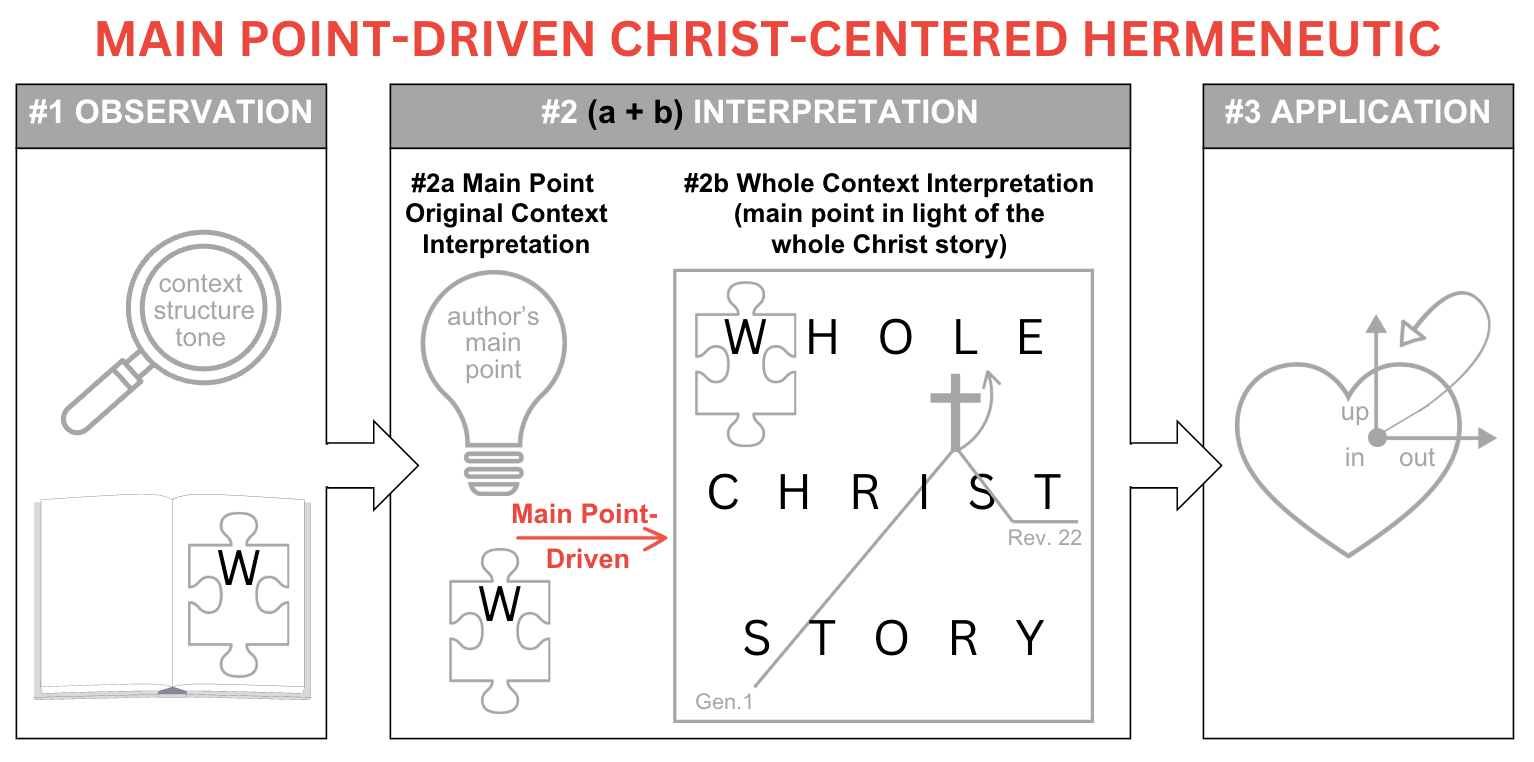
Figure 1
After articulating the main point in the original context (#2a), we discern how the passage contributes to the whole context of the Bible (#2b Whole Context Interpretation). This step is the Christ-centered interpretation. It is essential because the Bible is a collection of sixty-six books with one overarching story from Genesis 1 to Revelation 22. This storyline centers on the person and work of Christ and can be stated as the story of God rebuilding his life-giving kingdom through the work of his Son.6God’s kingdom is when God’s people are in God’s place, living under God’s rule. The result? God’s people experience God’s blessing, especially the blessing of God’s presence. See Vaughan Roberts, God’s Big Picture: Tracing the Storyline of the Bible (Intervarsity Press, 2002), 21–23; Graeme Goldsworthy, Gospel and Kingdom, The Goldsworthy Trilogy (Paternoster, 1981), 53–54. It begins in a garden and ends in a garden (and a great city!), and along the way there is tragedy and grace-filled triumph, all centering on the person and work of Jesus the Christ, the Son of God, who rights all wrongs.
Therefore, we must understand how each passage contributes to this Christ story. Just as the message of a puzzle piece remains incomplete until it is placed within the whole puzzle where it reaches its full meaning, so with every passage: “Without the whole we have a hole in our interpretation.”7This phrase originated with my friend, Ryan Boyer.
Faithfully implementing this conviction requires an intentional and consistent approach, which I call the “Main-Point-Driven” methodology or, more fully, the “Main-Point-Driven, Christ-Centered Interpretation.” The key concept is that the connection to the larger story must be guided by the main point and never by details from the passage not stated in the main point.8Greidanus, Preaching Christ from the Old Testament, 288, 308; Ian Duguid, “Old Testament Hermeneutics,” in Seeing Christ in All of Scripture: Hermeneutics of Westminster Theological Seminary, ed. Peter Lillback (Westminster Seminary Press, 2016), 19; King, Your Old Testament Sermon Needs to Get Saved, 59. This descriptive title provides exegetical boundaries and clarity to this crucial phase of interpretation.
The “Main-Point-Driven” methodology sounds obvious, but it is often neglected. Instead, interpreters set aside the main point to reflect on the passage once again, searching for elements that remind us about Jesus by parallel or contrast. These may include phrases, objects, actions, or principles. Sometimes a single connection is mentioned, but often a “spray approach” is utilized, where the teacher states multiple ways a passage points to Christ. For example, Landon Dowden states the main point of Esther 2:1–18, as: “We live in a dark world, and sometimes we are part of the darkness; nevertheless, God in his grace does not discard us but delivers us, even from ourselves, and deploys us for his purposes.”9Landon Dowden, Exalting Jesus in Esther, Christ-Centered Exposition Commentary (Broadman & Holman, 2019) pp. 47–68. I appreciate Dowden’s use of historical context and practical application points throughout this chapter. He suggests a range of ways the passage points to Christ:
“A. Ahasuerus exercised authority for his own gratification, but Jesus does so for our good.
B. Ahasuerus sought a beautiful and pure bride, but Jesus made us into one.
C. Ahasuerus left the women he used with shame, but Jesus has taken our shame away.
D. Mordecai could only check on Esther’s situation, but Jesus can change ours.”
While they are not heretical, the connections are not organic because none flow from the main point. There are no controls on connections. Therefore, I contend we must resist this common approach, which is prone to produce illegitimate connections.
Alternatively, sticking with Dowden’s main point and allowing it to lead the way, we discern that it taps into a recurring theme of God using the sinfulness of man to accomplish his mission, for his glory and our good. Esther is not alone. Joseph’s brothers sold him with evil intent, but God meant it for good (Gen 50:20), not to mention the evil schemes against Hezekiah, Nehemiah, and Daniel all turned for good. This theme eventually climaxes as Herod, Pontius Pilate, the Gentiles, and the people of Israel, sinfully gathered against Jesus to accomplish what God predestined for his glory and our good (Acts 4:27–31). Man made it the darkest day, but God made it the brightest. How stabilizing to realize that sinful humans are not in control. God uses the fallenness of man to fulfill his wise purposes.
This connection does not require elaborate rumination because it flows naturally from the main point. Let us, then, continue and explain how it is done.
1.2. Ask the Main Point: Christ Connection Question
To ensure the main point is guiding our #2b interpretation, ask the appropriate Christ Connection Question from below:
When in the Old Testament: “What kind of a main point is this, such that it directs us to the Christ event?”10By “Christ event” I include the person and work of Christ during the incarnation and beyond (i.e., his life, death, resurrection, ascension, and future return). The focus is determined by the main point and Christ connection.
When in the Gospels: “What kind of a main point is this, such that it demonstrates Jesus is the climax of God’s story?”
When in Acts-Revelation: “What kind of main point is this, such that it unpacks the implications of the Christ event?”
These questions intentionally provide three benefits. First, they guard us from returning to the passage in search of other details by asking about the “main point.”
Second, each one reminds us of the author’s directional focus by altering the question according to the redemptive-historical context. The Old Testament authors looked forward and prepared the reader for the coming Christ event. The Gospel authors pointed backward to demonstrate how Jesus fulfilled promises, resolved problems, and most clearly displayed biblical themes and the character of God. They also pointed forward to prepare the reader for life as Christ followers. From Acts through Revelation the authors glanced back to unpack how the work of Christ decisively changed God’s people positionally and conditionally, who are redeemed sinners, empowered to live as God’s people. They also pointed forward to the inheritance and full salvation experience that still awaits those in Christ. These distinctions are especially helpful when interpreting the New Testament, where, ironically, it can be challenging to apply a true Christ-centered interpretation.
Third, the questions prompt us to consider the six kinds of main points by asking, “What kind?” This provides added protection from returning to the text for reflection and potentially making illegitimate connections to Jesus.

Figure 2
Thankfully, if we were clear with the main point, the Christ connection will be obvious.11When there are multiple options, choose the most natural. If none make sense, then increase specificity in the main point.
1.3. Follow the Main Point Path to Jesus: C-H-R-I-S-T Acronym
I organize the six kinds of main points with the acronym, “C-H-R-I-S-T.”12After comparing lists of “paths” to Jesus from others and aiming for memorability, I propose these six. Determine the most organic path according to the one best completing the statement:
The main point of this passage is…
- A Command (biblical ethic) that can only be fulfilled and empowered by Christ
- A Hope (promise) we only have real reason to rest in because of Christ
- A Recurring theme that eventually climaxes in Christ
- An Ill (problem) that can only be made right or resolved by Christ
- A Storyline reminder of the promised redemption to be accomplished by Christ
- A Type (person, event, or institution) that pictures the Christ and his work
Let us consider each possibility.
C: A Command (biblical ethic) that can only be fulfilled and empowered by Christ
When the main point is a moral command (a biblical ethic) exhorting us to live a particular way, it directs us to Jesus as our only hope by taking us through several phases.13This includes not only the Ten Commandments or Levitical Law code but any passage that instructs a way of life under God, whether explicitly stated or implied, as in narrative literature.
First, we recognize that God’s commands are good and right, and God demands we be holy as he is holy (1 Pet 1:15–16). When he calls us to be kind, self-sacrificial, generous, and not be selfish, harsh, anxious, or grumbly, God is not offering suggestions or asking for partial obedience but perfection.
The problem is, if we truly listen, we constantly fail. Therefore, the commands call for God’s righteous judgment. This is bad news. We need resolution, to which the commands direct our attention.
By God’s grace and mercy, Jesus died in our place as a sin-bearing substitute, and His perfect command-keeping was credited to our account so that we became the righteousness of God (2 Cor 5:21). This is “The Great Exchange.” Everyone who trusts in the death and resurrection of Jesus is positionally purified before God as his forgiven child.
Furthermore, our condition on earth continues to be renewed. In the New Covenant, God’s people are given new hearts and the Holy Spirit so we can increasingly experience the joy of walking in faithful obedience to God’s good and wise commands (Ezek 36:25–27; Jer 31:31–34; Luke 22:20). In Christ, they are not burdensome, declaring, “You must fulfill me but can’t” (1 John 5:3). Instead, they extend a glorious invitation, “Now, in Christ, you can fulfill me!”14Tim Keller, “Gospel Preaching,” unpublished notes, London Church Planting Consultation, February 2009, 15.
Therefore, when the main point of a passage is a biblical ethic, it directs us to Jesus as a command that can only be fulfilled and empowered by Christ.
Sample text: Ecclesiastes 12:8–14
Main point: Your top priority is submitting your whole self (mind, body, plans, resources, etc.) to God, your Judge.
Christ connection: This passage exhorts us to submit our whole self to God because it is the place of freedom and joy. The problem is that our sinful hearts consistently fail to pursue this. We love our comfort and plans. Our flesh has desires contrary to God’s ways. Instead of submitting to God we grumble when his providential hand doesn’t cooperate with our vision. This is bad news. Seeking stability and satisfaction apart from God’s full authority is like chasing the wind. Furthermore, it calls for God’s judgment. We need God’s forgiveness, and we need internal transformation so we can enjoy this command. Thus, we must look outside ourselves to Christ. In his death and resurrection, he took the punishment for all who trust in him. We are given Christ’s righteousness before God and are empowered by the Holy Spirit and a new heart to pursue this great calling and live as truly human. We must fight against our indwelling sin and remind ourselves that submitting wholly to God is the path to freedom and joy. In what way do you struggle to submit your whole self to God? Take heart, in Christ you now can.
H: A Hope (promise) that we only have real reason to rest in because of Christ
Since the fall (Gen 3) God has held out hope for his people. This includes promises for comfort through pain, peace amidst confusion, help in times of trouble, justice, renewal, rest, the final eradication of sin, God’s presence, God’s listening ear, God’s providential care, and God’s watchful eye. God’s gracious promises are scattered throughout Scripture and are meant to encourage and strengthen the beneficiaries during their pilgrimage on earth.15“Hope” is a larger category than a direct promise and fulfillment (i.e., Micah 5:2; Matt 2:6).
But who are the beneficiaries? Everyone? No. They are exclusively those who have been made God’s people, which only happens through the atoning work of Christ Jesus. Our sin must be punished, and we must be forgiven so that we can come into God’s family and be heirs of his promises. Therefore, we need the substitutionary death of Jesus, in whom all the promises of God find their “yes” (2 Cor 1:20).
We should recognize that not all promises are fulfilled in the same manner.16Greidanus, Preaching Christ from the Old Testament, 206–12. Below are five kinds of promise-fulfillment:
(1) Direct fulfillment. These promises are fulfilled exactly as stated and occur one time. For example, Micah promised the Messiah would be born in Bethlehem (Mic 5:2; Matt 2:5–6).
(2) Surprising fulfillment. This occurs with promises delivered in poetic literature, which describe a reality behind the picture. For example, Isaiah promised, when the Christ arrived, “Every valley shall be lifted up, and every mountain and hill be made low” (Isa 40:3–5). John the Baptist insisted this passage was fulfilled, yet no geographical alterations took place. Of course, what happened was even greater. The Son of Man took on flesh to rescue God’s sinful people forever. Now that is an “earth changing” moment (Luke 3:4–6)!
(3) Recurring fulfillment. These promises are repeatedly fulfilled until they are “fully-filled” up in Christ. For example, God promises to comfort his people (Isa 66:13) and declares he hears the cries of the needy (Ps 69:33). Every generation of believers experience these great promises.
(4) Increasing fulfillment. Sometimes a promise increases and takes on different forms as it unfolds. Suppose your great-great-great-great-grandfather left a rich inheritance for the fifth generation from him, which must be used to purchase the best transportation money can buy. His imagination described it as the best “horses and chariots.” When the automobile was introduced, that generation described the promise as a car that could drive seventy miles per hour. Finally, today, the fifth generation is ready to receive the promise. Certainly, they do not think about horses. It would miss the point. Instead, they look for a personal jet or a self-driving electric truck.
Some of God’s promises unfold in the same way. After man was kicked out of the garden, God promised to bring the intimacy back. Eventually, God promised Abraham a land. But as the story progressed, the land became less about the physical borders and more about the dwelling place of God with his people. By the time of Jesus, he declared that the meek will inherit the earth (Matt 5:5), and Paul said Abraham “would be heir of the world” (Rom 4:13). Even in his own day Abraham looked beyond the land he could see, because “he was looking forward to the city that has foundations, whose designer and builder is God (Heb 11:10).
On one hand, in Christ we have already come “to Mount Zion and to the city of the living God, the heavenly Jerusalem, and to innumerable angels in festal gathering” (Heb 12:22). On the other hand, “Here we have no lasting city, but we seek the city that is to come” (Heb 13:14).
All along, the promise increased. One day it will be fully fulfilled, and all God’s people will receive the inheritance which is “imperishable, undefiled, and unfading, kept in heaven for you” (1 Pet 1:3–5). We will dwell with God in the new heavens and the new earth, and in the city of the New Jerusalem (Rev 21:1–2). In other words, to narrow the promise to the land boundaries of Canaan would go backwards and miss where the promise was headed.17Michael Lawrence, Biblical Theology in the Life of the Church: A Guide for Ministry, 9Marks (Crossway, 2010), 72–75.
5) Partial fulfillment. Some promises are partially fulfilled during one period of history and completed in another. For example, Jesus said he came to fulfill Isaiah’s words: “The Spirit of the Lord is upon me … to proclaim the year of the Lord’s favor.” However, he left out Isaiah’s next sentence, “And the day of vengeance of our God” (Luke 4:18–19; Isa 61:1–2). This portion of the promise will be fulfilled in the next installment when Jesus returns and destroys all evil.
All God’s promises are “yes” in Christ Jesus, and in him we can trust the final fulfillment of everything yet to come. Therefore, when the main point declares a hope-filled promise, it directs us to Jesus as our only real reason to rest in the promise.
Sample text: Psalm 3
Main point: The Lord is my shield and my glory, my sustainer and my salvation, I will not be afraid.
Christ connection: The main point declares there is reason to hope and rest in difficult circumstances because God is the one who cares for us. Even if the hardship is a result of our wronging, as it was for David. This is not a promise for those who reject God but for those who have been brought near through the work of Christ. Living on this side of the cross and empty tomb, we have even more reason to have this hope, for “he who did not spare his own Son but gave him up for us all, how will he not also with him graciously give us all things” (Rom 8:32). Have you any earthly fears? Of course! Yet, despite what our eyes see, in Christ this promise is ours and invites us to live in the freedom of it. Flee the anxious desire to control, and seek shelter in the Lord your sustainer and your shield!
R: A Recurring theme that eventually climaxes in Christ
The biblical narrative repeatedly highlights themes of redemption and the character of God, which eventually climax in or are displayed most clearly in Christ.18They do not include cultural or literary themes, like the themes of expecting a significant event when a biblical character arrives at a well, or the sea representing a place of chaos. These are true observations but do not fit in this category. These themes thread through the storyline and give us a better understanding of what Jesus is like, what his work accomplished, and what he will bring to pass when he returns.19Other names include canonical, longitudinal, and biblical-theological themes. Examples include:
- Salvation through substitution
- God’s character—love, faithfulness, grace, mercy, wisdom, etc.
- Man’s need of a mediator before God
- God’s judgment and triumph over evil
- Suffering under the sovereignty of God
- God’s presence
- God overturns the plans of the wicked for the advancement of his mission
Many other themes could be listed. Each time one reappears within a main point, it is like a signpost along the trail, directing the reader’s way as we journey to reach the theme’s goal in the person and work of Christ. It helps to recognize these themes climax in at least four different ways:20Greidanus, Preaching Christ from the Old Testament, 22–24. Tim Keller, “Gospel Preaching”, 5–8.
(1) The theme is completed. For example, Jesus is the long-awaited promised King to reign over all things (2 Sam 7:1–17; Ps 2:1–12; Dan 7:13–14; Matt 28:18; Rev 5:1–14).
2) The theme is most clearly displayed. For example, God’s grace, love, mercy, and justice are seen most evidently in the person and work of the Son of God.
3) The theme is resolved. For example, the themes of God’s love and God’s justice against sin are relieved of tension because of the person and work of Jesus.
4) The theme takes a twist. For example, the theme of God’s salvation to the weak and powerless takes a turn when Jesus brings salvation to the weak by becoming the weak and oppressed himself. Then, as the story continues the followers of Jesus declare that it is through our weakness that God’s power is made perfect (2 Cor 12:9).
Therefore, if the main point includes a theme recurring throughout redemption history, we zoom out and trace the theme’s development from Genesis to Revelation and rejoice as we see that reality shine most brightly in the person or work of Jesus.
Sample text: Judges 7:1–25
Main point: God graciously weakens Israel so she does not take credit for any victory.
Christ connection: The main point declares God ordains weakness for his people so they live dependent on God, for God’s glory. This theme was in Moses’s narrative, who vocalized his weakness and was discouraged when grumbled against. The same was true for Israel, weakened before Pharoah, rescued by God’s power. God granted a thorn in Paul’s flesh to shrink his view of himself and increase his view of God. How about you? Perhaps there is divine purpose in your weakness. These are not empty words. The all-powerful Son of God took on flesh, experienced human weakness unto death, even death on a cross. Therefore, Christ not only identifies with us in our weaknesses (Heb 2:17; 4:15), his resurrection victory demonstrates God used the greatest moment of weakness for his greatest moment of victory, for the good of his people and the glory of his name. So then, what weakness discourages you? Take heart, it is not a sign of God’s absence but of God’s plan, for your good and his glory.
I: An Ill (problem) that can only be made right or resolved by Christ
The Bible does not sugarcoat the problems of this world. Many passages aim to unsettle us. We read of barrenness, disease, famine, death, oppression, loss, the power of sin, the penalty of sin, and the devil seeking to destroy.21Bryan Chapell, Christ-Centered Preaching, 40–42. Evil emerges from outside of God’s people, within the community, and deep within our own hearts. These are emotionally difficult passages to read, and if we soften the disturbance we feel, we miss the good news. We must slog through the muck to find the gold.
For example, the end of Nehemiah leaves us uneasy. After God graciously returned Judah from exile, God’s people rebelled the minute God’s prophet left town. They profaned the temple and the Sabbath, and they married foreign women. Nehemiah eventually returned and brought reform again. But the reader knows Nehemiah will die and the people will rush to their sinful ways. The future looks bleak (Neh 13:4–32).
But listen carefully. The ugly realities of these passages lead us to Jesus because only through him can we face the pain with hope rather than defeat. Jesus alone conquers every ill effect of the fall, which we experience now in part. The full experience is certain but yet to come.
Therefore, when the main point of a passage highlights a painful reality on earth, we listen closely, letting it direct us to Jesus, who makes all wrongs right.
Sample text: Judges 19:1–21:25
Main point: God’s people do what is right in their own eyes, causing heart-breaking moral corruption (i.e., rape and kidnapping).
Christ connection: The final two scenes of Judges could be treated separately. They both highlight horrific sinful depravity within Israel. Unless God intervenes, God’s people will be kicked out of God’s presence forever. Take heed, nobody is immune to the seduction and destruction of sin—sometimes as the guilty; sometimes as the victim—causing us to long for sin to be conquered and hearts to be healed. Thanks be to God, Christ not only takes the penalty for our sin, he breaks its power so we can live in the freedom of pursuing what is right in God’s eyes rather than our own. And for those suffering from the sin of others, there is real hope. God sees. God knows. God wins. Jesus himself was betrayed with a kiss, beaten, and crucified. But then came the empty tomb and Christ’s ascension. The gospel demonstrates that God can bring life through sinful acts. Therefore, we can face the horrors and sorrows of our pilgrimage with hope. One day all wrongs will be made right. We shall see God, and he will wipe away every tear (Rev 21:4).
S: A Storyline reminder of the promised redemption to be accomplished by Christ
As redemption history unfolds there are passages where the Grand Author gives details as if to remind the reader, “Everything is still in my hands. Do not think all is lost. My design determines the days. No man can thwart my promises. I will redeem my people. Keep watching. Keep waiting. Keep listening.”
These passages remind us history has a divinely ordained trajectory culminating in the work of Jesus.22David Helm, Expositional Preaching: How We Speak God’s Word Today, 9Marks (Crossway, 2014) 75–76. They act like a director’s cut of a movie, where the Divine Director informs us of the “why” and “how” behind the scenes.
For example, the book of Ezra opens with God’s people in exile. But that is about to change because of God’s promise through Jeremiah (Ezra 1:1). God “stirred up the spirit of Cyrus king of Persia” (1:1), and God stirred the spirits of his people (1:5), so they returned home with full provisions. The promise to Abraham (Gen 12:1–3), David (2 Sam 7:8–17), and Daniel (Dan 7:13–14) was not forgotten. Keep hoping. The Christ will come to redeem and restore all things.
Therefore, when main points declare a storyline reminder, they tell us to broaden the horizon, to remember the promises and the storyline. They lead us to Jesus because the great climax of God’s redemption story is the person and work of Christ.
Sample text: 2 Kings 25:1–30
Main point: All seemed lost for exiled Israel, but the rightful Davidic king was graciously given a seat at the table with the king of Babylon.
Christ connection: The main point highlights a storyline reminder shining a glimmer of hope. The Southern Kingdom lost the battle against idolatry and experienced the curses of the covenant. Jerusalem was in ashes and the people in captivity. All seemed lost. Unspeakable sorrow. But the story was not over. God is faithful to his rescue mission when his people are not. The Davidic line would not end. The Christ must come to redeem. And so he did. And while the crucifixion surprised the disciples, his resurrection declared victory. The story was not over, and one day he will consummate his kingdom. Friend, has sin left ashes in life? The story is not over, and the faithful Christ will bring full restoration! Wait patiently, sorrowful with hope. Come, Lord Jesus!
T: A Type (person, event, or institution) picturing the Christ and his work (correlation + escalation)
God not only made promises and predictions of his coming Messiah by direct speech but also by visualizing them in biblical history. God ordained people, events, and institutions23This includes marriage and the ceremonial system with all the involved elements. (including their related elements) to have true historical significance while also pointing readers beyond themselves to someone like them but greater. These historical pictures are called types,24They are also called “shadows,” illustrating how they relate to what they point to (Col 2:17; Heb 8:5). A shadow is like the substance but not the real deal. and they point to their antitype. The study of types and antitypes is called typology.
Biblical typology does not always present Jesus as the antitype.25For example, Jeremiah refers to the first exodus to declare the coming exodus of Israel returning home to Jerusalem from Babylon, the land of exile (Jer 16:14–15). However, here we are only concerned with the types pointing to Christ. To qualify as a messianic type, two aspects must be present between the type and antitype.
First, there must be a correlation. The type resembles the antitype in a specific way (not every way) which must be represented in the main point.
Second, this correlation always displays escalation, or contrast, in the antitype (see Figure 3).26Leonhard Goppelt, Typos: The Typological Interpretation of the Old Testament in the New (Eerdmans, 1982), 17–18; Greidanus, Preaching Christ from the Old Testament, 212–20. The type resembles the antitype, but the antitype is greater. In other words, types are limited and insufficient by design, thus causing us to long for something better, or sometimes someone totally opposite.27It should be recognized, “Once a type, not always a type.” When something functions as a type in one passage, it does not mean it will in all passages. For example, the bronze serpent served as a type in Numbers 21:4-9, when people looked to it in faith for salvation, but not in 2 Kings 18:4, when people rebelliously worshipped it.
For example, Adam was a type of Jesus in that all experience death through Adam’s sin, just as those in Christ experience eternal life (Rom 5:12–17). The bronze serpent event functioned as a type in that all who were bitten by a snake and looked to the bronze serpent did not die. So, too, all who were bitten by sin and look to Jesus’s death and resurrection do not receive the venom of sin, which is death, but receive eternal life (John 3:14). The tabernacle was a type as it represented the unique dwelling place of God among his people. In Jesus, God “tabernacled” among men (John 1:14), who gave himself unto death, that we might be the dwelling place of God today (1 Cor 3:16; 6:19) and that God might dwell with us forever (Rev 21:3–4).
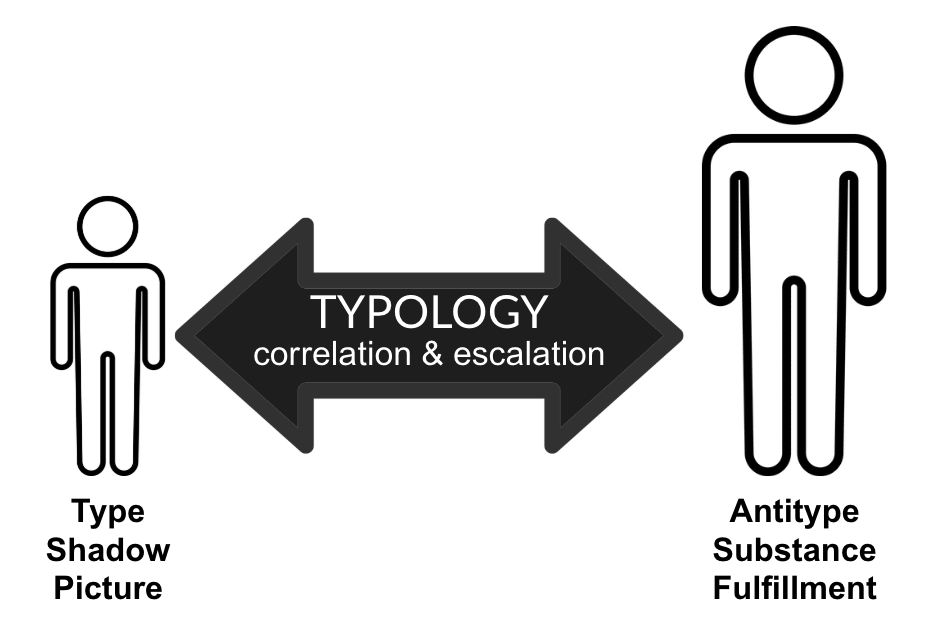
Figure 3
Therefore, when the main point includes a person, event, or institution pointing beyond itself in a particular way to Jesus the antitype, it is a type.28Insisting the type to be identified in the main point is a key guardrail to ensure legitimate Christ-connections. This is the one clarification I would include in James Hamilton’s already helpful explanation of typological interpretation. James M. Hamilton Jr., Typology: Understanding the Bible’s Promise-Shaped Patterns (Zondervan Academic, 2022), 26-27. See G. K. Beale, Handbook on the New Testament Use of the Old Testament (Baker Academic, 2012), 22. Clarify the specific correlation and escalation as you move from type to antitype.
Sample text: Ruth 4:1–12
Main point: Unlike Mr. No Name, Boaz willingly paid the cost to redeem the needy.
Christ connection: This passage presents Boaz as a type of the Christ to come. The correlation is the willingness to pay a high cost to redeem the needy. The escalation is Boaz paying with monetary goods to preserve the inheritance for the needy, though it will perish. But Jesus paid the cost with his life to establish an inheritance for the rebellious, which shall never perish. Boaz’s sacrifice was beautiful, and Ruth could trust Boaz would never turn her away after paying such a cost. But it is only a whisper compared to the beauty of Christ’s sacrifice. Why would we question his faithfulness after such a demonstration of love? Where do you doubt his loving care? Let Boaz point you to the greater Redeemer who will never leave or forsake you (Heb 13:5).
1.4. Summary
We covered a lot. Let’s summarize. To implement the Christ-centered hermeneutic, follow these steps.
Discern the Main Point
First, make observations that reveal the author’s emphasis (#1 Observations) by examining the context (historical, literary, grammatical), structure (arrangement), and tone of the passage. Do not look for connections to Jesus during this step.
Next, synthesize the author’s main point according to the original context (#2a Original Context Interpretation).
Ask the Main Point the Christ Connection Question
Now consider how the message fits within the whole Bible (#2 Whole Context Interpretation). Ask the appropriate Christ Connection Question:
When in the Old Testament: “What kind of a main point is this, such that it directs us to the Christ event?”
When in the Gospels: “What kind of a main point is this, such that it demonstrates Jesus is the climax of God’s story?”
When in Acts-Revelation: “What kind of main point is this, such that it unpacks the implications of the Christ event?”
Follow the Main Point Path to Jesus
Next, use the C-H-R-I-S-T acronym to discern the most organic path to Jesus. Determine which option best completes the statement:
The main point of this passage is…
- A Command (biblical ethic) that can only be fulfilled and empowered by Christ
- A Hope (promise) we only have real reason to rest in because of Christ
- A Recurring theme that eventually climaxes in Christ
- An Ill (problem) that can only be made right or resolved by Christ
- A Storyline reminder of the promised redemption to be accomplished by Christ
- A Type (person, event, or institution) that pictures the Christ and his work
After discovering the path, “work it out” according to the uniqueness of the passage (i.e., the specific command or specific theme, etc.), as briefly demonstrated above.
The final step is “#3 Application,” but that will be for another time. Instead, we move to a different crucial discussion.
2. Proof of Main-Point-Driven Methodology
We briefly consider an important question: Is the Main-Point-Driven methodology correct? Should this practice be promoted? The following are four reasons why the Christ-centered interpretation must be driven and controlled by the main point of the passage.
2.1. The Main-Point-Driven methodology honors the historical-grammatical hermeneutic.
This hermeneutic rightly teaches the biblical authors wrote with intentionality and our role as interpreters is to discern their main points, not ours (#2a Main Point Original Context). Therefore, we must discover how all the pieces of passages work together. Words and verses cannot be divorced from the surrounding grammar. Some phrases play a supporting role, while others play a primary role. This approach ensures the author’s “main thing” is our “main thing.” When we extend the textual boundaries to the whole biblical context, we must maintain these principles and not allow details which played a supporting role in the original context (#2a) to take a primary role in the larger context (#2b). For example, if a tree plays a minor role in a passage (unmentioned in #2a), it does not play a major role as pointing to the Christ who was hung on a tree (#2b). Instead, we must allow the author’s emphasis expressed in the main point to remain the emphasis as we consider the Christ connection.
2.2. The Main-Point-Driven methodology honors the intention of the Old Testament authors.
Peter declared,
The prophets who prophesied about the grace that was to be yours searched and inquired carefully, inquiring what person or time the Spirit of Christ in them was indicating when he predicted the sufferings of Christ and the subsequent glories. It was revealed to them that they were serving not themselves but you, in the things that have now been announced to you through those who preached the good news to you by the Holy Spirit sent from heaven, things into which angels long to look. (1 Pet 1:10–12)
Peter clarified the Old Testament authors held two convictions we must affirm to faithfully interpret their writings. The first is what many call sensus plenior (fuller meaning). The second is what Abner Chou calls “directionality.”
Sensus plenior emphasizes the intention of the divine Author and says the human author did not always know the full meaning of what he wrote. This is not problematic because the divine Author knew and would reveal it through a later human author. As Peter states, the prophets inquired for fuller understanding yet knew it would be revealed eventually.
It is important to recognize that the “fuller meaning” is not an entirely different meaning detached from the original human author. Rather, it is an extension of the original author’s point. Details and nuances of the original point were clarified and “filled in” as the divine author progressively revealed the full meaning through a later author (or authors). In other words, the divine author ensured the original and future human authors were harmonious, not contradictory.29D. A. Carson, “Matthew,” in Matthew, Mark, Luke, ed. Frank E. Gaebelein, vol. 8 of The Expositor’s Bible Commentary (Zondervan, 1984), 92–93; Douglas J. Moo and Andrew David Naselli, “The Problem of the New Testament’s Use of the Old Testament,” in The Enduring Authority of the Christian Scriptures, ed. D. A. Carson (Eerdmans, 2016), §3.8, 702–46.
Directionality is similar but emphasizes the human author’s intentions. It teaches that Old Testament authors intentionally directed the reader forward to look and long for the story’s consummation.30Abner Chou, The Hermeneutics of the Biblical Authors: Learning to Interpret Scripture from the Prophets and Apostles (Kregel Academic, 2018), 93-120; G. K. Beale, A New Testament Biblical Theology: The Unfolding of the Old Testament in the New (Baker Academic, 2011), 3-5. Every law, human hero, dark story, promise, and divine rescue points forward to resolution or full completion. The prophets knew they were not serving themselves, but their message would eventually be fulfilled (1 Pet 1:12). “Keep waiting; keep watching.”31Chou, The Hermeneutics of the Biblical Authors, 124, 93–120. Even more, they were highly skilled theologians and interpreters who intended future authors and audiences to develop or complete their original points, not with a “different” meaning but with an expanded understanding of the same meaning. In other words, if an Old Testament author read a future author’s expanded meaning of the original point, we would expect him to say, “Yes, I see that! It’s even better than I knew!” and not, “Wait, what? That has nothing to do with what I meant?” (see Figure 4).32Kevin DeYoung, “Can That Be Right? The New Testament’s Use of Old Testament Prophecy,” The Gospel Coalition, 8 December 2015, https://tinyurl.com/5uxwedvn.
Therefore, our Christ-centered interpretation must be driven by the main point of the author so that, if he listened to our interpretation, he would agree how it “filled in” his point.
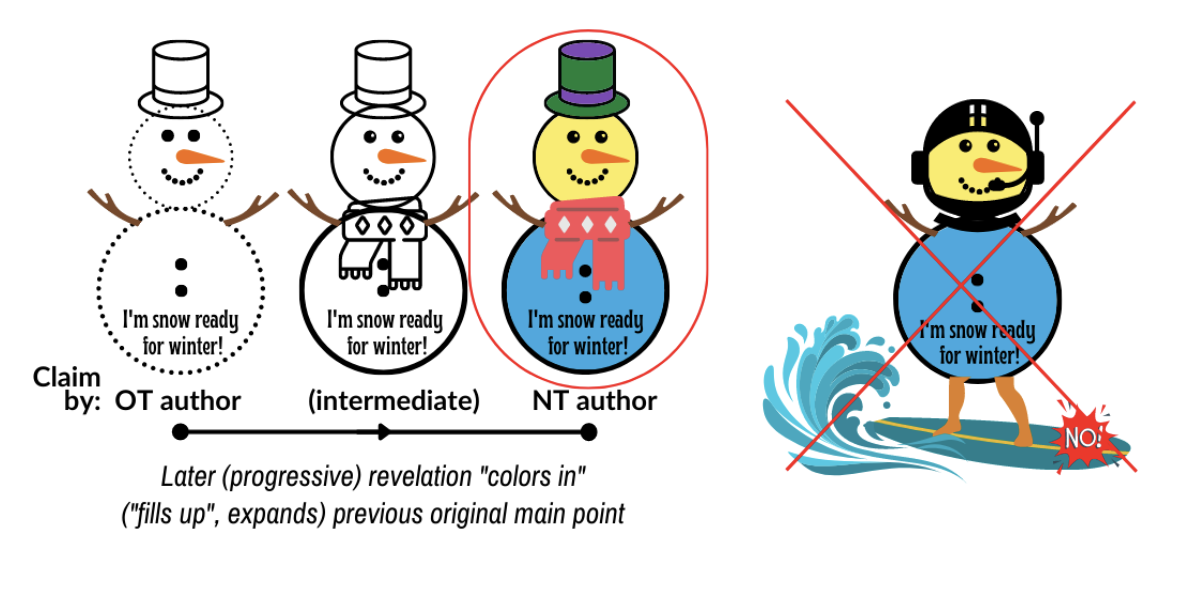
Figure 4
2.3. The Main-Point-Driven methodology follows the pattern of the New Testament usage of the Old Testament.
New Testament authors demonstrate a commitment to careful exegesis. They read the Old Testament authors within their original historical-grammatical context and allowed the main point to direct their New Testament hearts to the Christ event, just as outlined in this proposed methodology.33Multiple views exist regarding the New Testament use of the Old. See G. K. Beale, The Right Doctrine from the Wrong Texts? Essays on the Use of the Old Testament in the New (Baker, 1994) and Michael Vlach, How Does the New Testament Use the Old Testament? A Survey of the Major Views (Master’s Seminary Press, 2021). Admittedly, sometimes it is challenging to follow the logic of the New Testament author’s usage of the Old Testament. However, most passages are clear, and we are invited to replicate their hermeneutic.34G. K. Beale, “Did Jesus and His Followers Preach the Right Doctrine from the Wrong Texts? An Examination of the Presuppositions of Jesus’ and the Apostles’ Exegetical Method,” Themelios 14 (1989): 89–96. This requires distinguishing the various ways they used the Old Testament, of which G. K. Beale surveys at least twelve different uses.35Beale, Handbook on the New Testament Use of the Old Testament, 55–93. To simplify, understanding the following three uses increases clarity and confidence to handle the Old Testament like the New Testament authors.
A. To proclaim fulfillment of an Old Testament author’s main point, introduced using a “passage catch phrase.”
Imagine a loved one in the hospital severely injured. You lean in and ask her how she is doing. With short, painful breaths, she whispers, “When peace … like a river … attendeth … my way.” What does she mean? She did not answer your question. Except, she did, using a catch phrase from Horatio Spafford’s song, “It Is Well with My Soul.” This transports you not only to the line but to the message of the whole song. If you know the lyrics and story behind this hymn, you understand the point. While her circumstances are heart-breaking, her soul finds rest in the God of promise.
The biblical authors often employ this “passage catch phrase” tactic to draw our attention to the whole passage and main point of an Old Testament author.36C. H. Dodd, According to the Scriptures: The Sub-Structure of New Testament Theology (Nisbet, 1952), 132–33; Beale, Handbook on the New Testament Use of the Old Testament, 5. Without chapter and verse numbers, this could transport the audience to the whole passage of origin so they not only hear the Old Testament author’s main point but also see how the New Testament author “fills in” that main point. In other words, same sense with extended meaning, demonstrating how the Old Testament passage fits within the biblical storyline (i.e., he inserts the puzzle piece into the puzzle).
For example, Jesus’s cry from the cross, “My God, my God, why have you forsaken me” (Matt 27:46), transports us to Psalm 22. Hearing David’s main point of the whole psalm gives insight into Christ’s incredible faith on the cross.
Matthew’s claim that Joseph bringing baby Jesus out of Egypt fulfilled Hosea’s words, “Out of Egypt I called my son” (Hos 11:1; Matt 2:15), transports us to hear the main point of Hosea 11:1–11. Understanding Hosea’s point clarifies Matthew did not misread Hosea. Instead, Matthew declared the promised new exodus had arrived. Jesus was bringing the return to God Hosea spoke about, and the Lion was roaring for his cubs.
The examples abound and show us that the New Testament authors did not read verses out of context to squeeze Jesus in. Instead, they often implemented the main point-driven Christ-centered interpretation.
B. To illustrate the New Testament author’s point without interacting with the Old Testament author’s main point.
For this usage, rather than interpret the meaning of an Old Testament passage, the New Testament author used a person or event to illustrate his own argument to his audience.37Greidanus, Preaching Christ from the Old Testament, 234; Chou, The Hermeneutics of the Biblical Authors, 34. We do this. For example, if you made any of the following claims, Samson would be a good illustration:
- Fruitful ministry doesn’t always equal spiritual maturity.
- Painful consequences from our sin does not indicate God is finished with us.
- Nothing can prevent God from using his broken people to accomplish his mission.
None are a main point throughout the Samson narrative (Judges 14–16). However, Samson can be used to illustrate them without claiming that the Old Testament author made these claims. In the same way, New Testament authors sometimes used Old Testament accounts to illustrate their points.
For example, Samson is used to illustrate that God honors the smallest bits of faith (Heb 11:32). Paul used Sarah and Hagar to illustrate enslavement under Law versus freedom under Christ (Gal 4:21–5:6). James illustrated the relationship between faith and works by referring to Rahab (Jas 2:25).
We must not confuse the Old Testament being used as an illustration with interpretation of meaning, lest we conclude the New Testament authors read the Old Testament non-contextually.38Beale, “Did Jesus and His Followers Preach the Right Doctrine,” 89–96.
C. To announce the indirect fulfillment of an Old Testament pattern.
At times New Testament authors declared fulfillment of the Old Testament, but there is no stated promise corresponding to the fulfillment. This is legitimate because the Old Testament points forward to the Christ not only by direct promises but also by patterns.39Sometimes patterns are recurring themes and sometimes they are typology. When categorizing consider this principle: all types are patterns, but not all patterns are types. These historical situations paint a picture for what the Christ and his work would be like.40Beale, Handbook on the New Testament Use of the Old Testament, 57–66;R. T. France, “The Formula-Quotations of Matthew 2 and the Problem of Communication,” NTS 27 (1981): 233–51. In his book regarding typology, James Hamilton uses the helpful phrase, “Promise-shaped patterns.” Hamilton, Typology, 4.
For example, John said that Jesus’s unbroken bones fulfilled Exodus 12:46 and Numbers 9:12, though neither text states a promise (John 19:36). But they do command to not break the bones of Passover lambs. Therefore, as the ultimate Passover Lamb, Jesus’s bones were not broken.
Matthew claimed Jesus’s return to Nazareth as a child fulfilled the prophets, “That he would be called a Nazarene” (Matt 2:23), which no prophet specifically stated. But the pattern of God’s unimpressive rescuers, coming from forgotten places (i.e., Moses, Gideon, David), flows through the biblical storyline and is ultimately “filled up” in the coming of Christ.41Some may categorize this as typology, where Moses sets the pattern as the archetype, followed by Gideon and David being ectypes (Hamilton’s term), or semi-typological fulfillments (Beale’s phrase) of the antitype (Jesus) who eventually fulfills the pattern. Hamilton, Typology, 28, 35-51; Beale, Handbook of the New Testament Use of the Old Testament, 16. However, others may categorize the example as a recurring theme. But regardless of the label, as long as the main point is driving the Christ-centered interpretation, both decisions should yield the same flavor of application.
Remembering these three uses may clear up confusion. It is essential to understand that the Main-Point-Driven methodology follows the example of the New Testament authors.
We finish with a final reason to choose this methodology.
2.4. The Main Point-Driven methodology prevents all Christ connections from being similar.
This method ensures variety because it keeps with the emphasis of the biblical author. If the main point of the author commands us to forgive others or claims that God overturns the plans of the wicked for the advancement of his mission or promises that God hears the cries of his people, the Christ-centered interpretation keeps this emphasis as it is understood within the bigger picture. Therefore, this methodology prevents every Christ-centered interpretation from sounding the same.
More could be said. The point is that our pursuit of a faithful Christ-centered interpretation must be Main-Point-Driven, because this methodology honors the historical-grammatical hermeneutic, the Old and New Testament authors, and maintains variety according to the author’s emphasis.
All we have left to do is try it.
3. Practice of Main-Point-Driven Methodology
Using the main points below, practice the methodology by asking the appropriate Christ Connection Question. Then discern the path to Jesus, using the C-H-R-I-S-T acronym. Practice will illustrate the simplicity of the Main-Point-Driven methodology, along with suggested connections.42Answer options: 1=R; 2=S; 3=H, R; 4=C; 5=I, R; 6=C, H; 7=R; 8=R, T; 9=R, S; 10=H; R;
- Exodus 15:22–27 = God turns bitter water to sweet for his grumbling people, that they might know that he will be their Healer if they walk in his ways.
- Matthew 1:1–17 = Introducing Jesus the Christ, son of David, son of Abraham!
- Psalm 23 = I need not fear, for the Lord is my guiding shepherd, whose steadfast love chases me.
- 1 John 2:28–3:3 = Pursue righteousness according to who you are and what you will be.
- 1 Kings 9:1–11:43 = Israel began to decay when the king turned from the Lord, even when he was old and things were wonderful.
- Philippians 4:10–20 = Seek the secret of contentment and experience the joy of sacrificial living.
- Judges 14:1–15:20 = God orders the sinful ways of Samson to accomplish God’s mission of deliverance for Israel.
- Jonah 1:1–17 = God mercifully chases his rebellious prophet who gets thrown into the sea to save rebellious sailors.
- Mark 4:35–41 = Jesus of Nazareth has full authority over the wind and the seas.
- Nahum 1:1–3:19 = God’s jealousy for his people and his vengeance for the wicked shall be celebrated.
I hope you experience the Christ-centered interpretation as an enjoyable DIY project. With these tools you will find the Christ-connection can be organic, empowering, simple, and gloriously life-giving in and to the Lord.
Dan Allen
Dan Allen is Preaching and Teaching Pastor at CrossWay Community Church in Milwaukee, Wisconsin.
Other Articles in this Issue
LaMaster considers Elizabeth Castelli’s contention that Paul’s use of imitative language reinforces power in authority relationships...
Cameron Schweitzer argues that Drew Hunter’s earlier work on Jonathan Edwards’s understanding of typology is too narrowly christological...
This essay argues that evangelical retrieval of the Christian tradition finds a particularly fruitful interlocutor in Athanasius of Alexandria, whose “ruled readings” of Scripture and trinitarian exegesis model a canonically-coherent theological hermeneutic...
Wisdom and Folly in Laodicea: Revelation’s Message to the Laodiceans as Wisdom Discourse
by Joel MacInnesThis article examines Christ’s message to Laodicea as “wisdom discourse,” arguing that it employs “wisdom forms,” “allusions to wisdom literature,” and addresses “wisdom concerns...
The doctrines of grace found in Reformed soteriology are predicated upon an understanding of humanity’s total depravity stemming from original sin...
Other Reviews in this Issue