
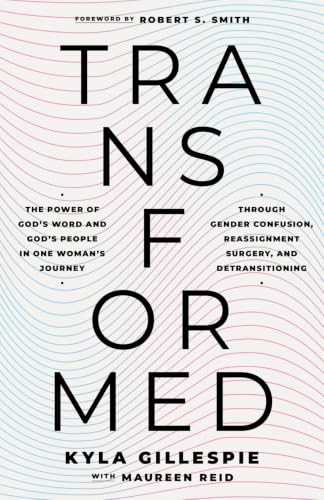
Transformed: The Power of God’s Word and God’s People in One Woman’s Journey through Gender Confusion, Reassignment Surgery, and De-Transitioning
Written by Kyla Gillespie (with Maureen Reid) Reviewed By Bryan PueIn Transformed, Kyla Gillespie recounts her dramatic journey through gender confusion, gender reassignment surgery, and eventual de-transitioning after encountering Christ and becoming grounded in the truth of Scripture. Combining memoir, testimony, and pastoral reflection, Gillespie traces the ways God used both his Word and his people to draw her toward redemption. Although the work is not intended as a scholarly treatment of gender dysphoria or Christian sexual ethics, Gillespie presents a compelling testimony that humanizes a frequently polarized cultural conversation while consistently pointing readers toward the hope of the gospel.
One of the book’s greatest strengths is its honesty. Gillespie writes with a humility and vulnerability that allows readers to enter into the emotional complexity of her story. She openly discusses the instability of her upbringing, fractured family relationships, struggles with identity, and longing for acceptance. Reflecting on the breakdown of her parents’ marriage when she was a child, she writes, “I couldn’t believe my ears. This was insane. The two people I looked up to the most were destroying our perfect family, right before my eyes. Panic raced in, and the blood rushed to my head” (p. 12). Such moments give the memoir emotional depth and help readers understand some of the personal pain that shaped her search for identity. Rather than presenting herself as a detached commentator on contemporary gender debates, Gillespie invites readers into the lived realities that shaped her thoughts and experiences.
The narrative structure strengthens the memoir’s impact. Gillespie traces the progression of her life, from childhood to adolescence to adulthood, showing how emotional wounds, relational struggles, and cultural influences shaped her understanding of her identity over time. Importantly, she does not portray her spiritual transformation as immediate or effortless. Instead, she candidly describes the internal conflict she experienced while wrestling with both her sexuality and the claims of Christ. At one point, as she describes the tension between surrendering to God and remaining in denial regarding his authority over her sexuality, she writes, “It was a tug-of-war, and I was caught in the middle” (p. 109). This honesty prevents the book from reading as simplistic or triumphalistic. Gillespie’s transformation was a gradual (and often painful) process marked by struggle, repentance, community, and growing dependence upon Christ.
Throughout the memoir, Gillespie consistently emphasizes the authority and sufficiency of Scripture. One particularly important passage appears near the conclusion of the book:
To really understand the truth of sex, sexuality, gender, and identity, we need to start from the beginning, from humanity’s inception. This means turning to the opening chapters of the Bible. For it is only from the inerrant, infallible, active, authoritative, living, and breathing Word of God that we are able to see who we are, how we were made, and why. (p. 183)
This theological conviction, while expressed later in the book, is actually the foundation of the entire work. Gillespie’s story is not ultimately presented as a celebration of personal self-discovery but as a testimony to God’s grace in reorienting her understanding of her true identity according to biblical truth.
Another significant strength of the book is its pastoral usefulness. Gillespie repeatedly demonstrates the importance of a loving Christian community in the process of spiritual restoration. Pastors, church leaders, parents, and friends are reminded that individuals wrestling with gender conflicts are image bearers deserving of compassion, patience, and truth. Particularly helpful are Gillespie’s reflections on the ways members of her church community walked alongside her with both conviction and grace. Describing the care shown by her church community, she notes that these brothers and sisters in Christ, “prayed for and figured out how to love me well and still speak the truth” while “navigating what could at any time become turbulent waters” (pp. 111–12). Reflections like these provide practical wisdom for those attempting to disciple the gender-conflicted in ways that are both faithful and compassionate.
The book’s style further enhances its impact. Gillespie writes in a vivid and engaging manner that keeps the narrative moving steadily forward. Its readability will make Transformed especially accessible for those who may feel intimidated by more academic discussions surrounding gender identity and Christian anthropology.
While Gillespie clearly communicates a high view of Scripture and an orthodox understanding of human identity and sexuality, her book contains relatively little interaction with the broader academic, psychological, or theological discussions surrounding transgender ideas and identities. Consequently, those looking for extensive exegetical argumentation, detailed engagement with revisionist perspectives, or interaction with contemporary scholarly literature will need to look elsewhere.
But given the book’s intended purpose and genre, this is hardly a weakness. Transformed is a biblically informed testimony, not an academic monograph. Gillespie is not attempting to provide a comprehensive psychological framework for understanding every aspect or variety of gender dysphoria, nor does she try to offer a detailed analysis of the contemporary debates surrounding sexuality and identity. Instead, she is offering a personal and powerful account of how the Lord met her in the midst of confusion and suffering, forgave her sins, changed her heart, and gave her back to herself.
As such, Transformed is a valuable and timely contribution to contemporary Christian discussions surrounding identity, sexuality, embodiment, and discipleship. Gillespie’s willingness to speak candidly about her regret, pain, turmoil, and redemption gives the book credibility. Importantly, the personal nature of the work helps us to avoid reducing individuals who experience gender dysphoria to political talking points or ideological categories.
Transformed will prove especially helpful for pastors, parents, counselors, and church members seeking to minister wisely to individuals wrestling with questions of gender identity. It may also serve as an encouraging testimony for Christians struggling with their own sense of identity and longing to understand their lives within the framework of God’s design. For all of us, Gillespie’s testimony provides an important perspective on an increasingly significant cultural conversation.
Ultimately, Transformed succeeds because it keeps the focus where Gillespie wants it to be—not on herself but on the redeeming grace of God in Jesus Christ. In a cultural moment often marked by confusion, anger, and polarization, Gillespie offers a deep and personal account shaped by conviction, humility, and hope. Her story stands as a reminder that the Christian response to those wrestling with gender and sexuality must always be marked by both biblical truth and Christlike compassion.
Bryan Pue
Bryan Pue, The Union Movement, Dewdney, British Columbia, Canada
Other Articles in this Issue
Main-Point-Driven: A Clear Methodology for Implementing the Christ-Centered Hermeneutic
by Dan AllenThis article addresses the need for a clear methodology for implementing the Christ-centered interpretation...
LaMaster considers Elizabeth Castelli’s contention that Paul’s use of imitative language reinforces power in authority relationships...
Cameron Schweitzer argues that Drew Hunter’s earlier work on Jonathan Edwards’s understanding of typology is too narrowly christological...
This essay argues that evangelical retrieval of the Christian tradition finds a particularly fruitful interlocutor in Athanasius of Alexandria, whose “ruled readings” of Scripture and trinitarian exegesis model a canonically-coherent theological hermeneutic...
Wisdom and Folly in Laodicea: Revelation’s Message to the Laodiceans as Wisdom Discourse
by Joel MacInnesThis article examines Christ’s message to Laodicea as “wisdom discourse,” arguing that it employs “wisdom forms,” “allusions to wisdom literature,” and addresses “wisdom concerns...
Other Reviews in this Issue