
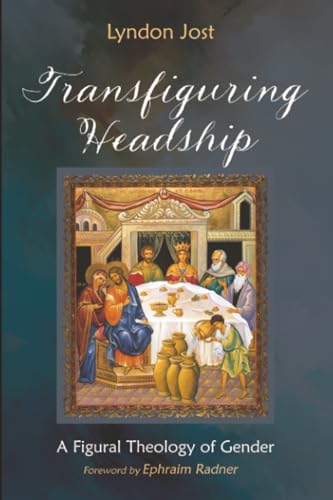
Transfiguring Headship: A Figural Theology of Gender
Written by Lyndon Jost Reviewed By Rachel GilsonThe evangelical conversation about gender and headship has long suffered from a peculiar inversion: the more heat a topic generates, the less precise its central terms tend to become. Lyndon Jost’s Transfiguring Headship: A Figural Theology of Gender is a serious attempt to reverse that tendency. He asks, with genuine philological and canonical care, what “head” (kephalē) actually meant before centuries of political and ecclesiastical contest remade it in their own image. The result is a theologically ambitious treatment that will reward careful readers, even in places where it might frustrate them.
Jost’s central contention is that headship in Scripture is neither primarily about authority nor about leadership, but about soteriological representation: “the head is the one in whom the salvation or damnation of the body are mediated” (p. 59). Christ is the interpretive center of both head and body, totus Christus; the gendered figures of male and female are to be understood only in relation to Christ. The man figures Christ the head; the woman figures Christ’s body, the church. Headship is not first a prescription about what men do so much as a declaration of what men signify: the man bears “representative responsibility” (p. 58) for the flourishing of the body to which he is joined, after the pattern of Christ’s self-giving relation to his church.
In six chapters, the book moves from historical and cultural analysis (the etymology of “headship” and its genealogy in Western history), through canonical exegesis (the soteriological function of heads in the Old Testament and the Pauline corpus), to a constructive figural theology of gender. Chapters three and four chart how male headship moved from social good to social evil. Drawing on the work of Ivan Illich, Jost argues that the rise of wage labor displaced the household as a site of shared production, reducing sexual difference to biology, and diminishing the perceived dignity of gendered vocations. Enlightenment dualisms and the elevation of paid labor, he argues in chapter 4, helped produce both an authority-heavy complementarianism and later feminist revisions.
The book’s most significant contributions come in its historical and exegetical sections. Jost’s etymological genealogy is genuinely illuminating. His demonstration that the English word “headship” was coined in early modern debates over whether pope, king, or Christ should be considered “head” of the church, and that this coinage encoded an authority-meaning foreign to the Hebrew rosh, is the kind of diachronic work that evangelical gender discussions rarely consider. His canonical reading of the Old Testament head-figure, tracing the pattern of corporate solidarity through Adam, Noah, Abraham, and Achan, builds a patient case that “head as soteriological representative” emerges from the inner logic of the canon itself. His exegesis of Ephesians 1:22–23 is particularly fine: the observation that Christ rules with his body over all things—rather than over his body—is not merely rhetorical; it captures something essential about the corporate character of Christ’s reign. Jost’s christological centering throughout displays an evangelical instinct well deployed. To read the head-figure through Christ, with Christ as both its referent and its fullest instantiation, is precisely the kind of canonical judgment that a figural theology demands.
Equally commendable is his constructive move regarding the woman as “glory”: in figuring Christ’s body, the woman represents not a diminished humanity but the paradigmatic form toward which all of Christ’s members are being perfected (p. 217). This reframes the question in a way that neither complementarianism nor egalitarianism has typically managed: not “how much authority does she have?” but “what does her particular creaturely form signify?”
These are real achievements, which make the book’s lacunae feel proportionately disappointing. The first concerns the exegetical foundations of Jost’s thesis. His entire constructive argument depends on establishing that kephale means “representative member” rather than “authority over.” He is right to press the distinction between lexical association and identity of meaning, but complementarian critics—Grudem most prominently—have mounted sustained challenges to precisely this reading, and Jost does not engage those challenges with sufficient directness. The historical argument about rosh is compelling; whether it settles the question of how Paul himself uses kephale in Ephesians and 1 Corinthians is a harder case. Readers who need that case made will find the exegetical work suggestive but not fully demonstrated.
The deeper problem is structural. There is a persistent conflation of the male-female relation in general with the husband-wife relation in particular. Jost’s figural logic (man as head, woman as body) is introduced as a claim about gendered humanity as such, and he invokes 1 Corinthians 11 (which he sees as being addressed to the assembled congregation, not to married couples) as evidence that the figures carry ecclesial weight. But whenever he cashes out the practical implications, he returns to the marriage pair. The unmarried woman, the unmarried man, and the congregation gathered for worship remain largely unaddressed. This is not a peripheral gap. If the figural logic is real, if men and women as such signify differently, not only as spouses, then the book must say something about what that signification means beyond marriage. That it does not is a noteworthy omission.
This conflation feeds directly into the book’s studied silence on ecclesial order and ordination. Jost’s conclusion gestures emphatically toward women’s full participation in the ministry of the church—“teaching, preaching, prophesying, discipleship” (p. 237)—and frames the inclination of male authority to “restrict and shut women down” (p. 235) as a betrayal of the figural logic of headship. But this raises an obvious question he declines to answer: does male headship, as he has defined it, generate any structural asymmetry in the governance of the church? Does the man’s role as figural head retain, in the assembly, some specific institutional expression, say, in the office of elder or overseer, or is the figural asymmetry exhausted by its marital instantiation? The two questions are connected: if headship is a gendered vocation that extends beyond marriage, there is at least a coherent case that it takes some form in the governance of the church body. If, however, it applies only within marriage, then the ecclesial question dissolves, but the figural framework Jost has built is narrower than he claims; it is not about gender more broadly but about husbands and wives particularly. He cannot have both a broad figural anthropology and remain silent on church order. The silence is not neutral. It will be read, by both complementarians and egalitarians, as evasion.
None of this should diminish the genuine achievement of Transfiguring Headship. Jost has written a book that takes Scripture seriously as a canonical whole centered in Christ, reads the head-figure with historical precision, and refuses the pinched alternatives that have dominated evangelical gender debates for a generation. He emphatically stands against both abusive male power and radical feminist readings, which both do violence to the Scriptures. That Jost ultimately declines to follow his own argument into the ecclesial realm where it is most urgently needed is a disappointment proportionate to its promise. Readers willing to press the questions Jost leaves open will find this volume an indispensable conversation partner.
Rachel Gilson
Southeastern Baptist Theological Seminary
Wake Forest, North Carolina, USA
Other Articles in this Issue
Main-Point-Driven: A Clear Methodology for Implementing the Christ-Centered Hermeneutic
by Dan AllenThis article addresses the need for a clear methodology for implementing the Christ-centered interpretation...
LaMaster considers Elizabeth Castelli’s contention that Paul’s use of imitative language reinforces power in authority relationships...
Cameron Schweitzer argues that Drew Hunter’s earlier work on Jonathan Edwards’s understanding of typology is too narrowly christological...
This essay argues that evangelical retrieval of the Christian tradition finds a particularly fruitful interlocutor in Athanasius of Alexandria, whose “ruled readings” of Scripture and trinitarian exegesis model a canonically-coherent theological hermeneutic...
Wisdom and Folly in Laodicea: Revelation’s Message to the Laodiceans as Wisdom Discourse
by Joel MacInnesThis article examines Christ’s message to Laodicea as “wisdom discourse,” arguing that it employs “wisdom forms,” “allusions to wisdom literature,” and addresses “wisdom concerns...
Other Reviews in this Issue