
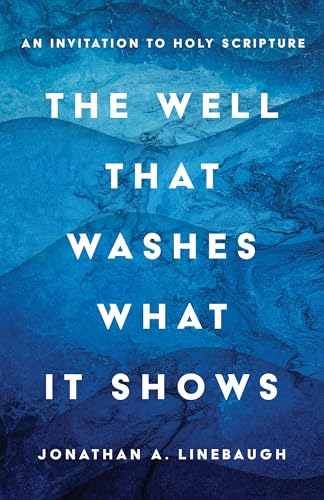
The Well That Washes What It Shows: An Invitation to Holy Scripture
Written by Jonathan A. Linebaugh Reviewed By Mark StephensWhile books abound on both the content and interpretation of Scripture, Jonathan Linebaugh’s The Well That Washes What It Shows is offering something different. The subtitle reveals its distinctive contribution: An Invitation to Holy Scripture. For all the books I have read on content and hermeneutics, precious few adopt the posture of invitation.
The opening chapter introduces the nature of Scripture. It is God’s personal address, possessing “living and creative power” (p. 1). Through it we encounter “the Father speaking in the power of the Holy Spirit to communicate and give the Son” (p. 8). The title of the book, drawn from a George Herbert poem, identifies the double work of Scripture as both showing our great need and then washing us clean. This two-beat rhythm persists through the entire book: Scripture diagnoses us and delivers us. Hence, the Bible is doing something to us, insofar as “to read the Bible … is to undergo the action of God, whose word creates and resurrects” (p. 11).
The main two subsections of the book are structured like a standard biblical survey, with each testament subdivided into three parts. For the Old Testament these are the Law, the Prophets, and the Writings. For the New Testament, they are the Gospels, Paul’s Letters, and then the remaining texts from Hebrews to Revelation.
In his chapter on the Law, Linebaugh speaks in terms of both promise and problem. On the one hand, the Torah is suffused with God’s grace, constantly offering life and forgiveness. On the other hand, the Torah wrestles with the reality of human rebellion; whether it is Adam in Eden or Israel redeemed from Egypt, people are “still the same” (p. 28). Thus, the fundamental question the Torah poses is whether disobedience and death will have the last word.
Chapter 2 surveys the Prophets, from Joshua through to Malachi. The opening sections rehearse basic data about the nature of prophecy (i.e., it is not simply foretelling), before providing a potted survey of Israel’s history and the prophets who spoke in various periods. This chapter develops what has already been asserted: the prophets speak words of both judgement and grace, diagnosis and deliverance. The most poignant moment in this section is Linebaugh’s reflections on Ezekiel’s “valley of dry bones” and the question his vision raises: Is God’s love able to raise disobedient humanity from the dead?
Chapter 3 engages the Writings, with a specific focus on the wisdom literature and the Psalms. The wisdom literature supplies us with diverse perspectives on both the goodness and the futility of life, which ultimately points hearers to put their hope in their Creator. The Psalms are portrayed as songs of both honesty and hope; they not only allow for the pouring out of one’s heart in pain and confusion, but also, in the words of Luther, offer “promises of Christ’s death and resurrection” (p. 62).
Chapter 4 sees the start of a new subsection, a tripartite approach to the New Testament. Linebaugh’s tome here sings with delight. The coming of Jesus is God’s “merciful surprise” (p. 67), and the Gospels are framed as texts that enable us to encounter this Jesus who “sets free, forgives, and gives life to those who are in bondage to sin and death” (p. 74). Crucially, the Gospels are understood as “preaching in the form of writing” (p. 72), because in each of them “Jesus is the gift given in the gospel” (p. 75).
Chapter 5 presents a compact survey of Paul’s letters, which is later supplemented by a chapter specifically on Romans. Paul’s pastoral writings speak words of grace and hope in Christ to address all human needs—not just the guilt of transgression, but our slavery to sin and our bondage to death. At this point Linebaugh adopts a new motif that he will carry to the end of his book: the “grace of God that is the crucified and risen Christ ‘for our sins’ cuts the chains that bind our being loved to our biography” (p. 105).
Chapter 6 seeks to survey Hebrews to Revelation but, for reasons of space, largely achieves this by discussing only Hebrews and Revelation. Nevertheless, each work is competently summarized and folded into the recurring themes Linebaugh has already established. Thus, the sermon to the Hebrews both warns and assures, simultaneously presenting Christ and exposing the “instability and hollowness” of all other hopes (p. 124). Revelation is shown not to be a riddle but an unveiling of the reality that in Christ God has acted, is acting, and will act to redeem his people from the forces of chaos and death.
Chapter 7 represents a third subsection of the book: a case study of Romans. For Linebaugh, Romans is the classic example of his overriding thesis that Scripture is a “living and active word that both reveals and redeems” (p. 125). Some of this chapter reads like a conventional New Testament introduction, including discussions of date and structure. At other times, the tone turns decidedly homiletic, reveling in the love of God, expressed in the cross, and poured into our hearts by the Spirit.
Chapter 8 draws the themes of the book together under the heading “Comfortable Words.” This captures well the way Linebaugh wants to frame the invitation of Scripture. The Bible is a summons to find life, not by avoiding our troubles, fears, and failures, but through finding that God speaks a word of resurrection hope at “the site of human need” (p. 167).
Linebaugh’s work admirably fulfils its stated goal. The language of “invitation” is precisely what this book achieves. There is a lyrical quality to the writing and an overriding tone of gladness at the goodness of God revealed in the gospel. In focusing our hearts and minds on what God is doing through Scripture, we are exhorted to see the Bible as an experience of searing vulnerability which ends not in despair but in sharing the joy of the God who justifies the ungodly and raises the dead. There is much here that will renew the weary disciple and guide the newborn novice.
At the same time, the book does evince a characteristic weakness. At times, seemingly adopting a Lutheran rather than a Reformed framework, the Old Testament tends to be treated as a foil to the New. The chapters on the Gospels and Romans are twice the size as that on the Torah. It is understandable in a work so brief that Linebaugh wants to assure the reader that the end goal is always to rest in the good news of Jesus. Nevertheless, giving more space to the New than to the Old too easily communicates that the point of Scripture is to flick forward to the end. I am certain this is not Linebaugh’s intention, but at the very least, the book could have offered one example of what it means to linger longer in the gracious words of the Old Testament.
This criticism aside, Linebaugh’s book would work well in a variety of settings, from the college classroom through to the church small group. Indeed, the text is eminently suitable to give to a ministry team or college faculty. For we all need reminding that Scripture is “alive and active” (Heb 4:12 NIV), a well that truly washes what it shows.
Mark Stephens
Sydney Missionary & Bible College
Croydon, New South Wales, Australia
Other Articles in this Issue
I first heard Don Carson speak in 1993 at Cornerstone Church, Nottingham...
A Better Priest and the Problem of Abiathar: Literary and Biblical-Theological Reflections on Mark 2:23–28
by Matthew EmadiI began my NSBT volume, The Royal Priest: Psalm 110 in Biblical Theology, with a quote from a sermon Don Carson preached, called “Getting Excited about Melchizedek...
Christianity brought two startlingly new ideas into the ancient world: the one God is Trinity, and God the Son became incarnate...
Key Questions Concerning the Book of Ecclesiastes: An Explanation of the Negative Views of Qohelet
by Richard P. Belcher Jr.I have two fond memories of meeting Dr. Carson...
Friends, Non-Israelites, and the Surprising Grace of God: A Grateful Retrospective on New Studies in Biblical Theology at 30
by Daniel C. TimmerIt is a joy and an honor to contribute to this special volume of Themelios dedicated to celebrating the thirtieth anniversary of New Studies in Biblical Theology...
Other Reviews in this Issue