
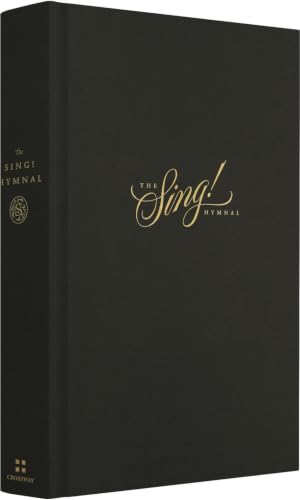
The Sing! Hymnal
Written by Keith Getty and Kristyn Getty, eds. Reviewed By Matthew WesterholmCan you solve this mystery? As I entered the choir room of an old church, I saw about fifty copies of the Baptist Hymnal (1991) neatly divided into stacks of five and equally spaced around the room on every windowsill. I was encouraged to think that this church still used hymnals, yet was also mystified: Why keep the hymnals on the windowsills?
Can you guess the answer? No, it wasn’t for the purpose of singing in the round. The hymnals were used to prop open the choir room windows.
In many churches, most people no longer remember the older use of their hymn books—providing the congregation with lyrics to be sung. This role became the job of, first, the overhead projector, then the LCD projector, and now (in more technologically adept churches) an LED wall with confidence monitors. New technology has brought churches many easy-to-see gains—lifted heads can sing more easily than heads face-down in a book, and new songs can be added at a moment’s notice. But while those gains are easily recognizable, it is more difficult to gauge what might have been lost.
So ubiquitous has been the demise of the church hymnal that, in 2025, when Crossway partnered with Keith and Kristin Getty to publish a new hymnal, it was an anomaly. Believers in the majority of churches that might use this hymnal would typically read the words on a screen and might continue to do so even if their church purchased cases of the Getty hymnal to keep in the book racks of their chairs or pews. In fact, when I attended a dedication service for the Sing! Hymnal, at which Crossway generously provided each attendee with a complimentary copy, some happily opened their new hymnals to sing. But during the corporate singing most of us lifted our eyes (and some of us our hands) while following the lyrics on the screens.
Nevertheless, informing a congregation of the next lyric has not been the only service hymnals have rendered Christians. Indeed, there are other uses where their true utility may come into its own. For many generations, they have served in domestic and academic contexts just as vibrantly as in churches (see Christopher Phillips’s The Hymnal: A Reading History [John Hopkins University Press, 2018]). The hymnal also provides a usable tool for smaller worshipping communities or those that are less equipped technologically: in chapels, nursing homes, small groups, or outdoor services.
The Getty hymnal features an admirable representation of historic hymnody—ancient hymns of Latin and Greek origin, Reformation hymns, as well as the best of revivalist songs. It also features an array of modern compositions, many written and published by the Gettys and their broader network of songwriters who prioritize congregational singability. The boundaries of this in-group are difficult to ascertain (N. B.: Getty Music has neither a denominational affiliation nor a doctrinal statement), but the loosely affiliated yet tightly aligned nature of this Getty Cinematic Universe creates the unique flavor of the hymnal.
How this hymnal presents these selections deserves some attention, so permit a brief discussion of page layout. A typical hymnal fits each work onto its own, single page. By contrast, the Sing! Hymnal presents the score more spaciously, sometimes overflowing the last line of a stanza across the top of a second of a two-page spread. This leaves much of the second, right-sided page (the “recto”) blank where another hymnal might insert a second, shorter hymn. But the Getty hymnal often fills that space with a combination of related Scripture readings, poems, prayers, and devotional quotations. For people expecting a similar layout to their other hymnals, the effect can be surprising. Here, the Sing! Hymnal takes up that neglected role of domestic and educational use. At its best, the interweaving of biblical passages and congregational hymns can invoke a rhythm of revelation and response. God’s word calls his people to worship, and his people employ a great hymn to respond in praise.
No attempt to assemble a definitive collection of hymns will please everyone, or perhaps anyone. Indeed, two criticisms might be levied against it. First, the hymnal has fewer compositions (497) than other recent examples by like-minded publishers—245 fewer than the Trinity Hymnal (1961/1990), and over 300 fewer than Lift Up Your Hearts (2013). In terms of size and scope, it is most similar to the 2015 collection from Master’s Seminary, Hymns of Grace.
Second, the selections themselves are curiously eclectic, although perhaps this is a fitting artifact for the amalgam that is Getty Music. Consider some seeming paradoxes: Getty Music spokespersons advocate for church-based ministry while representing a para-church organization. They decry performance-based aesthetics in worship during conferences held in the Grand Ole Opry. They bemoan spectacle while featuring high-energy (and well-executed!) Irish step dancing. So, it seems somehow fitting that a hymnal which champions congregational singing would conclude with nine pages devoted to Handel’s “Hallelujah Chorus” in the key of D. Congregational music proponents who argue for singable tessitura will be shocked to see high As in the soprano parts. My church choir sopranos might be able to hit that note, but that note will certainly hit back.
To my eye, it is best to understand the Sing! Hymnal not in the tradition of the major denominational hymnals of the recent century. Instead, it seems more accurate to consider it as a beautifully produced Getty songbook with two substantive additions: first, the addition of a broad selection of historic hymns, and second, a collection of devotional resources. Concerning those devotional resources, Crossway has recently released an expanding lineup of high-quality aesthetic devotionals (e.g., Jonathan Gibson’s liturgies for daily worship) designed to deepen personal and family worship. These devotionals utilize historical creeds, confessions, and structured Bible readings. The Sing! Hymnal sits well within this genre.
Understood from this perspective, and noting how hymnals have largely fallen out of use, the Sing! Hymnal is an achievement in remediation. With its beautiful design, its fabulous indexes, and its hymn stories, the Gettys have labored to ensure that this hymnal will provide Christian homes and smaller worshiping communities with a valuable tool; one that people can actually use.
Keith Getty is an immensely gifted brother in Christ—a fabulous musician and songwriter, as well as a sensible organizer and ministry leader. But perhaps his gift that most benefits the body of Christ is that of a convener. As populist and consumer winds increasingly shape the larger marketplace of contemporary worship, Getty Music has carved out a niche exulting in conservative theology and Christian discernment. Ministries like this (conservative and discerning) are often characterized by rigid standards and few, albeit fervent, members. In a unique way, the Gettys have used their gifts to gather a discerning community that is not narrowly parochial. They have forged a movement. There are too few ministries like Getty Music—clearly and convictionally pursuing kingdom purposes while irenically and joyfully forging kingdom partnerships.
So, may the Lord use the Sing! Hymnal—not to prop open the windows of old choir rooms but to open the very windows of heaven on our churches (cf. Mal 3:10) so that he may pour down much needed blessing upon us for his glory.
Matthew Westerholm
Matthew Westerholm
Bethlehem College & Seminary
Minneapolis, Minnesota, USA
Other Articles in this Issue
Main-Point-Driven: A Clear Methodology for Implementing the Christ-Centered Hermeneutic
by Dan AllenThis article addresses the need for a clear methodology for implementing the Christ-centered interpretation...
LaMaster considers Elizabeth Castelli’s contention that Paul’s use of imitative language reinforces power in authority relationships...
Cameron Schweitzer argues that Drew Hunter’s earlier work on Jonathan Edwards’s understanding of typology is too narrowly christological...
This essay argues that evangelical retrieval of the Christian tradition finds a particularly fruitful interlocutor in Athanasius of Alexandria, whose “ruled readings” of Scripture and trinitarian exegesis model a canonically-coherent theological hermeneutic...
Wisdom and Folly in Laodicea: Revelation’s Message to the Laodiceans as Wisdom Discourse
by Joel MacInnesThis article examines Christ’s message to Laodicea as “wisdom discourse,” arguing that it employs “wisdom forms,” “allusions to wisdom literature,” and addresses “wisdom concerns...
Other Reviews in this Issue