
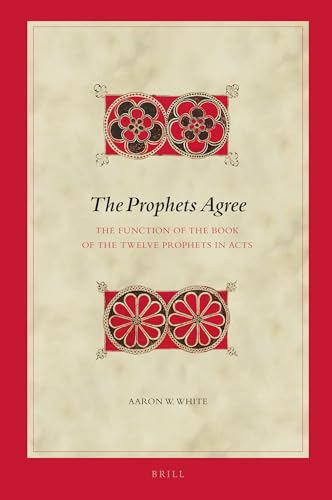
The Prophets Agree: The Function of the Book of the Twelve Prophets in Acts
Written by Aaron W. White Reviewed By W. Edward GlennyThis volume is a revised version of White’s 2017 PhD dissertation, written under the supervision of John Nolland at Trinity College, Bristol. In developing the topic, White focuses on the four quotations in Acts from the Book-of-the-Twelve-Prophets (TP): Joel 3:1–5 [2:28–32 MT] in Acts 2:17-21; Amos 5:25–27 in Acts 7:42b–43; Habakkuk 1:5 in Acts 13:41; and Amos 9:11–12 in Acts 15:16–18a. All four of these quotations are from the Greek Old Testament, and each is used at a significant turning point in the narrative of Acts chapters 1–15. Based on the references to the TP in Acts (called “book of the prophets,” 7:42; “the words of the prophets,” 15:16) and in keeping with the current consensus of prophet scholars, White understands the TP to be a literary unity, and for him this unity is “formed around the theme of the day of the Lord” (p. 41).
From the beginning he clarifies that his aim is “to show that Luke’s use of the TP is instrumental in reflecting the early church’s view of the universal lordship of Jesus, the Messiah, as it developed from Pentecost to the Jerusalem Council” (p. 2). Thus, the main theme of the TPs is developed in Acts by Luke’s use of the quotations from the TPs to show that Jesus is the Lord who ushers in the Day of the Lord prophesied in the TPs.
The book has four main chapters with an introduction and conclusion. In the introduction White builds his case for the study, surveys previous related works, and explains the process he will follow. He is especially influenced by the “three-way dialectic” of Francis Watson (Paul and the Hermeneutics of Faith, 2nd ed. [T&T Clark, 2016]), which for Watson involved Paul, the Jewish Scriptures, and an early Jewish interlocutor. For White it involves Luke, the Greek text of the TPs, and an early Jewish text using the same TP text. (Interestingly each of the TP texts quoted in Acts is used one time elsewhere in early Jewish literature.) For Watson, Paul is a “reader” of Scripture who knows it well “and is actively engaged in the process of interpreting its meaning into a new context” (White, pp. 30–31). However, White follows others who are concerned about Watson’s reticence to claim one voice as correct over the others, and his goal in the three-way conversation in his dissertation is to understand the construal of the normative text (LXX–PT) in Acts (pp. 34–35).
In chapter 1, the third interlocutor in White’s study of Joel 3:1–5 [2:28–32 MT] in Acts 2:17-21 is theTestament of Judah [T. Jud.] 24, a passage that appropriates terms and themes from LXX-Joel 3:1–5 at four points and supports the eschatological prophecy from Joel with allusions to prophecies about David’s line from Isaiah 11. As a result, the prophecy in T. Jud. 24 is strictly future (as Joel) and messianic. By contrast, the use of Joel in Acts 2, which is interpreted in view of Jesus’s death/resurrection/ascension, involves a present and future fulfillment of Joel. Furthermore, the messianic element in T. Jud.’s use of Joel combined with Isaiah 11 is not part of the fulfillment of Joel in Acts 2, but in the Acts 2 context messianic fulfillment is based on the use of Psalms in that context (Ps 16 in 2:25–28 and Ps 110 in 2:34). For White, the emphasis of the use of Joel in Acts 2 is the lordship of Jesus. One could quibble with White about this emphasis in Acts 2 rather than a focus on Jesus as both “Lord and Christ” (Acts 2:36) since the pouring out of the Spirit in Joel 3 is the work of the Spirit-anointed Messiah in Acts 2. However, White’s point is that the emphasis on Jesus as messiah comes from the Psalms quotations while the Joel 3 passage emphasizes his lordship, and Luke is using Joel to indicate that Jesus is the Lord who is inaugurating the last days, i.e., the “day of the Lord.”
In chapter 2, White analyzes the use of LXX-Amos 5:25–27 in Acts 7:42–43, and the third speaker he interacts with is the Damascus Document (CD-A 7:13–8:1). He argues that Amos 5:25–27 functions typologically in Acts 7 as a hermeneutical lens that draws together two eras of Israel’s history, revealing a pattern of idolatrous and sinful behavior in Israel that extends into Luke’s/Stephen’s day (p. 103). In contrast, the use of Amos 5:25–27 in CD-A is midrashic, employing gezerah shawah to turn the judgment in Amos 5 into a message of hope, based on the experience of the Qumran sect: the sect truly possesses the law, and its members are sent away from the Temple into exile by those who despise the law. Both interpretations of Amos 5 are eschatological and contemporize the text for their audiences, describing a schism involving the Temple, but the application to the communities is very different.
In chapter 3, White addresses the use of LXX-Habakkuk 1:5 in Acts 13, which describes God’s work through a foreign nation and is appropriated by Luke to describe God’s astonishing work among gentiles bringing them as gentiles into his own people under the lordship of Christ and not under the Law of Moses. Thus, the passage connects the emphasis on the lordship of Christ in Acts 2 and the confirmation of the salvation of gentiles as gentiles in Acts 15. The pesher of Habakkuk (4Q Florilegium Frgs. 1–2) applies the text to the Qumran sect’s situation, using the text to describe the eschatological conflict the Teacher of Righteousness and his covenant-keeping followers have with the Traitors. God will judge the Traitors (wicked priests and false prophets) by the Kittim (the Romans). As in Acts, God’s “work” and the astonishment concerning it involves gentiles, but the two authors’ uses of Habakkuk are different, applying the text to their unique situations.
The final quotation from TP in Acts (LXX-Amos 9:11–12 in Acts 15:16–18a, using 4Q Florilegium Frgs. 1–2 and 21,1 as interlocutor) is the topic of chapter 4, and it concerns the conditions for the entrance of gentiles into the people of God. In Acts 15 the LXX of Amos is fulfilled in the Christ events, and for White the “tent” of David that is rebuilt and restored is the church, the people of God in this age, which consists of Jews and gentiles (who are able to come to God as gentiles). These believers in Jesus make up the eschatological people of God under the lordship of Christ and their salvation fulfills Acts 1:8 and 2:39. In contrast the use of Amos 9 in 4Q Florilegium points to a future fulfillment limited to members of the sect.
In addition to the bibliography, the book has a brief appendix containing the texts of the early Jewish works discussed in chapters 2–4, as well as Indices of Sources, Authors, and Subjects. This book is recommended for those doing research in the use of the OT in the NT, especially in Acts. It also contains many insights into the theology and development of the argument of Acts.
W. Edward Glenny
Ed Glenny is professor of New Testament and Greek at the University of Northwestern—St. Paul, in St. Paul, Minnesota.
Other Articles in this Issue
Main-Point-Driven: A Clear Methodology for Implementing the Christ-Centered Hermeneutic
by Dan AllenThis article addresses the need for a clear methodology for implementing the Christ-centered interpretation...
LaMaster considers Elizabeth Castelli’s contention that Paul’s use of imitative language reinforces power in authority relationships...
Cameron Schweitzer argues that Drew Hunter’s earlier work on Jonathan Edwards’s understanding of typology is too narrowly christological...
This essay argues that evangelical retrieval of the Christian tradition finds a particularly fruitful interlocutor in Athanasius of Alexandria, whose “ruled readings” of Scripture and trinitarian exegesis model a canonically-coherent theological hermeneutic...
Wisdom and Folly in Laodicea: Revelation’s Message to the Laodiceans as Wisdom Discourse
by Joel MacInnesThis article examines Christ’s message to Laodicea as “wisdom discourse,” arguing that it employs “wisdom forms,” “allusions to wisdom literature,” and addresses “wisdom concerns...
Other Reviews in this Issue