
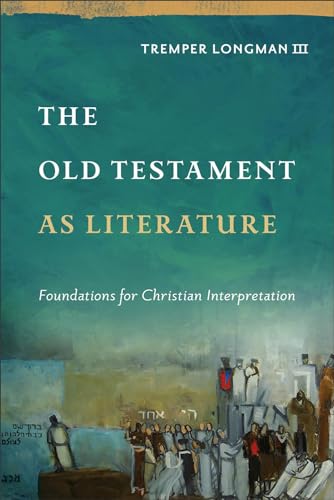
The Old Testament as Literature: Foundations for Christian Interpretation
Written by Tremper Longman III Reviewed By Brett M. JohnsonThe Old Testament as Literature is the first book of a three-part series called “Approaching the Old Testament” in which Longman seeks to “offer my best thinking at the twilight of my career” (p. ix). This book centers on the OT as literature, and two future volumes will focus on historical and theological perspectives of the OT. Longman’s book is broken up into three parts: Part 1 (chs. 1–6) presents the methodology of reading narrative and poetic texts; parts 2 and 3 apply the literary approach of part 1 to narrative texts in the Torah and Former Prophets (chs. 7–8) and to poetic texts from the Psalms, Wisdom Literature, Prophets, and Epic Poetry (chs. 9–11). In this review I will overview and analyze the highpoints of Longman’s methodology in part 1 and provide two examples from parts 2 and 3 to show the fruit of his literary approach.
In chapter 1, Longman analyzes the text’s meaning. Since the goal of this specific volume is not to discern the history behind the text or the theological implications of the text, Longman posits that the goal of the reader is to discover the meaning of a text as intended by the author(s) of the final form of the text (pp. 8–9).
Chapters 2 and 3 present a history of interpretation in OT as literature and OT genre. Longman begins with the historical-critical method followed by more text-centered approaches (especially the work of Robert Altar). Longman also shows the shortfalls of Gunkel’s view of genre and its function within literature, and he presents genre as a more flexible writing tradition that an author consciously or unconsciously writes within (p. 50).
Chapter 4 explores the characteristics of the narrative genre that contribute to a text’s “aesthetic quality” (p. 64). The first discussion focuses on the narrator, whom Longman differentiates from the author. While the author is the creator of the text, the narrator is a literary device by which an author “controls the (re)presentations of events” (p. 67). This distinction moves the discussion away from historical perspectives on authorship (which is to come in a future volume) to analyses of the literary features of the text. Along with the narrator, Longman illuminates other elements of narrative, including focalization, plot, characterization, setting, time, and dialogue.
Chapter 5 investigates poetry and its defining features as a genre. One specific feature of Hebrew poetry examined in the chapter is parallelism. He, like most scholars, moves away from Lowth’s understanding of parallelism and meter and agrees with Kugel, who sees the relationship of the A & B lines as “A, what’s more, B” (p. 112). This understanding may solve the problem caused by the Lowthian categories, but its simplicity can miss the forest for the trees. For example, the discussion of parallelism mainly examines line pairs or triads, while leaving analyses of larger sections of poems unexamined (see pp. 113–22). While line pair relationships are important, overvaluing parallelism has the possibility of pulling line pairs/triads away from their broader context within the poem. Longman also surveys other features of poetry, such as terseness, imagery, metaphor, simile, metonymy and synecdoche, personification, hyperbole, refrain, structural patterns, soundplay, and voice.
Chapter 6 focuses on intertextuality through Richard Hays’s widely held criteria of interpreting intertextual relationships within Scripture. Longman provides inner-biblical allusions within the OT, followed by NT use of the OT, and he concludes the chapter by disarming the narrative approach to the Psalms. Although I agree with Longman, the discussion seemed out of place in the chapter and took space that could have been used for other methodological approaches in the developing field of intertextuality.
I would next like to analyze two of the case studies to show how the methodology gives insight into real biblical examples. First, Longman seeks to solve the seemingly morally ambiguous actions of the midwives in Exodus 1. Should the midwives be allowed to lie to Pharaoh to keep the baby boys alive? In his methodology concerning narrative genre, Longman notes that “the Hebrew narrator is often reticent to provide a moral evaluation of a character’s actions in a story” (p. 83), but they will instead give implicit narrative details throughout the remainder of the narrative that show whether the action was moral. In Exodus 1, a close reading of the story helps Longman conclude that “rather than tell, the narrator shows readers that the midwives’ lie has God’s approval” (p. 198). Longman’s method in part 1 gives clarity to a morally ambiguous passage in Exodus 1, and it gives tools to the reader who will encounter similar situations throughout the OT.
The second case study is Deborah’s Song analyzed in part 3. Specifically, I would like to point out the final verse: “At her feet he sank, he fell; there he lay. At her feet he sank, he fell; where he sank, there he fell—dead” (Judg 5:27, NIV). In part 1, Longman explains how authors can use hyperbole to emphasize a point through exaggeration, and interpreting the hyperbole’s function can save the reader from “interpretive and theological errors” (p. 146). Longman notes the difference between Sisera’s death here and in Judges 4:21–22 (the narrative depiction) and discerns that “the hyperbolic imagery appearing in the poem … is simply intended to heighten the dramatic effect of Sisera’s downfall” (p. 264). Even though the poem and the narrative are “different,” Longman’s methodology for reading poetry helps the reader see the varying literary goals of narrative and poetry at work in the hyperbolic depiction of Sisera’s death.
In conclusion, while this book is not breaking new ground in OT scholarship, it does provide thoughtful tools picked up through Longman’s career and applies them to biblical examples. For the student or pastor desiring to gain practical tools in their literary toolbelt, I recommend this new one-stop shop for literary readings of the OT.
Brett M. Johnson
Brett M. Johnson serves at New Orleans Baptist Theological Seminary, New Orleans, Louisiana.
Other Articles in this Issue
Main-Point-Driven: A Clear Methodology for Implementing the Christ-Centered Hermeneutic
by Dan AllenThis article addresses the need for a clear methodology for implementing the Christ-centered interpretation...
LaMaster considers Elizabeth Castelli’s contention that Paul’s use of imitative language reinforces power in authority relationships...
Cameron Schweitzer argues that Drew Hunter’s earlier work on Jonathan Edwards’s understanding of typology is too narrowly christological...
This essay argues that evangelical retrieval of the Christian tradition finds a particularly fruitful interlocutor in Athanasius of Alexandria, whose “ruled readings” of Scripture and trinitarian exegesis model a canonically-coherent theological hermeneutic...
Wisdom and Folly in Laodicea: Revelation’s Message to the Laodiceans as Wisdom Discourse
by Joel MacInnesThis article examines Christ’s message to Laodicea as “wisdom discourse,” arguing that it employs “wisdom forms,” “allusions to wisdom literature,” and addresses “wisdom concerns...
Other Reviews in this Issue