
The Last Romantic: C. S. Lewis, English Literature, and Modern Theology
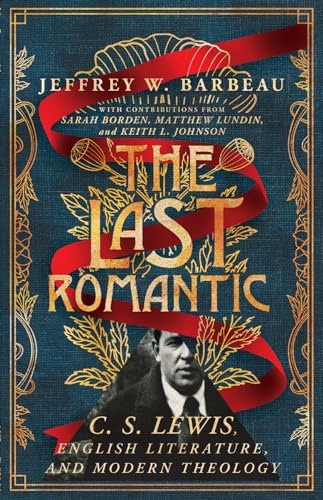
Written by Jeffrey W. Barbeau Reviewed By Blake McKinneyFew authors have displayed the breadth of Christian imagination like C. S. Lewis. From his creative world-building, like Narnia and Perelandra, to his compelling argumentation in Mere Christianity, to the moving imagery of The Great Divorce, Lewis has captured his readers’ attention and pointed them further up and further in. Scholarship on the life and writings of Lewis has blossomed in recent years, and Jeffrey Barbeau’s The Last Romantic: C. S. Lewis, English Literature, and Modern Theology contributes to our understanding of Lewis. Barbeau has published works on British Romanticism, Methodism, and English Romantic-era religion. He brings his areas of expertise to bear in this work that explores the impact of British Romanticism on C. S. Lewis. The Last Romantic is the eighth volume in IVP’s Hansen Lectureship Series that publishes books based on lectures at the Marion E. Wade Center at Wheaton College.
This book features three chapters drawn from the lectures: “C. S. Lewis and the ‘Romantic Heresy,’” “C. S. Lewis and the Anxiety of Memory,” and “C. S. Lewis and the Sacramental Imagination.” Each chapter features a response from a Wheaton faculty member, including Sarah Borden, Matthew Lundin, and Keith L. Johnson. Barbeau interacts with his respondents in the conclusion. This book also features never-before-published poetry by C. S. Lewis, discovered in the marginalia of Lewis’s personal library held in the Wade Center.
Barbeau opens chapter 1 with an intriguing discussion of a debate between Wheaton faculty members in the 1960s published in the Wheaton Faculty Bulletin concerning aesthetics, Romanticism, and C. S. Lewis. Readers may read Barbeau’s account for the details, but the crux of the debate was concern about “the Romantic trend in religion” represented by C. S. Lewis (p. 23). Barbeau then launches his analysis of the impact of British Romanticism on Lewis’s personal appeals in Mere Christianity and The Abolition of Man. He identifies William Wordsworth and Samuel Taylor Coleridge as the two Romantic writers with the most impact on Lewis.
Intellectual influence is a tricky thing to prove. Authors can cite and interact with the work of thinkers, but how can one prove that one thinker truly influenced another? Barbeau does not argue from citations and allusions alone. Rather, he demonstrates C. S. Lewis’s engagement with Romantic writers and the development of his thought through analysis of marginalia in books from Lewis’s personal library. Of special interest is Barbeau’s discussion of Romantic themes in The Abolition of Man, paired with an analysis of Lewis’s marginalia in his copy of Alec King and Martin Ketley’s The Control of Language—the book Lewis called “the Green Book” in his denunciations in The Abolition of Man.
In his second chapter, Barbeau compares Lewis’s autobiographical works with Romantic-era spiritual autobiographies. He contrasts Lewis’s Surprised by Joy and A Grief Observed with an unpublished diary of a young woman from the mid-nineteenth century, as well as the published autobiographical work of John Wesley. The connection between Lewis’s autobiographical works and John Wesley’s Journal would seem arbitrary if not for more of Lewis’s marginalia. Barbeau shows that Lewis’s marginalia prove that he read Wesley’s Journal shortly after his wife’s death and during the time he wrote A Grief Observed (p. 78). Barbeau’s analysis of the constructed nature of A Grief Observed in the vein of Wesley’s selectively edited Journal is compelling. Barbeau argues well that Lewis’s autobiographical works should be read as intentional, edited publications like Wesley’s rather than as diaries. This chapter also features a noteworthy addition to debates in scholarship on Lewis. Biographers of Lewis debate the veracity of Lewis’s timeline of his conversion. Barbeau introduces new evidence by means of tracing Lewis’s correspondence with Owen Barfield and Bede Griffiths, discussing the writings of Samuel Taylor Coleridge. He pairs this correspondence with Lewis’s concurrent marginalia that support Lewis’s account of events in 1929.
Barbeau’s final chapter considers “the legacy of the Romantic ‘symbol’ as the key to understanding Lewis’s effort to negotiate personal experience” (p. 112). He examines the tendency towards nature worship in British Romanticism and Lewis’s rejection of it in The Four Loves. He traces Lewis’s engagement in The Great Divorce with the human propensity to replace love for the Creator with love for part of the creation. He demonstrates Lewis’s engagement with William Blake and Coleridge in The Great Divorce. He then focuses his analysis on a lesser-known essay of Lewis’s, “Transposition.” Barbeau argues that Lewis’s use of symbol approaches something richer than the term “symbol” conveys. He calls it Lewis’s “sacramental imagination.” He concludes, “For Lewis, as with Coleridge, narrative participates in the real sacramentally” (p. 139). He closes with a commendation of Lewis’s common emphasis on the personal, not as a turn to groundless subjectivity but to demonstrate “that human imagination may point to higher realities than we recognize by sensory knowledge alone” (p. 144).
Jeffrey Barbeau has expanded our knowledge about the life and work of C. S. Lewis. His writing is engaging, and his subject is interesting. His careful analysis of Lewis’s marginalia suggests many further lines of research for Lewis researchers. His careful engagement with Lewis’s writings leaves the reader wanting to return to Lewis’s works to feel the weight of glory and to journey further up and further in by means of Christian imagination.
Blake McKinney
Texas Baptist College
Fort Worth, Texas, USA
Other Reviews in this Issue