
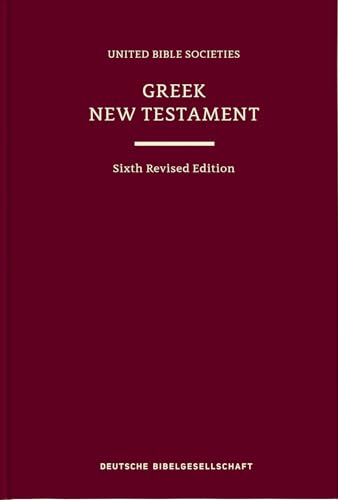
The Greek New Testament, 6th Revised Edition
Written by United Bible Societies Reviewed By Peter J. GurryFirst published in 1966, the UBS Greek New Testament hits its 60th birthday this year. It has long been the preferred hand edition for its intended audience of translators, students, and pastors. The arrival of this new, sixth edition is a major publishing event, especially as it is accompanied by a completely new textual commentary (reviewed separately). So much has changed with this edition that it can fairly be called the most significant update to the UBS edition in fifty years (when the third edition was first linked with the Nestle-Aland). By way of review, we can highlight the salient changes under the following headings: editors, format, text, and apparatus.
The largest change is not to the edition itself but to the team that is responsible for it. From the beginning, a distinguishing feature of the UBS Greek New Testament has been that its text is the product of a committee rather than an individual. The committee was originally designed to be widely representative of North American and European scholarship and is still aimed at reflecting “a consensus view of the current state of scholarship” (p. 4). Confessionally, its members eventually encompassed all three historic branches of Christianity (though the project has always been spearheaded and funded by Protestant Bible societies). That committee has changed somewhat over the years, with members added and removed, but by the time the UBS5 was published in 2014, all five of the listed editors had either passed away or were retired. This left some of us wondering about the committee’s future. However, the Preface to this edition explains that a new one was already formed in 2011. It consists of Hugh Houghton, Christos Karakolis, David Parker, Holger Strutwolf, David Trobisch, and Klaus Wachtel (Stephen Pisano was a member but passed away in 2019). To the best of my knowledge, this represents members from Protestant (Anglican and Lutheran), Eastern Orthodox, and Roman Catholic churches. The new committee was tasked with revising the edition, including which variation units to include and which witnesses to cite, but they did not, as explained below, make any new textual decisions. They did, however, reevaluate and reassign the popular letter grades (A to D), despite admitting they have misgivings about the whole system (p. 13). The result is somewhat awkward in that the reader is given this committee’s level of certainty about someone else’s textual decisions. Overall, the revisions led to 269 A-ratings, 447 B-ratings, 235 C-ratings, just 17 D-ratings, and 48 diamond readings (explained below).
Moving to formatting, the most obvious change is that the entire edition has been re-typeset using Minion font. The result is very pleasant and, along with other changes mentioned below, makes the whole page more inviting to this reviewer’s eye. The physical size is comparable to the previous edition. This is achieved, despite slightly thicker pages (reducing bleed-through) and a thicker cover, because the number of pages is reduced from 990 to just under 700. Much of that is due to a reduced apparatus (see below), but the preface, introduction, and appendices are also shorter. The paragraphing and section headings are largely unchanged, but poetic formatting now follows the Nestle-Aland for the first time (see, e.g., Col 1:15–20; Titus 3:4–7; Heb 1:3–4). Sadly, the four beautifully detailed color maps of the ancient world have been replaced by two smaller, more basic black-and-white versions. Old Testament quotations are now marked with italics instead of bold type with some updates to what is marked as such (e.g., Mark 13:24–25 is now treated as a quotation). Much more substantial is the change to the cross-referencing system itself, which has moved from the bottom of the page to the outer margins and now only marks Old Testament quotations (which are still indexed). Gone completely is any reference to non-biblical citations (e.g., 1 Enoch 1:9 in Jude 14–15), biblical allusions (e.g., Ps 2:7 in Matt 3:17), and literary parallels (Epimenides in Titus 1:12). The resulting index of Old Testament quotations is a mere six pages. But the most significant format change—if it can be called that—is also the one I expect to cause the most angst among the intended audience: the order of books now reflects Greek manuscript tradition with the Catholic Letters following Acts and Hebrews sandwiched between 2 Thessalonians and 1 Timothy. Though it may seem novel, the same order can be found in nineteenth-century editions like Westcott and Hort and even in the late twentieth-century edition of Robinson and Pierpont.
Of course, in any new edition the big question is always: where has the text changed? Like its predecessor, the UBS6 has adopted the editorial decisions of the much larger Editio Critica Maior (ECM) where available. In the UBS5, that meant only the Catholic Letters, but here it expands to include Mark, Acts, and Revelation. Everywhere else, the text remains as before and thus reflects the text of the UBS3 from 1975. In all, 165 changes were introduced in the newly updated books, and these are listed conveniently in an appendix (33 in Mark, 52 in Acts, 80 in Revelation). None of these, it must be kept in mind, is the decision of the UBS committee itself, but of the different ECM editorial teams (though a few UBS members are also ECM editors). If any generalizations can be made about the changes, they would be that Byzantine readings are slightly more represented and the text of Revelation has fewer solecisms. If I had to pick a candidate for “most surprising decision,” it would be the rejection of the sentence, “and the rest of the dead did not come alive until the thousand years was complete,” in Revelation 20:5. Could this decision, if right (and I think it is wrong), affect millennial views? Amillennialists may hope. Brackets are another change. The use of double brackets has been expanded so that there are now no “missing verses” (e.g., Acts 8:37) while the use of single brackets has been reduced. Following the ECM, the latter are abandoned in favor of the diamond symbol. This represents places where the ECM editors left a decision open and so print the text as a split line (one reading on top of the other). Here, there are no split lines, and so the default is to print the top-line text which usually matches the previous edition’s text. In all, just under thirteen percent of the ECM’s diamond-marked variations are included in this edition: 14 of 66 in Mark; 14 of 156 in Acts; 6 of 43 in the Catholic Letters; 13 of 106 in Revelation (unfortunately, no full list is given as was in UBS5). This shows just how few split lines in the ECM are deemed significant for translation or exegesis.
While textual changes always get the most attention in a new edition, I would venture that the changes to the apparatus are more significant here. Overall, the apparatus has been streamlined and reduced. Some of this is due to the complete removal of the discourse segmentation apparatus and the reduction of the cross-referencing system explained above. For this reviewer, the removal of the former is a gain with no real loss: its value was far outweighed by how cumbersome it was to use. Another reduction is that references to modern Bible translations, added in the fifth edition, are gone again. Further reduction comes from the remaining textual apparatus in terms of both the number of variants and the evidence listed. In the first case, although 138 variation units are new, there are fewer overall. The number is down from 1,418 to 1,017. Likewise with the textual evidence. After being increased in UBS4, patristic evidence is now vastly reduced: only Greek authors, and only up to the fifth century, are included (with Tertullian the lone Latin exception). The resulting list of patristic sources has gone from 169 entries to just 28. Versional evidence is slimmer, too, with Armenian, Georgian, and Slavonic cut. Yet another reduction, and an important one, comes in regard to Latin. Old Latin manuscripts are no longer cited individually (the siglum “vl” for vetus latina replaces “it”) and the same is true of different print editions of the Vulgate. Oddly, the Old Syriac does not get the same treatment but is still distinguished by three of its four known manuscripts (Curetonian, Sinaitic, and the Sinai New Find; Vat. iber. 4 is not cited). The changes to the citation of Greek manuscripts are mostly cosmetic but do affect each category. Lectionaries are now cited only as a group and only when they differ from the Byzantine text. Fewer minuscules are cited in Paul and in books edited for the ECM. The citation of majuscules also follows the ECM in using Gregory-Aland numbers (e.g., 03) for alphabetic designations (e.g., B), though both are still given in the introduction. Though some readers may balk, this is good news for my students who always forget that D (05) in Mark is not D (06) in Romans. As for the papyri, they are now cited up to P141. The fourteen added since UBS5 date from the second to the seventh century and attest to eleven New Testament books. One new addition is the citation of the Textus Receptus when it differs from the Byzantine text. As a result of all the reductions, it is rare to find a page where the apparatus takes up more than a quarter of the page—a real contrast with previous editions.
These constitute the most important changes. I have kept my evaluations of them to a minimum since they mostly speak for themselves. After several months of use, I have found the new edition much more inviting than any of its predecessors. The editors succeeded admirably in their goal of making the edition “more focused and user-friendly” (p. 8*). As a result, I expect this edition to increase the UBS’s already loyal fan base, especially among those new to the Greek New Testament. If I have an overriding concern, it is that the apparatus surrenders too much in the process so that those of us accustomed to leaning on the UBS for its extra detail will now have to go elsewhere, perhaps all the way to the ECM. But all editions have their limits, and this one is no different. It makes for an excellent hand edition, one that is well conceived and well executed, and promises to carry on the UBS legacy for many years to come—perhaps another sixty.
Peter J. Gurry
Midwestern Baptist Theological Seminary
Kansas City, Missouri, USA
Other Reviews in this Issue