
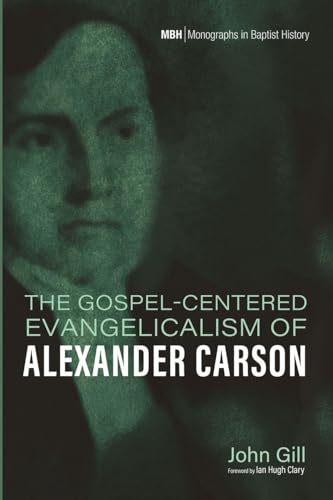
The Gospel-Centred Evangelicalism of Alexander Carson
Written by John Gill Reviewed By Alexander ArrellWhile it is often called the land of saints and scholars, Ireland rarely receives much attention in theological studies today. John Gill, professor of Christian studies at California Baptist University, seeks to correct this oversight. In this book, based on his doctoral dissertation at The Southern Baptist Theological Seminary, he explores the life and ministry of Alexander Carson. His work not only helps to retrieve the legacy of this noteworthy saint and scholar, but it also provides an important insight into nineteenth-century evangelicalism. In particular, Gill shows that Carson’s theology is an excellent example of the standard beliefs of British evangelicals in the nineteenth century.
As the pastor of the Baptist church in Tobermore, a small rural village in the north of Ireland, Carson initially seems like an unusual choice for such a significant study. Nevertheless, Gill demonstrates that the scale of Carson’s ministry and the strength of his scholarship mean that he deserves our attention. The opening chapter provides an overview of his life and work. This short summary not only weaves together all of the relevant biographical sources, but it also provides an insightful introduction to the theological temperature of Presbyterianism and the development of Baptist churches in nineteenth-century Ireland. Gill also includes a helpful survey of Carson’s voluminous and varied theological output, including works on hermeneutics and the philosophy of Bible translation, biblical exposition in both Testaments, doctrinal treatises on the atonement, polemical defences of the doctrine of Scripture and the Trinity, and interactions with Roman Catholic theology and the rise of biblical criticism.
To the extent that Carson is remembered today, it is often for his treatise Baptism in Its Mode and Subjects Considered (1831). In this work, Carson presents a powerfully persuasive account of Baptist principles, which was widely read and interacted with at the time. For example, he received honorary degrees from Kentucky and Louisiana on account of this treatise. Similarly, his contemporary, the Princeton Presbyterian Charles Hodge, recognized it as one of the best defenses of the Baptist position. Nevertheless, despite the popularity of his ecclesiological polemics, Gill shows that Carson did not operate from a spirit of denominational narrowness. As Carson himself declared in 1842, when preaching at the fiftieth anniversary of the Baptist Missionary Society, “Brethren, I yield to no man in zeal for baptism: but baptism is not my gospel. I love all who love Christ” (p. xvi).
It is this love for all who love Christ, and Carson’s theological unity with them, that Gill goes on to examine in the main body of the work. He uses David Bebbington’s popular quadrilateral to explore key aspects of Carson’s theology and demonstrate that he conforms to the broader model of nineteenth-century evangelicalism. Gill includes a chapter on each of Bebbington’s four evangelical emphases: the Bible (ch. 2), the cross (ch. 3), conversion (ch. 4), and activism (ch. 5). Given the great extent of his work and ministry, this is a helpful way to uncover Carson’s core convictions and concentrate on his central concerns. The chapter addressing Scripture is particularly revealing, given the controversies that Carson engaged in on the topic as well as the theological climate at the time. Indeed, it shows that long before Charles Spurgeon famously defended the doctrine of Scripture at the end of the nineteenth century, another erudite and influential Baptist leader was well known for doing the same.
Gill’s work is a brilliant introduction to this incredibly influential yet often overlooked figure. However, it is important to note that it also suffers from a wider methodological limitation in the field. As Gill himself admits, Bebbington’s quadrilateral was developed based on a study of evangelicalism in England, Scotland, and Wales (p. 148). It did not include a detailed consideration of the Irish context and, for that reason, we should be cautious about automatically extending Bebbington’s analysis across the Irish Sea. Using his quadrilateral as an organizing principle allows Gill to demonstrate that Carson generally conforms to the core beliefs of evangelicals in the rest of the British Isles. However, it limits substantive exploration of how Carson might differ from them in other important ways or conform more closely to those within his own Irish context. Gill helpfully uncovers evidence of such differences, briefly discussing Carson’s distinctive views on church order, theological alignment with Sandemanism, and personal relationships with Scotch Baptists. Such issues would benefit from further consideration in light of Carson’s immediate Irish context. We should also not overlook how the numerical and cultural strength of Roman Catholicism in Ireland may have uniquely shaped the beliefs and practices of Irish evangelicals, including Carson. Therefore, while Bebbington’s quadrilateral sheds much light, there is a need for a similar study of Irish evangelicalism that is sensitive to its own political, historical, and religious context. Assessing Carson’s theology as part of this wider study would build on the excellent work that Gill has begun. It would also deepen our understanding of the Baptist movement that began to spread across Ireland in the wake of the ministry of this significant saint and scholar.
Alexander Arrell
Alexander Arrell serves at Union Theological College, Belfast, Northern Ireland, UK.
Other Articles in this Issue
Main-Point-Driven: A Clear Methodology for Implementing the Christ-Centered Hermeneutic
by Dan AllenThis article addresses the need for a clear methodology for implementing the Christ-centered interpretation...
LaMaster considers Elizabeth Castelli’s contention that Paul’s use of imitative language reinforces power in authority relationships...
Cameron Schweitzer argues that Drew Hunter’s earlier work on Jonathan Edwards’s understanding of typology is too narrowly christological...
This essay argues that evangelical retrieval of the Christian tradition finds a particularly fruitful interlocutor in Athanasius of Alexandria, whose “ruled readings” of Scripture and trinitarian exegesis model a canonically-coherent theological hermeneutic...
Wisdom and Folly in Laodicea: Revelation’s Message to the Laodiceans as Wisdom Discourse
by Joel MacInnesThis article examines Christ’s message to Laodicea as “wisdom discourse,” arguing that it employs “wisdom forms,” “allusions to wisdom literature,” and addresses “wisdom concerns...
Other Reviews in this Issue