
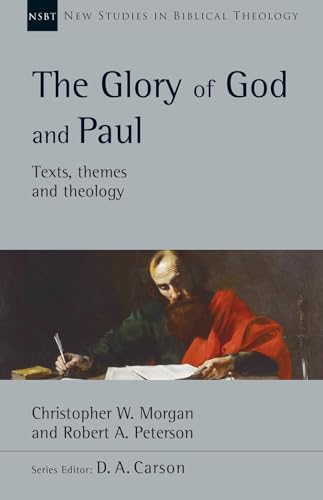
The Glory of God and Paul: Texts, Themes, and Theology
Written by Christopher W. Morgan and Robert A. Peterson Reviewed By Mikko SivonenThose who know Chris Morgan are familiar with his pastoral heart in the context of theological education. As a long-time local pastor and dean of Christian Studies at California Baptist University, Morgan has been a pivotal figure in creating a vigorous ecosystem for Californian evangelical life, particularly Baptist life, over the past decades. Consequently, his influence has spread beyond California’s borders. Morgan’s commitment to sound theology, to the local church, and to educating the next generation of pastors and leaders is evident in his life’s work; his books are known for scriptural faithfulness, and he can organize complex and important theological topics in accessible language.
Morgan’s recent book, The Glory of God in Paul, published in the NSBT series and co-authored with his long-time collaborator, Robert A. Peterson, explores the glory theme in Paul. The glory motif in biblical studies, particularly in Pauline studies, has engendered several dissertations and publications in the past 10 years, building on the work of Carey Newman’s groundbreaking study, Paul’s Glory-Christology: Tradition and Rhetoric (Brill, 1992). For example, Donald Barry (Glory in Romans and the Unified Purpose of God in Redemptive History [Pickwick, 2016]), Mikko Sivonen (“The Doxa Motif in Paul: A Narrative Approach to the Vindication of the Glory of God through Christ” [ThD diss., University of Helsinki, 2018]), Haley Goranson Jacob (Conformed to the Image of His Son: Reconciling Paul’s Theology of Glory in Romans [IVP, 2018]), and Donnie Berry (The Earth Will Be Filled: A Biblical Theology of the Glory of God [IVP Academic, 2025]) have all written on the topic. Morgan and Peterson’s book is a helpful and accessible addition to the discussion of this important theme, found both in Scripture and theology.
The first two chapters lay the groundwork for the book’s aim, namely, to explore the glory theme in Pauline epistles. Chapter 1 offers a panorama of God’s intrinsic and extrinsic glory in Scripture and theology. The authors paint a big picture, showing how God’s intrinsic glory flows out to make it visible. God’s glory appears in seemingly tension-filled ways: it is transcendent yet immanent, full and received, unique and shared. Glory appears in every major section of the Bible and is woven throughout all major parts of redemptive history.
Chapter 2 looks at the storyline of redemptive history: how the glory is manifested in creation, shattered in the fall, inaugurated in the redemption, and promised to be fully restored in the consummation. According to the authors, there is no “grander theme than that of God’s glory” in the Scriptures (p. 31).
Chapters 3–7 examine six Pauline epistles in light of the glory motif. Chapter 3 examines the glory of God in Romans. According to the authors, salvation is presented in a major way in Romans through the glory theme. Chapter 4 explores the glory of God in 1 Corinthians 15, showing the centrality of glory in both Jesus’s and believers’ resurrection. In chapter 5, Morgan and Peterson compare the Old and New Covenants as they are described in 2 Corinthians 3–4, the most glory-filled of all New Testament scriptures. They show how the New Covenant glory is superior to the Old Covenant. Paul’s letter to Ephesians in terms of glory and the church is analyzed next in chapter 6. “God’s ultimate goal for the church is to glorify himself in his people and in his son” (p. 171). Finally, the authors see eschatological glory as the central theme in 2 Thessalonians. God’s glory is fully manifested in the “resurrected, transformed, glorified bodies” of the believers (p. 199). In the final two chapters, Morgan and Peterson both systematize the findings and make applications to the Christian life.
The authors’ careful exegetical work (though missing discussion on some Pauline passages like 1 Cor 11), combined with a sound biblical-theological approach and an ability to synthesize findings coherently, engenders another gift to the church, especially to the teachers and pastors who want to familiarize themselves with one of the most, if not the most, important motifs in Paul. How God in his glory and humans as the image and glory of God (and as sinners who fall short of God’s glory) relate to the image and the glory of Christ and the promise of final glorification is a colossal and fascinating reality.
In addition to careful biblical exegesis, Morgan and Peterson draw prudently from wider scholarship, interacting with the best-known commentators and contemporary biblical theologians. The bibliography is generally up to date, though the authors overlook some more recent monographs. Furthermore, issues such as what lexemes in addition to doxa should contribute to our understanding of the concept of glory and what is the relationship between honor and shame are outside of the scope of this book.
Regardless, Morgan and Peterson have written another solid book, this time a clear and systematic presentation of the glory theme in Pauline letters, both textually and theologically. While the book feels at times like a classroom-type presentation and could potentially have benefited from more creative delivery, the substance of this fine volume is vital for understanding both Paul and the entire Bible. Morgan and Peterson’s book serves as a great and helpful resource for that undertaking.
Mikko Sivonen
Mikko Sivonen serves at Agricola Theological Seminary, Espoo, Finland.
Other Articles in this Issue
Main-Point-Driven: A Clear Methodology for Implementing the Christ-Centered Hermeneutic
by Dan AllenThis article addresses the need for a clear methodology for implementing the Christ-centered interpretation...
LaMaster considers Elizabeth Castelli’s contention that Paul’s use of imitative language reinforces power in authority relationships...
Cameron Schweitzer argues that Drew Hunter’s earlier work on Jonathan Edwards’s understanding of typology is too narrowly christological...
This essay argues that evangelical retrieval of the Christian tradition finds a particularly fruitful interlocutor in Athanasius of Alexandria, whose “ruled readings” of Scripture and trinitarian exegesis model a canonically-coherent theological hermeneutic...
Wisdom and Folly in Laodicea: Revelation’s Message to the Laodiceans as Wisdom Discourse
by Joel MacInnesThis article examines Christ’s message to Laodicea as “wisdom discourse,” arguing that it employs “wisdom forms,” “allusions to wisdom literature,” and addresses “wisdom concerns...
Other Reviews in this Issue