
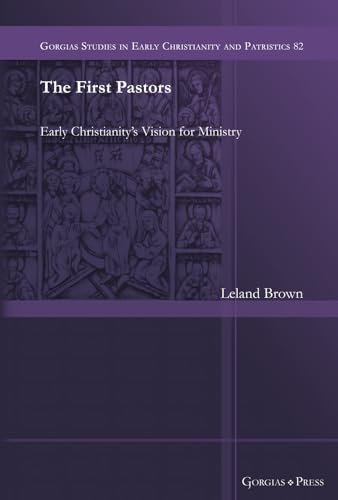
The First Pastors
Written by Leland Brown Reviewed By Camden PulliamThe church fathers have been used to defend countless ministry models, ecclesiological structures, and missiological emphases. Scholars and practitioners alike continue to examine these documents—and the men who wrote them—attempting to ascertain a better sense of the historical realities at play in the early church and a better path to the hopeful realities in our churches today. But in Leland Brown’s newest work, a publication of his dissertation from the Southern Baptist Theological Seminary, an attempt is made to understand the church fathers’ ministry on their own terms. The research question at hand is, “What is the pastoral theology of the Church Fathers, taken from their own words?” (p. 2). Such an endeavor should pique the interest of every ministry leader today, especially those who aim to root their work in the early church.
Leland Brown is a pastor at East Cooper Baptist Church in Mount Pleasant, South Carolina, and also serves as a Senior Director with the London Lyceum. But if one wants to discern his credentials, do not read his bio; read his work. His scholarship in The First Pastors speaks for itself. Brown shows extensive familiarity with the primary texts of the church fathers, the secondary literature, and the linguistic issues at play, often dissecting the complexities of the Greek text. His scholarship in this work is superb.
Brown argues that the church fathers shared a stable and uniform vision for ministry (p. 211). To demonstrate this thesis, he evaluates their pastoral theology textually and theologically. That is, he does not interpret the Fathers according to their sociological milieu or shifting cultural contexts. (This emphasis sets him apart from the broader field of scholarship.) Instead, he reads them on their own terms to ascertain the organic themes within. What develops is a sublime (yet not surprising) similarity to the pastoral theology of the New Testament. Brown shows that their pastoral theology centered on four elements: the virtue of the leader, his authority being grounded in God himself, his primary work of teaching and protecting the flock, and his suffering as an essential element of his task.
The leader’s virtue is of supreme importance, not his charismatic gifting or evangelistic output. The singular way to determine a pastoral leader’s calling is his relational virtue. Is he gentle, humble, meek, peace-making? In a word, is he “blameless”? The leader’s virtuous life is his primary ministry. His godliness is more important than his giftedness.
Brown also shows that the Fathers understood the leader’s authority to come from God’s own lordship. The flock submits to the leader because he is God’s steward. Of course, this can be fraught with interpretive questions (e.g., apostolic succession) or potential abuse. But the Fathers clearly held that the church’s leaders had an authentic heavenly authority that demanded submission.
The leader’s work is diverse. Pastoral leaders must teach, lead, protect, and care for the flock. There is a centrality to teaching that cannot be replaced, and it dovetails with the protective work required to lead the congregation, maintain unity, and guard from false teachers. Yet still, amidst all other responsibilities, the authoritative leader must be gentle as a dove with the poor, widowed, and needy in the congregation.
Perhaps the most intriguing element of Brown’s study was his focus on the leader’s suffering. Any reader of the church fathers should expect suffering to rise as a theme. But the unexpected portion is Brown’s focus on the leader’s suffering from within the church. Brown demonstrates that the church fathers believed that leaders would necessarily suffer from individuals within their midst. This reading will certainly encourage any current pastor who is surprised at the fiery trial coming upon him from his own congregation, thinking that something strange was happening to him (1 Pet 4:12). The church fathers show that it is not strange at all.
At the same time, Brown gives little attention to the suffering from without. When reading the Fathers, martyrdom and external threat is a consistent concern. Brown comments on this element briefly (p. 167), but one would expect it to play a larger role in his study.
The scholarly payoff of Brown’s work—one that is well received—is that the church fathers’ unity begins with their shared theological vision about pastoral identity and work (p. 217). In other words, they are not uniform because of church structure, as some confessional strands may contend, nor are they significantly diverging from one another due to social and cultural development, as critical scholarship has argued. Instead, a New Testament model of ministry serves as the “through-line” for all church fathers. Of course, pastors in evangelical churches may detect this “through-line” carrying forward into their congregations today. Faithful ministry—despite countless cultural-historical contexts—requires the same virtue, authority, work, and suffering as it did in the first and second centuries.
One final limitation of the book (which Brown himself addresses on p. 95) is the vague nature of leadership in the early church. “Who are the ‘leaders’ in view?” one might ask. Bishops, elders, deacons? Brown sidesteps the question and lumps all those with authority into a category of “pastoral leaders.” This serves Brown’s argument well, since his focus is not on a classification and taxonomy of ecclesiological structures. Nevertheless, one should not look to Brown’s book to sort out the complexities of this issue in the church fathers.
Though this is an academic work, it is instructive for pastoral leaders today. God’s church should not succumb to modern reinventions, nor should pastors refashion their work with the times. Leland Brown shows that the church fathers rooted their shared pastoral theology in the New Testament. As such, they can say, just like the Apostle Paul, “follow us, as we follow Christ.”
Camden Pulliam
Camden Pulliam serves at Midwestern Baptist Theological Seminary, Kansas City, Missouri, USA.
Other Articles in this Issue
Main-Point-Driven: A Clear Methodology for Implementing the Christ-Centered Hermeneutic
by Dan AllenThis article addresses the need for a clear methodology for implementing the Christ-centered interpretation...
LaMaster considers Elizabeth Castelli’s contention that Paul’s use of imitative language reinforces power in authority relationships...
Cameron Schweitzer argues that Drew Hunter’s earlier work on Jonathan Edwards’s understanding of typology is too narrowly christological...
This essay argues that evangelical retrieval of the Christian tradition finds a particularly fruitful interlocutor in Athanasius of Alexandria, whose “ruled readings” of Scripture and trinitarian exegesis model a canonically-coherent theological hermeneutic...
Wisdom and Folly in Laodicea: Revelation’s Message to the Laodiceans as Wisdom Discourse
by Joel MacInnesThis article examines Christ’s message to Laodicea as “wisdom discourse,” arguing that it employs “wisdom forms,” “allusions to wisdom literature,” and addresses “wisdom concerns...
Other Reviews in this Issue