
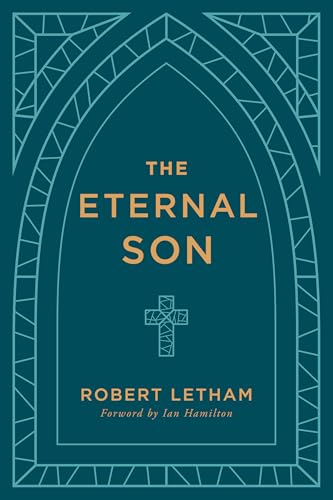
The doctrine of Christ is the church’s most precious possession, and Robert Letham has written a sensitive and engaging historical-systematic treatment of this in The Eternal Son. He has previously written a tome on the Trinity, The Holy Trinity: In Scripture, History, Theology, and Worship (P&R, 2004). His current project is a trilogy of books, where each volume will explore one of the divine persons. The Eternal Son is the second piece in this trilogy. The Holy Spirit was released in 2023, and a volume on the Father is forthcoming. This work of Christology is well-researched and penetrating, evidencing Letham’s lifelong devotion to trinitarian theology. He shows that Christology is not merely a doctrine to be placed on the shelf alongside others but that Christ is the heart of the gospel and the Christian faith.
The first three chapters set the stage. In chapter 1, Letham establishes the Trinitarian foundations for the doctrine of Christ, such as the concepts of eternal generation, perichoresis, inseparable operations, and distinct appropriations. In chapter 2, he deals with the Son’s eternal existence, highlighting how this pre-existence is related to predestination and election. If we are chosen in Christ before the foundation of the world (Eph 1:3), then the Son’s eternal nature is not just a presupposition but the foundation for our salvation. Chapter 3 deals with the incarnation, which Letham calls the “center of the Gospel” (p. 67). Here the reader is introduced to the centrality of Cyril of Alexandria’s thought to the development of Christology. Cyril champions the concept of one unified christological subject (person), thereby rejecting the Nestorian tendency to divide the person of Christ into two subjects. And it is through Cyril’s eyes, Letham argues, that the Council of Chalcedon must be interpreted. The debates following Chalcedon were largely disputes among rival interpreters of Cyril, not between his supporters and opponents.
From there, the book is a historical journey from the fifth century onward, with the chapters generally following the debates and discussions chronologically. While many evangelical perspectives appear to consider the Chalcedonian Definition of 451 AD as the final resolution of early christological debates, Letham effectively illustrates that this event initiated a period of increased doctrinal contention. In chapter 7, Letham explains the twin threats of monoenergism and Monothelitism, which arose in the seventh century. Respectively, these views held that Christ operated only through one energy or operation and one will. Through the case study of the Gethsemane scene in the Gospels and the advocacy of Maximus the Confessor, Letham shows these views to be lacking and out of the bounds of orthodoxy. He then addresses the influence of the Reformation and the aftermath of the Enlightenment upon Christology. Ideas that spring up in the modern era, such as kenotic Christology, are also critiqued with great insight. Letham concludes with a final chapter reflecting on the soteriological impact of the doctrine of Christ’s person.
Theological discourse often separates the person of Christ from his salvific actions, with these distinct aspects occasionally forming separate volumes within a series. And to be sure, there is not a lot of material in The Eternal Son on the doctrine of the atonement. While Letham acknowledges this, his concluding chapter introduces soteriology emerging from Christology. Protestants can give the sacraments short shrift, but Letham reflects on the dual function of baptism and the Lord’s Supper and their role in the believer’s relation to the person of Christ. In baptism, we are promised union with him; through communion, we feed on him. Letham concludes with a Protestant take on the controversial notion of theosis. Commonly assumed to be merely an Eastern Orthodox idea, Letham provocatively suggests that we are already in possession of something similar under the more Western label of glorification.
The Eternal Son is a book that is well suited for a theological student to acquire an overview of the development of christological doctrines. It is introductory but written with a level of engagement that would well prepare a reader for further study. Despite its limitations in providing an exhaustive historical examination or a thorough analysis of specific disputes, the book serves as an excellent introductory resource. Letham is especially good where he shows the contemporary relevance of certain issues. Monothelitism is not dead, for example. It lives on in evangelical circles through living advocates such as Garrett J. Deweese and William Lane Craig. The book’s two appendices are polemical, directly engaging contemporary christological proposals that he finds dubious.
In Letham’s telling, ancient debates are described as having perennial relevance. Cyril of Alexandria and Karl Barth are presented as interlocutors who find common ground despite a temporal distance of approximately fourteen centuries. Something similar can be said of John Calvin, Origen, and Gregory of Nazianzus. Letham exposes the reader to many important theological voices; he is very generous in presenting various theological figures. Though objecting to Barth on several aspects of his theology, Letham commends the Swiss theologian at various points throughout the book. He even mentions the Eastern Orthodox theologian Sergei Bulgakov. This generosity results from the true catholicity of Letham’s project.
The Eternal Son is the product of a very mature systematic-historical theologian. Its author has devoted a long career to the study of the Trinity and the doctrine of Christ. Christology is a treasure of the church, and it is in good hands with Robert Letham.
Steve Swan
Steve Swan serves at Yellowknife Alliance Church, Yellowknife, Northwest Territories, Canada.
Other Articles in this Issue
Main-Point-Driven: A Clear Methodology for Implementing the Christ-Centered Hermeneutic
by Dan AllenThis article addresses the need for a clear methodology for implementing the Christ-centered interpretation...
LaMaster considers Elizabeth Castelli’s contention that Paul’s use of imitative language reinforces power in authority relationships...
Cameron Schweitzer argues that Drew Hunter’s earlier work on Jonathan Edwards’s understanding of typology is too narrowly christological...
This essay argues that evangelical retrieval of the Christian tradition finds a particularly fruitful interlocutor in Athanasius of Alexandria, whose “ruled readings” of Scripture and trinitarian exegesis model a canonically-coherent theological hermeneutic...
Wisdom and Folly in Laodicea: Revelation’s Message to the Laodiceans as Wisdom Discourse
by Joel MacInnesThis article examines Christ’s message to Laodicea as “wisdom discourse,” arguing that it employs “wisdom forms,” “allusions to wisdom literature,” and addresses “wisdom concerns...
Other Reviews in this Issue