
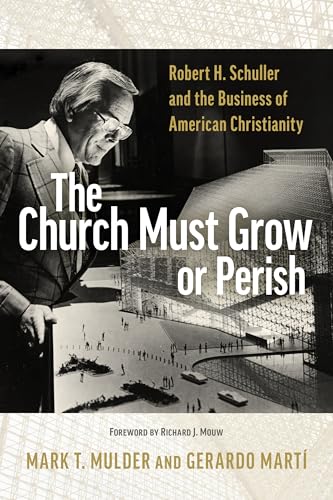
The Church Must Grow or Perish: Robert H. Schuller and the Business of American Christianity
Written by Mark T. Mulder and Gerardo Martí Reviewed By Austin NicholsonRobert H. Schuller (1926–2015) strove to remodel American Christianity for the twentieth century from his Orange County drive-in church and avant-garde Crystal Cathedral. For several decades, he sustained national prestige and global fame through his leading religious broadcast, Hour of Power, until his mega-ministry collapsed into bankruptcy in 2010. Sociologists Mark T. Mulder and Gerardo Martí first traced the dramatic rise and fall of Schuller’s organization in The Glass Church: Robert H. Schuller, the Crystal Cathedral, and the Strain of Megachurch Ministry (Rutgers University Press, 2020). Building on years of research and a broad base of archives and interviews, Mulder and Martí have now produced a comprehensive biography of Schuller for the Eerdmans Library of Religious Biography. Along with their academic expertise, the authors each carry a personal connection to their subject: Mulder shares Schuller’s rural Midwestern upbringing and Dutch Reformed background, while Martí grew up in Garden Grove, California, under the shadow of the towering Crystal Cathedral, frequenting its programs and activities throughout his adolescence. Together, they offer a penetrating look at the life, thought, and influence of Schuller, who they argue “crafted a market-oriented Christianity” that permeates many corners of the American church today (p. 277).
The destruction of Schuller’s Iowa family farmstead by a tornado in 1944 provides a ready metaphor for his driving conviction: unless deliberately fortified from the tornadic secularizing currents of modern society, the Christian church would likewise be swept away. For Schuller, the evidence of effective fortification from the winds of modernity—and proof positive that his techniques of perpetual innovation and market adaptation represented the future of Christianity—was numerical and physical growth. “A church must never stop growing,” Schuller advised the many pastors who sought to emulate his success, “when it ceases to grow, it will start to die” (p. 5). His philosophy of relentless expansion—aptly described as “the ecclesial equivalent of ‘keeping up with the Joneses’”—vaulted him into celebrity, earned him many critics, and spelled his ministry’s ultimate downfall (p. 288).
Like many other twentieth-century mega-ministry pioneers (e.g., Bill Bright, W. A. Criswell, Oral Roberts), Robert Schuller came from humble origins in Middle America. Yet, as the authors emphasize, surprising contradictions distinguish his otherwise unorthodox career. Unlike most of his fellow mega-preachers and televangelists, Schuller cannot be accurately described as evangelical, fundamentalist, or charismatic. He never departed the mainline Reformed Church in America (RCA) of his Dutch Calvinist roots, despite charting his own path in theology and practice. Educated at RCA-affiliated Hope College and Western Theological Seminary, Schuller emerged from a deep study of Calvin’s Institutes, believing his tradition had misunderstood the Reformer’s writings on human depravity. Instead of “fetishizing humiliation and conviction,” he determined to henceforth proclaim “uplift and agency … hope rather than guilt” (p. 43). Disillusioned by his early ineffectiveness in a small Chicago pulpit, Schuller soon turned to positive-thinking guru Norman Vincent Peale (a pariah among RCA purists) and social salesman Dale Carnegie. After growing his first congregation from thirty-five members to four hundred in under five years, he accepted the RCA’s invitation to plant a new church in the booming suburbs of Orange County, California, in 1955.
In California, Schuller embraced novelty, a willingness to disrupt established norms, and a seeker-sensitive posture (before the invention of the term). He rented a drive-in theater on Sunday mornings to establish not any old Reformed church but “a positive-thinking mission that will meet the needs of the people here who don’t go to any church!” (p. 73). For the rest of his career, as the authors reiterate, Schuller faced constant criticism for his unorthodox routes to success. He tailored his therapeutic sermons to the felt material needs of his audience—upwardly mobile, mostly white suburbanites overwhelmed by the pace and demands of modern life—rather than attempting to exegete a biblical text, teach doctrine, or issue a gospel plea. Schuller determined to accommodate his message to what modern people would find relevant and useful. By soft-selling Christianity from the pulpit, modelling church management after the corporate boardroom, and shamelessly pursuing ostentatious building projects and external funding sources, Schuller provided a template for aspiring megachurch pastors that he aggressively marketed through books, his Institute for Church Leadership, and, eventually, a television audience of millions.
Across ten chapters and a theory-heavy epilogue, the authors weave social and theological analysis, relevant historical context, and biographical substance, especially regarding Schuller’s marriage to his invaluable partner, Arvella, and his intense struggles with self-esteem, anxiety, food, and weight. The footnotes reveal a varied source base of Schuller’s published works, personal correspondence, eyewitness interviews, press clippings, and secondary literature. Chapters 6 and 7 explore how Schuller balanced relationships with architects, donors, entertainers, and congregants while pushing ahead with the construction of the $16-million Crystal Cathedral in the late 1970s. Chapter 9 explores the expansion of Hour of Power into Russia and Schuller’s relationship with President Clinton, and chapter 10 details the ministry’s rapid financial collapse after a failed familial succession plan.
The authors note Schuller’s weaknesses and contradictions but portray their subject sympathetically. At times, key assertions seem overstated. Schuller was clearly a pivotal and interesting figure who achieved extraordinary success, but did he truly “intuit a new form of Christianity … crafted and contoured for the latter half of the twentieth century in America”? (p. 33). Although Schuller boldly marketed himself as a singular trendsetter, claiming responsibility for launching the megachurch movement and once labeling himself “the founder of the church growth movement,” his ministry’s notable aspects had clear antecedents, inspirations, and contemporary peers (p. 129). Schuller mostly avoided political controversy, but his embrace of a radical individualism and adoption of market principles coincided with the ascendant conservatism of the postwar Sun Belt and the well-established fusion of business and American Protestantism. Despite constant references, the authors strangely wait until chapter 8 to elucidate “positivity thinking,” Schuller’s theology of self-esteem and individual action that he once called “almost as important as the resurrection of Jesus Christ” (p. 196). Schuller’s style and substance had many critics, but I completed the book still lacking a concrete sense of his pulpit rhetoric or the thrust of a typical Sunday message. Despite these shortcomings, the biography is cohesive, thorough, and well-researched.
Mulder and Martí contend that Schuller’s influence on the trajectory of American Christianity has been underappreciated and “poorly understood” (p. 23). Schuller may not have been the definitive fountainhead of the methods and contours of seeker-sensitive megachurches and their diffuse imitators today, but he was a bold, early adopter of many popular and controversial elements in contemporary churches. The Church Must Grow or Perish includes many positive and negative historical lessons that will enlighten scholars, pastors, and keen observers. After all, Schuller’s church did grow, yet it too perished.
Austin Nicholson
University of Mississippi
Oxford, Mississippi, USA
Other Articles in this Issue
Main-Point-Driven: A Clear Methodology for Implementing the Christ-Centered Hermeneutic
by Dan AllenThis article addresses the need for a clear methodology for implementing the Christ-centered interpretation...
LaMaster considers Elizabeth Castelli’s contention that Paul’s use of imitative language reinforces power in authority relationships...
Cameron Schweitzer argues that Drew Hunter’s earlier work on Jonathan Edwards’s understanding of typology is too narrowly christological...
This essay argues that evangelical retrieval of the Christian tradition finds a particularly fruitful interlocutor in Athanasius of Alexandria, whose “ruled readings” of Scripture and trinitarian exegesis model a canonically-coherent theological hermeneutic...
Wisdom and Folly in Laodicea: Revelation’s Message to the Laodiceans as Wisdom Discourse
by Joel MacInnesThis article examines Christ’s message to Laodicea as “wisdom discourse,” arguing that it employs “wisdom forms,” “allusions to wisdom literature,” and addresses “wisdom concerns...
Other Reviews in this Issue