
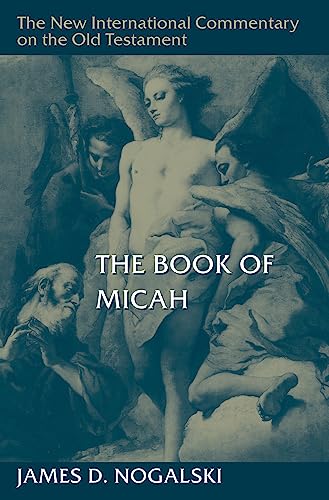
The Book of Micah, New International Commentary on the Old Testament
Written by James D. Nogalski Reviewed By Peter C. W. HoThis volume replaces Leslie Allen’s contribution (1976) in the NICOT series. It is hardly an exaggeration to say that James Nogalski has shaped an entire generation of research on the Book of the Twelve since the publication of his seminal works, Literary Precursors to the Book of the Twelve (BZAW 217 [de Gruyter, 1993]) and Redactional Processes in the Book of the Twelve (BZAW 218 [de Gruyter, 1993]). With more than three decades of publishing at the highest level, including at least fourteen volumes and four commentaries, alongside extensive experience leading international academic committees and editorial boards, there are currently very few scholars who possess Nogalski’s breadth and depth of expertise on the Book of the Twelve. Those familiar with the NICOT series will already know that it not only upholds the authority of Scripture but also consistently represents some of the finest Old Testament scholarship presently available. This volume continues to strengthen NICOT’s standing as the premier academic commentary series in Old Testament studies.
The opening forty-five pages of this approximately 250-page volume provide an up-to-date and highly useful introduction to the book of Micah, covering its history, composition, authorship, setting, and textual history. The highlight of this introduction is Nogalski’s reading of Micah within the larger literary framework of the Book of the Twelve. Here, he discusses how Micah functions as a bridge between Jonah and Nahum, creating a sequence of three books that sustain a continuing concern with Assyria. Nogalski’s approach reflects the enduring strengths of classical redaction criticism alongside a strong inclination towards understanding the rationale and message of the book’s final form.
For Nogalski, redaction criticism serves the message of the text rather than the reconstruction of hypothetical historical stages. He tends to avoid speculative discussions regarding textual dependency and instead views the Twelve as an “editorially created scroll” with “editorial insertions of compositions that invite readers (ancient and modern) to ask how the twelve prophetic writings function as a literary collection” (p. 27). As a whole, Nogalski sees the book of Micah addressing the fate of Assyria, Israel (Samaria), Judah (Jerusalem), and the nations.
The structuring of the commentary proper follows a clear and coherent logic and is presented with consistency throughout the volume. Discussion on each textual unit begins with a concise overview that highlights major structural divisions and literary features. This is followed by Nogalski’s own translation of the Masoretic Text and is appended with detailed textual notes on ancient manuscript variants, especially in relation to the LXX and Qumran texts. It is worth noting that Nogalski is generally resistant to unnecessary textual emendation, a position that gives the commentary a refreshing restraint.
Nogalski’s commentary is a masterclass in balancing rigorous scholarship with readability. He demonstrates extensive engagement with some of the most important scholarship on the Twelve in both English and German, with German works comprising at least a quarter of the select bibliography located in the preliminary section of the volume. A sizable part of his research appears in the extensive footnotes, where the meticulous reader will discover deeper insights.
Nogalski consistently explains textual obscurities, traces thematic and literary connections, and highlights poetic features such as assonance, paronomasia, and wordplay that shape the rhetorical force of the text. Yet he does not write as someone disposed to conform to the unspoken expectations of the scholarly guild, nor does he hide behind a pretentious or performative scholarly façade. Despite the depth of scholarship, his writing remains remarkably clear, readable, and accessible.
Nogalski also does not neglect the question of what it means to read Micah today. Besides a brief but thoughtful section entitled “Contemplating Micah Today” in the Introduction, he regularly pauses at the conclusion of major text units to offer reflections and highlight significant points of contemporary application. To me, these are among the most heartening portions of the commentary.
For example, he observes how the prophet Micah “speaks truth to power, not in ideological rants as one often sees on social media of our day” (p. 135). In Micah’s own historical setting, the prophet courageously denounced the idolatrous political leadership of Israel and Judah at huge personal risk. Nogalski then contrasts this with the tendency of some Christian communities and Protestant leadership today to remain silent when social injustices emerge in ways that threaten their own institutional or social advantage. Such reflections are brief, but they are thoughtful, measured, and pastorally aware.
There are several features of this commentary that readers will particularly appreciate. First, Nogalski demonstrates an impressive methodological balance throughout the volume. While he interacts carefully and respectfully with some of the most sophisticated scholarly opponents, he avoids writing in a manner that privileges his own research while dismissing competing perspectives. Likewise, he refuses to overcommit himself to any specific methodological agenda. Instead, he gives sustained attention to syntax, textual criticism, historical context, poetics, redaction, and broader holistic readings in a balanced and integrated manner.
Second, although Nogalski has written previously on Micah in the Smyth & Helwys Bible Commentary Series and has addressed the composition of the Twelve extensively elsewhere, this volume nevertheless feels fresh and does not read like a mere repackaging of his earlier publications. At the same time, readers who wish to appreciate the full depth of his arguments will still need to consult those earlier works alongside this commentary.
Third, this remains primarily an academic and technical commentary. Theological reflection, traditional interpretation, and sustained applicational discussion are relatively limited. Although Nogalski occasionally offers pastoral or theological insights, readers looking for extended theological engagement or sermonic application may be better served by other commentary series such as the NIV Application Commentary. There is comparatively little interaction with the church fathers or reformers, such as Calvin or Luther, or with more recent Christian theological movements.
Leslie Allen’s earlier volume included a dedicated section on “Theology” in the Introduction, but this refreshed version no longer contains such a section. This does not mean that Nogalski neglects theology altogether. Significantly, his section on “Reading Micah in the Twelve,” a major area of scholarly development that emerged after Allen’s work, offers an important contribution to understanding the theology of the Minor Prophets. Nogalski’s primary task is to elucidate the text, which he has done extremely well.
As a brief side note, I did not find the Hebrew transliterations especially helpful. This observation probably pertains more to the series’ stylistic decisions than to Nogalski. My sense is that seminary students learning biblical Hebrew from grammars published within the last one or two decades generally no longer rely on transliterations.
I highly recommend this commentary on Micah. The quality of research throughout the volume is simply outstanding. It is an important contribution to contemporary scholarship on the Twelve and will serve as an invaluable resource for pastors, teachers, students, and scholars alike.
Peter C. W. Ho
Peter C. W. Ho serves at Singapore Bible College, Republic of Singapore.
Other Articles in this Issue
Main-Point-Driven: A Clear Methodology for Implementing the Christ-Centered Hermeneutic
by Dan AllenThis article addresses the need for a clear methodology for implementing the Christ-centered interpretation...
LaMaster considers Elizabeth Castelli’s contention that Paul’s use of imitative language reinforces power in authority relationships...
Cameron Schweitzer argues that Drew Hunter’s earlier work on Jonathan Edwards’s understanding of typology is too narrowly christological...
This essay argues that evangelical retrieval of the Christian tradition finds a particularly fruitful interlocutor in Athanasius of Alexandria, whose “ruled readings” of Scripture and trinitarian exegesis model a canonically-coherent theological hermeneutic...
Wisdom and Folly in Laodicea: Revelation’s Message to the Laodiceans as Wisdom Discourse
by Joel MacInnesThis article examines Christ’s message to Laodicea as “wisdom discourse,” arguing that it employs “wisdom forms,” “allusions to wisdom literature,” and addresses “wisdom concerns...
Other Reviews in this Issue