
The Art of Narrative Analogy: Identifying and Interpreting Parallel Passages in the Bible
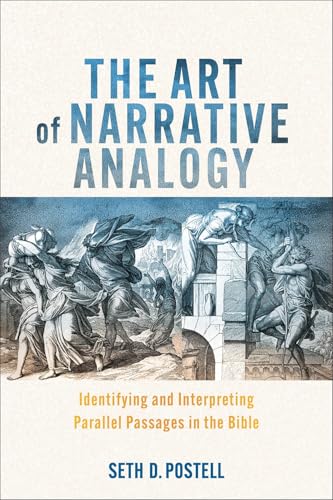
Written by Seth D. Postell Reviewed By Drew N. GrumblesWho are the only two people in the Bible to be called a “discerning man”? (Joseph and David; see Gen 41:33 and 1 Sam 16:18). What are the only two events in the Bible that refer to stinking fish? (The first exodus and the second; see Exod 7:18 and Isa 50:2). Though such questions may be seen as useful only for Bible trivia, Seth Postell argues that these kinds of literary connections give the interpreter insight into the meaning of texts. Postell serves as professor at Israel College of the Bible, a Hebrew-speaking Messianic Bible college in Netanya, Israel. He writes The Art of Narrative Analogy to provide a method for the interpreter to discover his or her own connections within narrative texts of the Old and New Testaments. He argues that biblical authors intentionally create meaning by alluding to and patterning their narratives after previous ones in the Scriptures. This technique exists within books (e.g., Peter and Paul in Acts), across books (e.g., Genesis and Esther), and across testaments (e.g., Moses and Jesus).
In chapter 1, Postell explains narrative analogy. He defines it as “a story written with the specific intent of paralleling an earlier biblical narrative” and notes that “the meaning of the narrative analogy is based upon the specific point of comparison” (p. 5). Postell emphasizes the authorial intent of these comparisons over bare intertextuality (p. 11). One question Postell does not address is how often the authors use narrative analogies. Based on his book and his prolific examples, one would think these are everywhere. But if this is such an important hermeneutic, why do we know so little of it?
In chapter 2, Postell explores the distinction between narrative analogy and typology, distancing his work from the latter method. Here one finds an important concern with his approach. Postell disapproves of typology, seeing it as overly christological, as “spiritualizing” the text, and as non-literal exegesis (p. 163). He opts instead for “predictive analogy” or a prophetic use of analogy (p. 163). He later says, “the goal of this book is to promote a responsible reading of the Bible that seeks the authorial intent” (p. 181). Many readers will share a fundamental hermeneutical disagreement with the author. Frankly, Postell did not need to bring up this controversy. One can use narrative analogies as an aspect of typology. For example, if Joseph is a type of Mordecai, this does not preclude (but rather strengthens) the view that both Joseph and Mordecai can be types of Christ. Postell’s anti-typological take distracts, if not frustrates, the reader seeking connections in the text that develop across redemptive-canonical history.
Chapters 3–8 explain Postell’s method of identifying and interpreting narrative analogies. Postell emphasizes uniquely shared terminology (e.g., stinking fish) and often a parallel sequence of events. He explores different ways that analogies create meaning. Sometimes, figures are similar (Peter and Paul in Acts). At other times, figures demonstrate divergence (Joseph resists temptation while King David fails). Interestingly, other characters reveal a “dynamic analogy.” Postell explains, “In a dynamic analogy, a single figure in the source story is paralleled by two or more figures in the target story; or multiple figures in the source story parallel a single figure in the target story” (p. 11). For example, Postell masterfully examines the book of Esther, where Mordecai is like Joseph but then Haman is treated like Joseph. Then, in chapter 8, Postell explores extended analogies, where entire books compare narratives or characters (such as the entire book of Joshua modeling the exodus/Moses).
The final chapter explains “predictive analogies,” which are analogies not using narrative but poetic interpretations of narrative, or prophetic and apocalyptic literature (p. 164). This chapter seems out of place in a book about narrative analogies. Nevertheless, the chapter explores interesting parallels between Moses and the Servant and Isaiah’s use of the exodus theme. The work here shows many similarities to typology, or the OT use of the OT in general.
One other small alteration could have improved this work. Postell loves Star Wars and fills the book with illustrations from the movie series. Those less familiar with the series will find these illustrations unhelpful, if not bewildering (because of the extent to which Postell goes into detail). The illustration works as an opening introduction to the concept of narrative analogies, but it should have been sequestered to the beginning of the book and not served as a recurring thread.
The Art of Narrative Analogy stands out for its unique contribution. More technical works such as those of Adele Berlin, Robert Alter, and John Sailhamer have their use. This work can help the typical student or pastor to begin to look for connections in narratives. If nothing else, many who may have already noticed the similarities in different texts (like those of Moses and Joshua) will now have greater confidence to explore further connections and discern meaning in the text. What seems like mere Bible trivia can prove profoundly relevant, as Postell shows us.
Drew N. Grumbles
Albany Baptist Church
Albany, New York, USA
Other Reviews in this Issue