
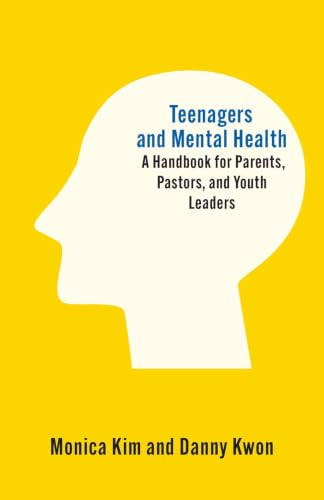
Teenagers and Mental Health: A Handbook for Parents, Pastors, and Youth Leaders
Written by Monica Kim and Danny Kwon Reviewed By Paul S. JeonThere are books that inform and there are books that shepherd. Teenagers and Mental Health belongs to the latter category. Drawing on decades of experience in counseling and youth ministry, Monica Kim and Danny Kwon offer a resource that is both theologically grounded and pastorally sensitive, written not from a distance but from within the lived realities of ministry among teenagers and their families. The book is organized in two parts. The first establishes a theological foundation, situating mental health within the biblical narrative of creation, fall, redemption, and consummation. The second addresses specific struggles—anxiety, depression, trauma, and suicidal ideation—with clarity and care. This structure reflects a sound instinct: theology should serve practice and practice must remain anchored in theology.
The work is notably usable. While it benefits from a sequential reading, it readily accommodates situational engagement. Especially in the second half, readers can turn directly to the relevant chapters and find immediate, thoughtful guidance. This reflects an awareness of ministry’s realities—often reactive and time-sensitive—while preserving a coherent theological vision consistently oriented toward Christ and the life of the church.
A central strength lies in the authors’ integration of technical expertise and lived experience. Kim writes as a clinician; Kwon as a youth pastor. Yet neither adopts the posture of a detached specialist. Their counsel is shaped by years of walking with teenagers and families through complex and often painful situations, yielding a wisdom that is not merely conceptual but tested. They write as those who have “walked the road,” and their work carries that weight. This depth is further evidenced in their ability to anticipate the questions readers are likely to raise—regarding the role of the church, the limits of care, and the relationship between theological and clinical categories—and to answer them with restraint and pastoral discernment.
Theologically, the book is well anchored. The authors resist reductionism and dualism, affirming that human beings are embodied souls and that mental suffering cannot be reduced to either the spiritual or the biological aspects of human existence. Their engagement with psychological insights, under the authority of Scripture, models a posture that is both judicious and appropriately open. Their attentiveness to the inner lives of teenagers is particularly noteworthy. Recognizing that much of adolescent experience is affective and difficult to articulate, they prioritize presence, patience, and careful listening. They are not merely correcting ideas but attending to deeper currents of fear, shame, and longing, reflecting a holistic theological anthropology even where this is not fully developed in explicit terms.
At several points, however, the strength of the book invites further development. While the authors situate their work within the biblical narrative, the eschatological horizon could be more fully integrated. Mental suffering is not only to be alleviated but located within the movement toward the new creation, and a clearer emphasis on this final horizon would deepen the framework by situating present care within ultimate hope. Similarly, the cultural assumptions shaping contemporary mental health discourse warrant further attention. The modern emphasis on inward identity and authenticity significantly influences how suffering is understood. While the authors consistently direct readers to Christ, a more explicit engagement with these cultural assumptions would strengthen their pastoral insights, enabling readers not only to operate within existing categories but also to evaluate them. In addition, a fuller integration of the church’s doctrinal inheritance could provide a more explicit grounding for the book’s account of identity and healing. In a context marked by inward instability, the church’s external confession offers a necessary anchor.
A further reflection concerns the book’s implicit cultural framework. While attentive to teenage experience, it appears to assume primarily a Western, individualistic context. For many adolescents—particularly in immigrant or bicultural settings—mental distress is deeply relational, shaped by family expectations, communal dynamics, and intergenerational pressures. The authors’ pastoral instincts translate well across these contexts, especially in their emphasis on presence, relational care, and ecclesial belonging. At the same time, a more explicit engagement with these realities could extend the book’s reach, allowing readers to see how similar struggles—such as anxiety over academic performance, depression tied to family obligation or shame, or identity conflicts between home culture and peer culture—may take on different forms depending on cultural context.
These observations are best understood as suggestions for development rather than serious deficiencies. They arise precisely because the book is so thoughtful, pastorally attuned, and theologically serious. Its vision of the church—as refuge, lighthouse, and first responder—provides a helpful model for understanding both the possibilities and the limits of ecclesial care. The church’s role, while not exhaustive, is indispensable.
In a context where many pastors and parents feel uncertain about how to respond to rising mental health challenges of adolescents, Teenagers and Mental Health offers a steady and reliable guide. It avoids simplistic solutions and instead calls for faithful presence, wise discernment, and sustained care rooted in the gospel. For these reasons, it is warmly recommended. It will serve pastors, parents, and ministry leaders well—not because it resolves every question but because it provides a faithful framework for care marked by both clarity and humility.
Paul S. Jeon
Paul S. Jeon is assistant professor of New Testament and Pastoral Theology at Reformed Theological Seminary in Washington, DC, and senior pastor at NewCity Church in Vienna, Virginia.
Other Articles in this Issue
Main-Point-Driven: A Clear Methodology for Implementing the Christ-Centered Hermeneutic
by Dan AllenThis article addresses the need for a clear methodology for implementing the Christ-centered interpretation...
LaMaster considers Elizabeth Castelli’s contention that Paul’s use of imitative language reinforces power in authority relationships...
Cameron Schweitzer argues that Drew Hunter’s earlier work on Jonathan Edwards’s understanding of typology is too narrowly christological...
This essay argues that evangelical retrieval of the Christian tradition finds a particularly fruitful interlocutor in Athanasius of Alexandria, whose “ruled readings” of Scripture and trinitarian exegesis model a canonically-coherent theological hermeneutic...
Wisdom and Folly in Laodicea: Revelation’s Message to the Laodiceans as Wisdom Discourse
by Joel MacInnesThis article examines Christ’s message to Laodicea as “wisdom discourse,” arguing that it employs “wisdom forms,” “allusions to wisdom literature,” and addresses “wisdom concerns...
Other Reviews in this Issue