
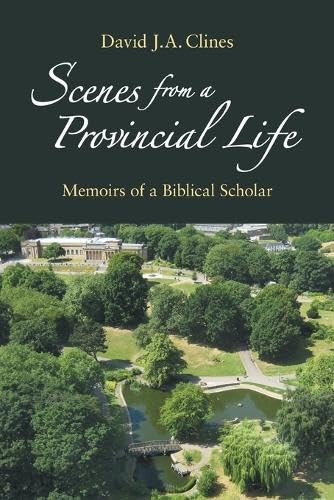
Scenes from a Provincial Life: Memoirs of a Biblical Scholar
Written by David J. A. Clines Reviewed By Anthony R. PettersonI sat next to David Clines once at a session of the International Society of Biblical Literature Conference in 2012. We spoke afterwards and I remember him being warm and inquisitive. After mentioning that I taught at Morling College in Sydney, he told me that he had attended the Hebrew classes of John A. Thompson in the late 1950s when the college was located at Ashfield (Thompson wrote the NICOT commentary on Jeremiah among other things). Clines was not officially enrolled as far as I recall but attended to supplement his Sydney University Hebrew classes. It was with this story in mind that I purchased his memoirs to see if he made mention of it. Alas, this story of what is probably our college’s most famous audit student didn’t make it to print.
In his fascinating autobiography, David Clines recounts his childhood family life in Oatley, Sydney, his school and university education in Sydney, then his post-graduate study in Cambridge. The second half of the book covers his scholarly career in Sheffield, with one year at Fuller Theological Seminary in California.
Stories of his upbringing in Sydney and his schooling were especially intriguing to this Sydneysider. A significant part of his childhood formation was his family’s affiliation with the Brethren assemblies, of which he gives mixed assessments. For instance, “From the age of 4 until I was baptized (and so became an adult member of the assembly) I probably sat through 500 of these Morning Meetings. It was a kind of cruelty, but my 750 hours of compulsory silence with only a Bible, a hymnbook and my Bible trivia book left me very familiar with the contents of the Bible, and proved an excellent foundation for a biblical scholar. So I am not complaining” (p. 15).
His five years at Sydney University (1956–1961) offer a snapshot of a bygone golden era in the study of the humanities: classes in Latin, Greek, Hebrew, and Ancient History, accompanied by annual production of Greek or Latin plays in the original languages. During this time, he began teaching at a new Brethren Bible School in Sydney for training missionaries and church workers and led Brethren youth camps.
After completing an honours degree, he received a scholarship to attend Cambridge University (1961–1964). Here he recounts his teachers and subjects and his time at Tyndale House. From there he took his first academic appointment at Sheffield University, where he spent the bulk of his career. Over three chapters he gives insights and reflections on his work, including writing a commentary on Job, the founding of Sheffield Academic Press and the Journal for the Study of the Old Testament, and the rationale and history behind what is perhaps his greatest publishing legacy, the Dictionary of Classical Hebrew, published in nine volumes between 1993 and 2016.
After his return to Sheffield from Fuller at the end of 1975 (where he had taught a course on the Pentateuch, which inspired his book The Theme of the Pentateuch), Clines tells how he was unable to find a local church that measured up to his experience in California. While his children continued to attend youth groups, and his wife continued to attend church, at this time he says, “I could live with all the Apostles’ Creed apart from the belief in the ‘communion of saints.’” His colleague, Anthony Thiselton, “was appalled” (p. 81).
Somewhat tellingly, his giving up on church marks a turning point in the book. While the book to this point is full of personal stories, after this confession, the book is almost devoid of personal anecdotes unrelated to his scholarly career. There is no acknowledgement or explanation of his shift away from evangelical faith, only his desire expressed in an unfinished final chapter for the “liberation of biblical scholarship from the control of religiously committed believers.… Why do we not hate it when the great majority of biblical scholars are adherents of a religious tradition?” (p. 131). He continues his accounts of his colleagues and their scholarly contributions, including four pages on Cheryl Exum, but divulges nothing about his personal relationships and family life.
David Clines’s academic achievements are towering, and his legacy will be long felt in biblical studies, but the message of his memoirs for me was the critical importance of active involvement in a local church.
Anthony R. Petterson
Anthony R. Petterson
Morling College
Sydney, New South Wales, Australia
Other Articles in this Issue
Main-Point-Driven: A Clear Methodology for Implementing the Christ-Centered Hermeneutic
by Dan AllenThis article addresses the need for a clear methodology for implementing the Christ-centered interpretation...
LaMaster considers Elizabeth Castelli’s contention that Paul’s use of imitative language reinforces power in authority relationships...
Cameron Schweitzer argues that Drew Hunter’s earlier work on Jonathan Edwards’s understanding of typology is too narrowly christological...
This essay argues that evangelical retrieval of the Christian tradition finds a particularly fruitful interlocutor in Athanasius of Alexandria, whose “ruled readings” of Scripture and trinitarian exegesis model a canonically-coherent theological hermeneutic...
Wisdom and Folly in Laodicea: Revelation’s Message to the Laodiceans as Wisdom Discourse
by Joel MacInnesThis article examines Christ’s message to Laodicea as “wisdom discourse,” arguing that it employs “wisdom forms,” “allusions to wisdom literature,” and addresses “wisdom concerns...
Other Reviews in this Issue