
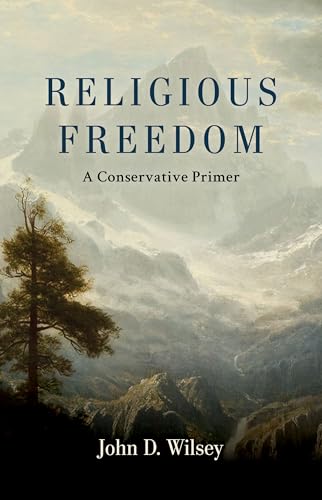
Religious Freedom: A Conservative Primer
Written by John D. Wilsey Reviewed By Blake JohnsonIn his recent work, Religious Freedom: A Conservative Primer, historian John Wilsey contributes to the current debates over political theology. He defends a particular vision of conservatism, which he calls aspirational conservatism. This approach embodies conservatism as something prepolitical, “a temperament … a way of life before it ever represents a political stratagem” (p. 33). Opposing Christian postliberalism in particular, he seeks to introduce readers to what Alexis de Tocqueville saw as the heart of the American experiment: the union of “two spirits” into one, the spirit of liberty and the spirit of religion.
In this endeavor Wilsey is largely successful, and many will benefit from his story-filled introduction to historic conservative thought. Beyond that, however, those looking for assistance in more pressing and contemporary skirmishes regarding the scope and meaning of “religious freedom” may be disappointed.
Chapter 1 provides clarifications that are key to defining political conservatism. Wilsey distinguishes true conservatism from some of the false images that form in peoples’ minds when they hear the term—e.g., “racism, religious fanaticism, classism, narrow-mindedness, and blind traditionalism.” Wilsey is clear: “if conservatism means any of these things, then it should be rejected out of hand” (p. 29). He shines the light of history upon the subject to distinguish between particular manifestations on the one hand and the substantive essentials on the other. Relying on Matthew Continetti’s “twelve postwar categories for the Right” witnessed in American history, Wilsey points out the great disparities between differing expressions of conservatism and calls the reader to instead focus on what constitutes “the permanent beneath the flux.” Generally, this looks like the pursuit of Order before Liberty (p. 42). More specifically, it is the commitment to conserving “the harmony between the spirit of liberty and the spirit of religion” (p. 32).
Chapter 2 continues to lay groundwork, addressing what Wilsey considers “the conservative imagination.” Conservatism must be about more than politics; it must be about “the pursuit of a life of the mind, a well-formed imagination, a philosophical framework to understand reality” (p. 63).
The goals of the book take on greater clarity in chapter 3. Wilsey distinguishes between Nationalism and Patriotism, which he calls, respectively, “Closed American exceptionalism” (disordered) and “Open American exceptionalism” (rightly ordered). He critiques both sides of the political divide: those of the left who would denigrate the American identity altogether and those of the right who would do the same by questioning the national ideal of blending religion and liberty. This is where he begins to build a case against postliberal thought—an effort he continues throughout the book.
In chapter 4 Wilsey presents the central argument of the book: that “too much order results in tyranny, and too much liberty results in anarchy” (p. 118). He emphasizes that both represent two-front battles, as versions of each arise on both the Left and the Right. He labors to fairly articulate and critique the argument of Stephen Wolfe and his Case for Christian Nationalism (pp. 126–31). Wilsey points out what others have missed: that Wolfe’s argument is concerned neither with the role of the church, nor with the matter of American nationality per se, but instead seeks “to cast a vision for the purpose of the state in general” (p. 105). Wilsey concludes that Wolfe’s magisterial Christian nationalism fits within the broad schema of postliberalism (pp. 141–43).
Chapter 5 retreats from the more nuanced debates within Christian thought and appeals instead to history to advocate for conservatism broadly. By means of numerous examples, Wilsey demonstrates that to reject aspirational conservatism is to embrace “vain utopianism” (p. 155). True conservatism does not eschew change: “Change is inevitable, and ‘stability is not immobility’” (p. 163). “The study of history,” Wilsey concludes, “helps us to put away childish things.… Childishness ignores complexity and will not abide paradox” (p. 167).
In the final chapter, Wilsey writes of the need to embrace a civic religion. Here he speaks positively of the effects of non-Christian religion to a degree that some will find surprising. He employs the likes of C. S. Lewis’s apologetic and Anselm’s Ontological Argument, each of which reason to a God but not necessarily the God of Scripture. Wilsey describes “religious consciousness … basic to the human condition” as that which “separates libertinism from liberty” (p. 195), and he describes conservatives as prizing religion and religious institutions “no matter their personal beliefs” (p. 175). He follows these broad statements with an acknowledgement that, for its part, America clearly had a Christian founding (p. 181), while also taking pains to emphasize that this is not the same thing as being founded with a Christian identity. He thus distinguishes religious freedom and Christian identity as two competing answers to the question of how America was founded (John Wilsey, “America as the City Upon a Hill” [PhD diss., Southeastern Baptist Theological Seminary, 2009], 239).
Wilsey faithfully seeks to confront and correct big-government, postliberal Christian Nationalists. Unfortunately, he leaves entirely unaddressed what could be called presuppositional, limited-government Christian Nationalists. This silence is unfortunate, since this is precisely where much of the religious liberty debate is happening today. It is a space occupied by self-identifying Christian Nationalists such as Doug Wilson, to be sure. But other serious Christian thinkers, who do not identify with that label, stand in close proximity, engaged in good-faith efforts to clarify where the differences are. This is what Kevin DeYoung meant recently when he said, “I am not a Christian Nationalist, but I almost could be” (Kevin DeYoung, “6 Questions for Christian Nationalists,” Clearly Reformed, 1 December, 2025, https://clearlyreformed.org/6-questions-for-christian-nationalists/). And it is the ground that 9Marks president Jonathan Leeman occupies as he exposes the fatal flaws behind equating freedom of religion with a vague freedom of conscience. Indeed, calling it a “view from nowhere,” he even wonders whether such a grounding for religious freedom is “itself the greater enemy of religious freedom” (Political Church: The Local Assembly as Embassy of Christ’s Rule [Downers Grove, IL: InterVarsity Press, 2016], 87).
For American evangelicals, the question at heart is this: Are the foundational truths of the Declaration of Independence really self-evident, or are they instead particular results of a Christian worldview? This is a significant question in debates about religious freedom today, particularly within the Baptist world that Wilsey inhabits and for whom his is a representative voice. However, it is worth noting that recent writings and interviews by key Baptist figures like Albert Mohler, Stephen Wellum, and others reflect the same concerns as Leeman’s noted above (David Schrock, “Interview with Albert Mohler on Christian Nationalism,” SBJT 28.2 [2024]: 148–67). But those battles are not acknowledged at all in Wilsey’s book, and so no light is shed to help those in the fray. This is disappointing in a 2025 work that would speak to the subject of religious freedom.
Religious Liberty: A Conservative Primer fulfils the aim of the second half of its title. Wilsey paints a picture of conservatism that reveals both its beauty and its complexity. And his commendation of rightly ordered patriotism is greatly needed today. But those who come to this book hoping to be better equipped for some current religious liberty debates may be disappointed.
Blake Johnson
Evangelical Fellowship
Amarillo, Texas, USA
Other Articles in this Issue
I first heard Don Carson speak in 1993 at Cornerstone Church, Nottingham...
A Better Priest and the Problem of Abiathar: Literary and Biblical-Theological Reflections on Mark 2:23–28
by Matthew EmadiI began my NSBT volume, The Royal Priest: Psalm 110 in Biblical Theology, with a quote from a sermon Don Carson preached, called “Getting Excited about Melchizedek...
Christianity brought two startlingly new ideas into the ancient world: the one God is Trinity, and God the Son became incarnate...
Key Questions Concerning the Book of Ecclesiastes: An Explanation of the Negative Views of Qohelet
by Richard P. Belcher Jr.I have two fond memories of meeting Dr. Carson...
Friends, Non-Israelites, and the Surprising Grace of God: A Grateful Retrospective on New Studies in Biblical Theology at 30
by Daniel C. TimmerIt is a joy and an honor to contribute to this special volume of Themelios dedicated to celebrating the thirtieth anniversary of New Studies in Biblical Theology...
Other Reviews in this Issue