
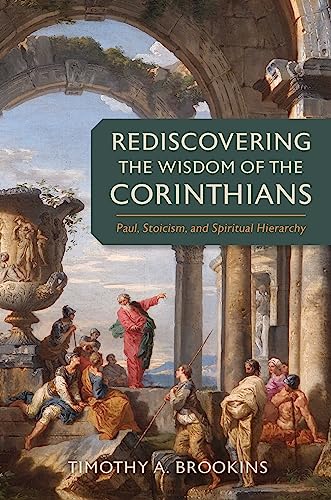
Rediscovering the Wisdom of the Corinthians: Paul, Stoicism, and
Written by Timothy A. Brookins Reviewed By Adam G. WhiteIn 1 Corinthians 1–4, Paul devotes a lengthy section of the letter to address divisions that have occurred in the church. These are reflected in the slogans of 1 Corinthians 1:12: “I follow Paul, I follow Apollos, etc.” What has led to these divisions is a perception amongst some that they possess a wisdom that is superior to the wisdom possessed by the rest of the church. Previous scholars have noted that this wisdom reflects ideas found within the Stoic/Cynic tradition, and it is this that is likely informing the slogans and attendant behaviour that we see later in the letter (e.g., 6:12: “I have the right to do anything”; 8:1: “we all possess knowledge”). Other more recent studies, however, suggest that the core of the divisions relates to oratory. Specifically, those of the Apollos faction were enamoured by his superior rhetorical abilities and have subsequently come to favour him over Paul. While the Corinthians were still perhaps incorporating ideas from popular philosophy, it is the rhetorical abilities of their teacher that sets them apart. Brookins, however, challenges this popular assumption, arguing that the problems in Corinth are rooted specifically in Stoicism. In other words, the “wisdom” that has led to the divisions is not sophistry but rather a Stoic-inspired understanding of natural hierarchy in which the wise man places himself above those he considers to be spiritually underdeveloped. In the case of the Corinthian church, this has led to a faction of Paul’s followers perceiving themselves as superior to and in rivalry with other members of the church.
The book contains three main sections. Part 1 (chs. 1–2) presents an overview of the previous scholarship on the question of the Corinthian wisdom (ch. 1). This is followed by a brief overview of the history of Stoicism and the ways in which the language of sophia was defined within Stoicism and how this could have come into dialogue with the Christian message at Corinth (ch. 2). Part 2 (chs. 3–9) is where Brookins does the exegetical heavy lifting. Here, he systematically works through 1 Corinthians 1–4 with a close analysis of the Greek text, highlighting at each point the Stoic connections in the passage. Throughout this section, Brookins also critiques the main proponents of the rhetorical view (primarily, Winter, Litfin, and Pogoloff), arguing instead that these chapters need to be understood as being informed by Stoic ideas and values. Chapter 9 of this section draws together these insights and extends them to other sections of the letter where this wisdom is being manifested in the Corinthians’ behaviour (e.g., the sexual immorality in 5:1–6:20 or the participation in activities of idol temples in 8:1–11:1). Overall, he proposes that the “Corinthian wisdom” is in fact a type of “sub-Stoicism”—that is, Stoic doctrine “subordinated” to Paul’s teaching.
In part 3 (chs. 10–13), Brookins proposes an entirely original background to the situation in the church. He argues persuasively that the factions of 1:12 reflect a typical rivalry between different philosophical schools, with the named individual as their teacher (ch. 10). Specifically, he proposes that some in the church saw Paul as the founder of a new philosophical “school” in Corinth and have broken off into their own faction. The other three factions have subsequently formed as a reaction to this new group. According to Brookins, this Paul faction began and subsequently took shape in the household of Titius Justus, in whose house Paul moved the church after being driven from the synagogue (Acts 18:7). Some of the members of this founding group had formal acquaintances with Stoicism both due to their more elite status as educated men, as well as with their connections to some of the local Stoic philosophers (well-attested in first-century Corinth [ch. 11]). Over time, and in the ongoing absence of Paul, Stoic ideas have come to embed themselves in the Christian doctrines of this group. This resulted in a new identity grounded in their “sub-stoicism.”
Overall, the book is a significant milestone in Corinthian scholarship. Brookins’s proposal that it is Stoicism that lies behind the Corinthian wisdom is entirely compelling. While previous scholars have argued along these lines, Brookins has (in my view) put the matter beyond doubt. However, I remain unconvinced by other aspects of the thesis. Notably, Brookins presents the background of the Corinthian wisdom in either/or terms. That is, it is either philosophy or rhetoric, his proposal being that Stoic philosophy provides the only necessary explanation for the Corinthians’ wisdom. But this was not a dichotomy reflected in ancient education. Philosophical schools also prioritised oratory and vice versa. Moreover, the arguments put forward by advocates of the rhetorical thesis in Corinthians still (in my mind) offer a more plausible explanation for aspects of 1 Corinthians 1–4, most especially 2:1–5. But despite my reservations on this point, it does not detract from the central thesis of the book. That is, what happened in Corinth was the emergence of a “sub-Stoicism” that has led to the factional behaviour discussed in 1 Corinthians 1–4. Brookins’s extensive knowledge of the primary sources as well as his depth of comparative analysis throughout the study has established this as a solid foundation for ongoing discussion of the topic. This conclusion, I believe, sets the book apart as one of the turning points of Corinthian scholarship.
Adam G. White
Adam G. White serves at Alphacrucis University College, Parramatta, New South Wales, Australia.
Other Articles in this Issue
Main-Point-Driven: A Clear Methodology for Implementing the Christ-Centered Hermeneutic
by Dan AllenThis article addresses the need for a clear methodology for implementing the Christ-centered interpretation...
LaMaster considers Elizabeth Castelli’s contention that Paul’s use of imitative language reinforces power in authority relationships...
Cameron Schweitzer argues that Drew Hunter’s earlier work on Jonathan Edwards’s understanding of typology is too narrowly christological...
This essay argues that evangelical retrieval of the Christian tradition finds a particularly fruitful interlocutor in Athanasius of Alexandria, whose “ruled readings” of Scripture and trinitarian exegesis model a canonically-coherent theological hermeneutic...
Wisdom and Folly in Laodicea: Revelation’s Message to the Laodiceans as Wisdom Discourse
by Joel MacInnesThis article examines Christ’s message to Laodicea as “wisdom discourse,” arguing that it employs “wisdom forms,” “allusions to wisdom literature,” and addresses “wisdom concerns...
Other Reviews in this Issue