
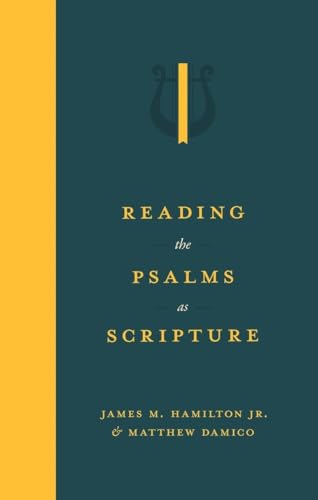
Reading the Psalms as Scripture
Written by James M. Hamilton Jr. and Matthew Damico Reviewed By S. D. EllisonI am writing this review in Peru, a land of incredible variety. It stretches from the coastal region touching the Pacific and its plentiful sea life, through the desert region with its barrenness, into the mountainous areas terminating in high altitude with the snow-covered Andes, and finally breaching the Amazon jungle and all the exotic features of that climate. Yet Peru is one land. So too the Psalms is a book of incredible variety—genres, authors, moods, length, vocabulary, and so on. But it is one book. Hamilton and Damico demonstrate both the variety and unity of the Psalms admirably in Reading the Psalms as Scripture.
James M. Hamilton Jr. is the professor of biblical theology at The Southern Baptist Theological Seminary and senior pastor of Kenwood Baptist Church, Louisville. He has published widely on the Psalms as well as many other aspects of biblical studies and biblical theology. Matthew Damico is the pastor of worship and operations at Kenwood Baptist Church, Louisville, and the director of Kenwood music. He is a graduate of the Southern Baptist Theological Seminary, and this is his first book. An interview with Lexham Press implies that the material is largely Hamilton’s, with Damico being the catalyst for writing up the material as a book and presumably pulling material together—perhaps he was more intimately involved in creating content for chapter 9, ‘Singing the Psalms as Christians’. Together, they have produced a profitable volume for the church.
The book possesses a brief introduction orientating readers to the Psalter and a summary conclusion proffering seven theses for reading the Psalms, which distils the argument of the book into four pages. Between these book ends are nine stand-alone chapters entitled ‘Reading the Psalms as a Book’, ‘Reading the Psalms with their Superscriptions’, ‘Reading the Psalms as Individual Compositions’, ‘Reading the Psalms in the Psalter’, ‘Reading the Psalms in Light of Earlier Scripture’, ‘Reading the Psalms and Messianic Typology’, ‘Reading the Psalms as Interpreted by Later Old Testament Authors’, ‘Reading the Psalms as Interpreted by New Testament Authors’, and ‘Singing the Psalms as Christians’. The chapter titles clearly and effectively map the content of the book. While the chapters are stand alone, they do interact and build upon one another. I should also note here that the chapter on reading the Psalms as individual compositions and its engagement with Hebrew poetry remedies a weakness I highlighted in my Themelios review of Hamilton’s Psalms commentary (Themelios 47 (2022): 588–89, https://www.thegospelcoalition.org/themelios/review/psalms-hamilton-ebtc/).
There are at least three reasons this book will benefit its readers. First, the authors persistently resist the temptation to engage the secondary literature on the Psalter. Rather, they rigorously and relentlessly return to the text of Scripture—encouraging their readers to open their Bible alongside reading the book. The authors are not, however, ignorant of the secondary literature. Second, therefore, this book is probably the first presentation of the academic work on the canonical shape of the Psalter conducted over the past forty years available in a popular-level, accessible volume. Others have come close, such as O Palmer Robertson’s The Flow of the Psalms: Discovering Their Structure and Theology (Philipsburg, NJ: P&R, 2015) or perhaps my own ‘Reading the Psalter as a Book’ (Themelios 49 [2024]: 607–17). Its accessibility means the church will now benefit from the academy—Hamilton and Damico serving as trustworthy guides. Third, the final chapter on singing the Psalms is a great argument for the recovery of singing psalms in our churches today. While worship wars is not a field into which I wish to stray in this review, no faithful Christian could be disappointed by singing more Scripture. Hamilton and Damico assert, “God intends his people to sing, and to sing psalms. In most evangelical circles, we are more likely to find that churches ignore the psalms…. We have bankrupted our own tradition and are needlessly cutting ourselves off from manifold benefits” (pp. 118–19).
One potential disadvantage of this work is its brevity and accessibility. For those who are not convinced of the approach—such as the canonical shape of the Psalter; or a messianic, typological reading of the psalms; or the particular cross-references highlighted with earlier and later Old Testament portions and the New Testament—there is not enough discussion or presentation of evidence to convince. If one desires this engagement, one needs to follow the sparse footnotes or look to Hamilton’s commentary and articles on the Psalms. Of course, such discussions are not Hamilton and Damico’s purpose in the book, which may make this an unfair criticism. But when introducing new concepts to a popular audience, some consideration for these things must be taken into account, given that new proposals are often met with some scepticism. Sceptics are unlikely to be convinced by this volume alone.
Notwithstanding this potential weakness, I plan to use this volume in two ways. First, I think it would prove a helpful book to read in a church book group or home group/small group context. While four or five reflective questions at the end of each chapter would greatly enhance its usefulness in this setting, it remains a provocative conversation starter that points readers to the biblical text. Second, I intend to use this volume (or parts of it) as seminar reading for an introductory undergraduate class on the Psalms. Its accessible level will ensure all students grasp what has been taught, and those who have been diligent in engaging the lecture material appropriately will be provoked by the content to wrestle with the Psalter on these matters.
I have mixed emotions concerning this volume. On the one hand, I am delighted that material which overlaps with my doctoral work is now available in a more popular form. On the other hand, I am disappointed because this is the book I wanted to write on the Psalms—but alas, it has been written! Reading the Psalms as Scripture is a gem of a book that brings the best of recent scholarship on the Psalms into a short accessible format for every Christian.
S. D. Ellison
Davy Ellison holds a PhD in OT biblical studies from Queen’s University, Belfast and serves as the director of training at the Irish Baptist College, Moira, Northern Ireland.
Other Articles in this Issue
I first heard Don Carson speak in 1993 at Cornerstone Church, Nottingham...
A Better Priest and the Problem of Abiathar: Literary and Biblical-Theological Reflections on Mark 2:23–28
by Matthew EmadiI began my NSBT volume, The Royal Priest: Psalm 110 in Biblical Theology, with a quote from a sermon Don Carson preached, called “Getting Excited about Melchizedek...
Christianity brought two startlingly new ideas into the ancient world: the one God is Trinity, and God the Son became incarnate...
Key Questions Concerning the Book of Ecclesiastes: An Explanation of the Negative Views of Qohelet
by Richard P. Belcher Jr.I have two fond memories of meeting Dr. Carson...
Friends, Non-Israelites, and the Surprising Grace of God: A Grateful Retrospective on New Studies in Biblical Theology at 30
by Daniel C. TimmerIt is a joy and an honor to contribute to this special volume of Themelios dedicated to celebrating the thirtieth anniversary of New Studies in Biblical Theology...
Other Reviews in this Issue