
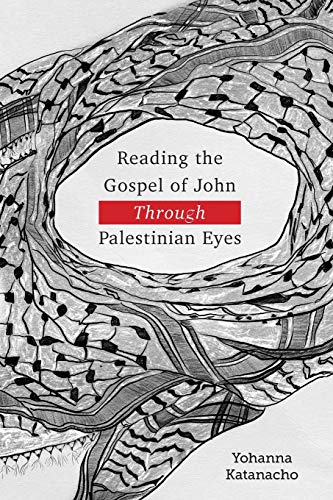
Reading the Gospel of John Through Palestinian Eyes
Written by Yohanna Katanacho Reviewed By Gary M. BurgeYohanna Katanacho is a Palestinian Israeli evangelical who lives and works in Nazareth, Israel. He belongs to the large Palestinian Arab minority in Israel and the small Palestinian Christian community within it. And yet, he has an outsized voice within the Palestinian church. He is on a short list of leading Arab-Christian scholars in Israel/Palestine whose members are writing not only for their community but also for the West. And this explains his unique and singular importance.
Each of us writes history or theology from a perspective. This might be shaped by innumerable factors such as ethnic background, nationality, gender, socio-economic location, historical setting, or national/cultural context. Unwittingly we assume that our own context is the norm and we read others “far from us” too rarely.
Reading Katanacho is thus a helpful—no, a necessary—exercise because we gain insight from a perspective that sharpens our own and diversifies it richly. He is writing as an Arab, a Palestinian, an Israeli, and a Christian who resides in Galilee. He has witnessed the religious rivalries (Judaism, Islam, and Christianity) that reside just beneath the surface of his country. He has also witnessed his country’s dangerous political conflicts. He lives as a member of a distressed minority, such that (despite the fact that his own Arab/Palestinian community makes up nearly 50% of the total population of Israel and the occupied territories), he is still told that this country does not belong to him because of his ethnicity. And he has seen violence and discrimination. The nearby West Bank has frequent conflicts between Jewish settlers and Arab villagers, leaving over two hundred Palestinians dead in 2025. And then there is Gaza in the south, where for over two years about 70,000 of Katanacho’s fellow Palestinians (27% of them children) have died violently, in the wake of the terrible events of October 7, 2023.
This is the context that shapes Yohanna Katanacho’s world and writing. When he talks about peace or hope, he is doing it from within a setting that has known little of it. Peace is not a casual term to him; it is an on-the-ground dream and lost reality.
His current volume on the Gospel of John is not a commentary in the usual sense. There are points where he is writing verse-by-verse explanations of the text. And here he excels marvelously, giving, for example, detailed cultural insights into the wedding of Cana. However, this is not the book’s plan. We find here a series of integrative essays about important themes all shaped by Johannine thinking. He writes about “holy space” (ch. 3), “holy time” (ch. 4), “holy history” (ch. 5), “the holy nation” (ch. 6), and the chapter I flew to immediately: “holy land” (ch. 7). Each of his sixteen chapters picks up a theme and then recreates the theological worldview of John by building the deep structures that are presupposed by the gospel.
The careful reader will at once spot the difference between this book and the usual western commentary. Katanacho’s own context slips through. When he writes chapter 12 (“the persecuted people”) you know that this is not a casual subject for him. However, he does not simply write from the tragedy of Palestinian life but rather universalizes these themes so that a believer in Nigeria, Egypt, Nepal, or Europe will read his words and immediately learn how John’s teachings are relevant to life.
Yohanna Katanacho is a scholar (PhD, Trinity Evangelical Divinity School), a pastor (Christian and Missionary Alliance Church) and a teacher at Nazareth Evangelical College. And each of these vocational callings runs through his writing. He is not simply offering esoteric interpretations for the academy but is writing to bless and enrich the people of God, in Nazareth and around the world. Nathanael once asked, “Can anything good come out of Nazareth?” (Jn 1:46). He was speculating about Jesus, of course, and when he met his Lord, the wonder of Jesus became clear. Another modern answer is yes, good things are coming from Nazareth: Yohanna Katanacho writes from this same city and his offer of this book is a wonder, a gift, to the church.
Gary M. Burge
Calvin Theological Seminary
Grand Rapids, Michigan, USA
Other Reviews in this Issue