
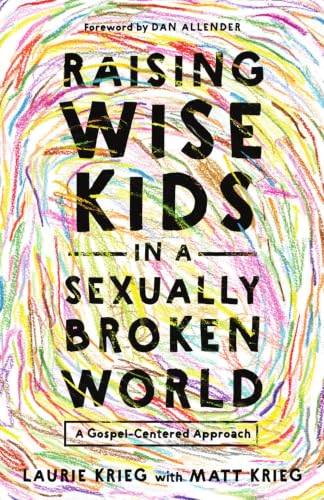
Raising Wise Kids in a Sexually Broken World: A Gospel-Centered Approach
Written by Laurie Krieg with Matt Krieg Reviewed By Kate StevensCharles Spurgeon once said, “The affections, typically understood as the heart, are the wellspring of crimes…. The essential self of man is wrong, and manhood’s vital essence is corrupt” (The Heart—A Den of Evil, sermon 1867). However, were God at the center of our affections, human beings would have no desire to turn elsewhere for inappropriate comfort or attention. Nor would we succumb to the temptation to see and treat others as physically and sexually expendable. But the fact is that we are sinful people living in a broken world where we give our love away cheaply and often carry the scars to prove it. Moreover, as parents, we fear that our children will repeat our mistakes.
Aware of these risks and realities, Laurie Krieg with her husband Matt have written an incredibly helpful book, Raising Wise Kids in a Sexually Broken World. The book aims to equip parents to do something with both the perennial and evolving questions that arise when teaching children about sexuality. The goal of the book is to instill the wisdom of Jesus in kids, so they are faithful and confident in navigating this complex, fallen world.
The Kriegs are not only parents of three school-aged children but also carry experiential and professional weight. Laurie is the director of parent programs and discipleship at The Center for Faith, Sexuality, and Gender. Matt is a licensed mental health therapist with a focus on helping people with sexuality related issues. Furthermore, they are both candid about Laurie’s history of abuse and her struggle with same-sex attraction. (They discuss these matters at greater depth in their previous book, An Impossible Marriage: What Our Mixed-Orientation Marriage Has Taught Us About Love and the Gospel [InterVarsity Press, 2020].)
This book begins with a gospel exposition, which is then followed by a discussion of five aspects or expressions of our sexuality: marriage and singleness, gender, God’s design for sex, body safety, and pornography prevention. Each is handled by an explanation and then practical steps of action. The general target audience is parents of children who are twelve and under, but the book contains many more specific guideposts as to what to address with kids based on their age.
Raising Wise Kids in a Sexually Broken World has three main strengths. First, it is saturated with the gospel throughout, not just at the beginning. For example, when expounding on marriage and singleness in chapter 3, Krieg discusses the specific benefits of each but also makes the crucial zoom-out statement, “It is wise to talk about the options for marriage and singleness as valuable ways to live into God’s mission to restore and redeem the world unto King Jesus” (pp. 41–42). Likewise, in talking about gender in chapter 6, she reminds parents that while our kids are “struggling with living in a sin-drenched world and body,” they were made by God and redeemed by Jesus (p. 93).
Second, Krieg tackles each topic with specific evidence and practical suggestions. For example, chapter 11 uses psychological, social, and religious texts to support the myriad effects of pornography and its ubiquity among Christians, both adults and teenagers. She then follows this up with an age-appropriate breakdown of how to broach the subject of pornography with children (pp. 173–74) and what to do if (or, more likely, when) kids come across it (pp. 175–77).
The third strength is that Krieg works hard to see that no aspect of sexuality is missed. For example, she talks of the heart and mind dimensions of sexuality and how children should view their own future and their role in the lives of others. She even touches on how parents may have been affected by their own sexual failings, long before children were ever part of their lives. For many parents, conversations with children about sexual matters naturally stir up past baggage and even reopen old wounds, especially if they are yet to resolve their own history and clarify their views on some aspects of biblical sexuality. Krieg astutely anticipates this, encouraging parents to teach children from wisdom rather than fear or shame, “because adolescents can pick up emotional nuances like no one else” (p. 100).
This last strength could easily devolve into the greatest weakness of the book—its intensity. If parents dive into this book solely focused on their child, they could be blindsided by their own stories, fears of what their child is being exposed to, missed opportunities at crucial ages, and ignorance of the topics mentioned. This is all to say that the Kriegs’ book should possibly come with a stronger warning to read it slowly and carefully and not to do so in isolation from other parents. The sexual climate and chaos of this generation is a lot to process, and the stakes are indeed high. I could see a nervous parent reading this and expecting the worst for their child. I could also see a wise, older saint reading this alongside a small group of young parents in a sober and prayerful way to the great benefit of many.
Spurgeon was right: “man’s vital essence is corrupt.” So, it is not surprising that all the research, argumentation, and scriptural testimony in this book confirms this tragic truth. But thankfully that is not the only truth. The gospel is good news for adults and children alike: it brings healing where there has been damage, cleansing where there has been defilement, and forgiveness where there has been failure. Not only that, it can also help us face our own corruption, learn to resist temptation, and grow in faithfulness and wisdom. Best of all, it promises believers living in a sexually broken world that one day Jesus will return to make all things new. So, until then, our aim is to raise wise kids who know his grace and desire to imitate him.
Kate Stevens
Kate Stevens, Zionsville Fellowship, Zionsville, Indiana.
Other Articles in this Issue
Main-Point-Driven: A Clear Methodology for Implementing the Christ-Centered Hermeneutic
by Dan AllenThis article addresses the need for a clear methodology for implementing the Christ-centered interpretation...
LaMaster considers Elizabeth Castelli’s contention that Paul’s use of imitative language reinforces power in authority relationships...
Cameron Schweitzer argues that Drew Hunter’s earlier work on Jonathan Edwards’s understanding of typology is too narrowly christological...
This essay argues that evangelical retrieval of the Christian tradition finds a particularly fruitful interlocutor in Athanasius of Alexandria, whose “ruled readings” of Scripture and trinitarian exegesis model a canonically-coherent theological hermeneutic...
Wisdom and Folly in Laodicea: Revelation’s Message to the Laodiceans as Wisdom Discourse
by Joel MacInnesThis article examines Christ’s message to Laodicea as “wisdom discourse,” arguing that it employs “wisdom forms,” “allusions to wisdom literature,” and addresses “wisdom concerns...
Other Reviews in this Issue