
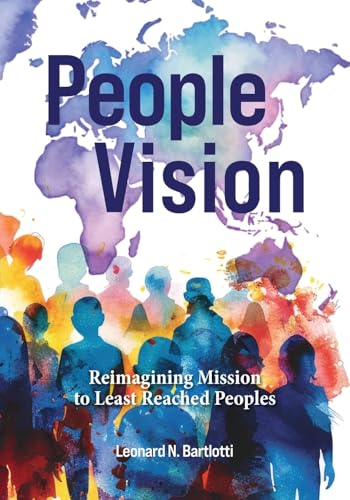
People Vision: Reimagining Mission to Least Reached Peoples
Written by Leonard N. Bartlotti Reviewed By Micah B.Leonard Bartlotti’s People Vision provides a much-needed reframing of how to think about ethno-linguistic people groups. Ralph Winter’s talk at the first Lausanne Congress in 1974 provided the catalyst for thinking about people groups. Winter argued that churches should target ethno-linguistic people groups instead of geopolitical countries. Winter’s assumptions and categories once seemed obvious but have come under scrutiny. People Vision brings together a team of missiologists and practitioners from around the world to address these concerns and rediscover the people-group paradigm.
A strength and a challenge of the book is the wide range of topics, divided into seven sections, contributed by over sixty authors. The topics include: the biblical foundations for people-group thinking, denominational and agency focus on unreached peoples, practitioner challenges in focusing on unreached peoples worldwide, church methods, global efforts at collaboration, and specific challenges and future strategies for targeting the unreached. Bartlotti explains that People Vision aims to provide an “overview of people group thinking, the priority of least reached peoples today, and innovative efforts to reach them” (p. 27).
The first section focuses on the biblical foundation of people-group thinking. This is the area that has received the greatest opposition. Critics argue that the people-group approach relies on modern sociological divisions rather than biblical ones. The authors respond by showing how the ethno-linguistic definition of people groups is firmly grounded in Scripture.
The second and third parts describe the journey of a few key mission agencies toward a focus on the unreached, as well as the on-the-ground experience of individuals. Neither of these sections advances an argument for or against unreached people groups, but they offer anecdotes about people-group thinking in recent history. These sections highlight some of the obstacles that churches and practitioners face when focusing on the unreached.
The second half of the book details global mobilization strategies to the unreached, considers some of the complexities and challenges of these efforts, and concludes by describing the heart of unreached ministry as “a tool to make sure we don’t miss anyone” (p. 267). Rather than serving as a robust defense of the ethno-linguistic people group concept, the book focuses on helping the church catch a vision for sending people to places where Christ is not named.
There are two major strengths of People Vision. First, Bartlotti identifies the need to recast people-group thinking in view of the needs of the unevangelized. People Vision does not redefine people groups but focuses on the complexities of globalization and urbanization in making disciples among the unreached. They respond to criticism of traditional paradigms that sought to develop monoethnic congregations. Bartlotti writes, “Gospel freedom allows and celebrates, but does not demand, homogeneous ethnic churches” (p. 38).
Second, People Vision is a practical book that invites churches, organizations, and individuals into the discussion and helps recast a vision for bringing the gospel to whole ethnic groups without access. This is a welcome missiological addition that will help further the discussion regarding people groups in missions.
The introduction, first chapter, and conclusion, all written by Bartlotti, provide a cohesive argument for a biblical understanding of people groups, the need to re-envision the approach, and a way forward in light of shifting global realities. The primary weakness of People Vision as a whole, however, is that it reads like a collection of loosely connected articles, given the vast number of contributors and subjects. The sheer volume of topics in People Vision obscures the book’s main point.
Secondly, since the biblical basis for ethno-linguistic people-group thinking has received the most objections, this book could have provided a more in-depth biblical analysis of people groups in Scripture and maintained that analysis throughout. The first part of the book, which presented the biblical grounds for people-group thinking, provided an excellent overview and analysis, but it left the reader wanting more. Bartlotticould have strengthened this book and reached a wider audience by including voices from biblical scholars who have written on ethne (nations).
The definition and use of people-group terminology throughout the book can sound contradictory. For example, in the conclusion, Bartlotti argued that the Bible’s use of “people groups” primarily refers to ethno-linguistic groups and is distinct from groups of people with shared interests (p. 259). The chapter, “Rethinking the People Groups Concept,” provides an excellent reference point for outreach to social groups in an urban context. Still, the chapter is out of place because it focuses on groups of people with shared subcultures like “punks, bikers, hipsters, and other sexual orientation types” (p. 203) rather than on narrowing in on a biblical perspective of people groups. Even though the chapter does not claim that social groups are ethno-linguistic people groups, including a chapter on social groupings further confuses the biblical framework of people groups that the book seeks to “reimagine.” The chapter entitled “The Rise of Muslim-Background Churches” likewise contributes to an ambiguous definition of people groups, as it focuses on “Muslims,” a group defined by religious affiliation rather than the ethno-linguistic definition used throughout the book.
People Vision provides an excellent reanalysis of people groups, wrestles with difficult case studies, and relies heavily on practitioners, churches, and organizations. The book does fall short of the lofty hope of the foreword, to be “the most important book in many years” (p. xi), mainly because it fails to address the biblical foundation for people groups comprehensively. However, the main value is its thoughtful analysis and compelling motivation to reach the unreached.
Micah B.
Micah B. serves at Gulf Theological Seminary, Dubai, UAE.
Other Articles in this Issue
Main-Point-Driven: A Clear Methodology for Implementing the Christ-Centered Hermeneutic
by Dan AllenThis article addresses the need for a clear methodology for implementing the Christ-centered interpretation...
LaMaster considers Elizabeth Castelli’s contention that Paul’s use of imitative language reinforces power in authority relationships...
Cameron Schweitzer argues that Drew Hunter’s earlier work on Jonathan Edwards’s understanding of typology is too narrowly christological...
This essay argues that evangelical retrieval of the Christian tradition finds a particularly fruitful interlocutor in Athanasius of Alexandria, whose “ruled readings” of Scripture and trinitarian exegesis model a canonically-coherent theological hermeneutic...
Wisdom and Folly in Laodicea: Revelation’s Message to the Laodiceans as Wisdom Discourse
by Joel MacInnesThis article examines Christ’s message to Laodicea as “wisdom discourse,” arguing that it employs “wisdom forms,” “allusions to wisdom literature,” and addresses “wisdom concerns...
Other Reviews in this Issue