
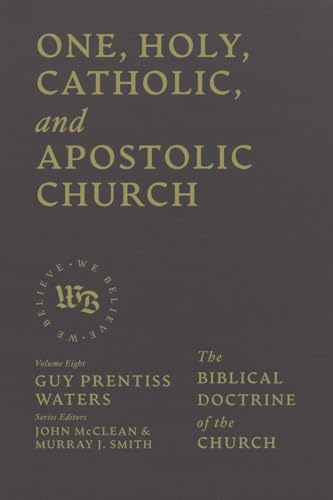
One, Holy, Catholic, and Apostolic Church: The Biblical Doctrine of the Church
Written by Guy Prentiss Waters Reviewed By Thomas Haviland-PabstGuy Prentiss Waters is the James M. Baird, Jr. Professor of New Testament at Reformed Theological Seminary. Though a New Testament scholar, Waters has written several books and articles venturing into ecclesiology, such as Well-Ordered, Living Well: A Field Guide to Presbyterian Church Government (Grand Rapids: Reformation Heritage, 2022). In contributing to the We Believe series with his One, Holy, Catholic, and Apostolic Church, Waters continues to give attention to the doctrine of the church.
The series seeks to build upon and “constructively develop” (p. xxviii) primary doctrines of the Christian faith in conversation with Scripture and doctrinal theology. Waters’s contribution reflects well the goals of this series. The book is divided into three main parts. The first part (chs. 1–7) gives attention to Scripture, specifically, the biblical-theological and canonical teaching of Scripture on ecclesiology. The second part, comprising chapters 8–13, focuses on the doctrine of the church—including discussions on the church’s attributes, marks, government, life, and mission. The third part consists of one chapter (ch. 14) which discusses the relationship between the church and the state. To conclude, Waters provides seven theses to summarize his findings on the doctrine of the church.
There are several strengths that characterize this work. Beyond the fact that Waters’s discussion is clearly written and sound in the main, he provides in the first section a penetrating exposition of relevant biblical texts to support his understanding of the doctrine of the church. Interestingly, Waters makes a compelling case for the use of confessions in his discussion on the marks of the church. He defines confessions as documents “developing” the ecumenical creeds “and responding to errors,” as “human documents” serving as “summaries, in uninspired language, of the truths of inspired Scripture” (p. 154). Given this definition, the author offers numerous reasons for using the confessions: (1) there are examples in Scripture of summaries of doctrine (e.g., 1 Cor 15:3–4); (2) confessions help the church’s mission by enabling her to “communicate the gospel precisely … and consistently” (p. 156); and (3) confessions fosters unity within the church and between different church bodies.
Though Sunday as a day of worship is assumed by most Christians in the world, Waters provides some helpful reasons it ought to be so, such as, e.g., Jesus rising from the grave on the first day and John the apostle speaking of “the Lord’s Day” in Revelation 1:10. Though non-Sabbatarians may not appreciate his argument here, the New Testament seems to point toward the first day of the week as having significance for corporate worship. In his discussion of the government of the church, Waters makes a sound argument for elders “jointly” administering church discipline, clarifying that apostles doing so individually was due to “their extraordinary office” (p. 178) and thus not prescriptive for the church today. Regarding the mission of the church, Waters rightly emphasizes preaching as primary over against deeds. Though deeds are important, they cannot supplant but must supplement and confirm the preaching of the gospel. In the final chapter, Waters makes a compelling case for a “two-kingdoms” approach to the question of the church/state relationship, writing that each signifies “distinct spheres of authority” (p. 246). Finally, Waters soundly navigates the complex question of the role of the Spirit in both the Old and New Testaments, arguing rightly that the Spirit “had been active … redemptively under the old covenant,” and, as such, the new covenant represents “a deepening and expansion” (p. 78) of the Spirit’s work under the old covenant.
Despite its many strengths, some weaknesses also need to be mentioned. The author asserts, rather than argues, that “church” in Matthew 16:18 and 18:17 refers to elders, not the entire congregation (p. 218). Furthermore, the author does not clearly connect these passages (Matt 16:19 with 18:19) and seemingly omits explicit commentary on the relationship between Matthew 16, 18, and 28. In conjunction with this, Waters asserts at a separate juncture that the church is endowed by Christ with the prerogative to enact church discipline, yet he stipulates that its exercise is confined to a plurality of elders, “not by the congregation” (p. 218, emphasis mine). Here, he is making a distinction between the power held by the church and the authority wielded by elders only. However, he fails to demonstrate this on exegetical grounds. Similarly, Waters implies that the Presbyterian form of church government is the one that is biblically faithful. However, his engagement with other approaches, specifically Congregationalism, the distinct Reformed model of church government, is regrettably brief and therefore lacking in depth. Finally, it would have been beneficial, given ongoing discussions within Presbyterian denominations, to address the question of female ordination and service as deacons. Notwithstanding these limitations, its lucidity, conciseness, and focus on the fundamental aspects of church doctrine render this work one of the premier contemporary treatments of ecclesiology overall, and of Reformed Presbyterian ecclesiology specifically.
Thomas Haviland-Pabst
Montreat College
Asheville, North Carolina, USA
Other Reviews in this Issue