
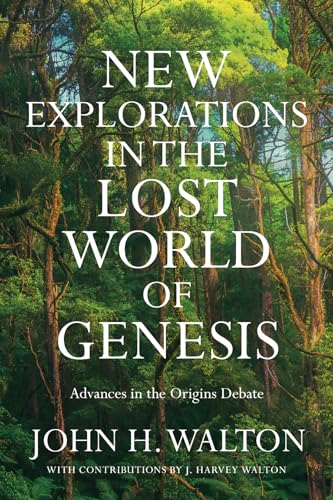
New Explorations in the Lost World of Genesis: Advances in the Origins Debate
Written by John H. Walton, with contributions byJ. Harvey Walton Reviewed By G. Kyle EssaryJohn Walton, long a leading evangelical voice on Genesis, first published the popular Lost World of Genesis One in 2001. Over the past sixteen years, he has published seven more volumes in the series, including this latest one. This book supplements previous arguments, with only occasional revisions (p. 8). It also includes contributions from J. Harvey Walton, whose research inspired many of the revisions. As with previous volumes, readers will find this volume clear, readable, provocative, and engaging.
After an introductory chapter on the background of this book, chapter 2 discusses Walton’s methodology. This longest chapter shows how his methodology shapes his conclusions. Scripture, he argues, has divine authority through human agency, with inerrancy applying only to biblical affirmations and not necessarily references. For instance, a character’s reference may not be theologically or historically accurate. However, he extends this idea “beyond … traditional confines” (p. 22). Are shared ANE concepts, such as cherubim and seraphim, the serpent in Genesis 3, or the divine council in 1 Kings 22 reference or affirmation? He gives no answer but shows how far one might extend this dichotomy. He suggests that concepts shared with the broader ANE are “most likely a reference,” while those that depart from standard ANE thought are “most likely affirmation” (p. 25). Thus, “the Bible is true in all that it affirms … but that does not mean that [references] stand as something that the Bible affirms in its authority” (p. 27). Distinguishing between the two is, for Walton, crucial for determining what counts as authoritative and inerrant.
Chapters 3–4 supplement Walton’s previous work on Genesis 1. Walton previously highlighted Genesis 1 as a treatise on function instead of material origins. Walton now prefers the term order instead of function. If Genesis 1 moves from chaos to order, then those made in God’s image are order-bringers (p. 91). The goodness of creation refers to its orderliness (pp. 93–94). Divine rest refers to achievement of order (p. 130). Even the broader movement from creation to new creation is now conceptualized as an expansion of divine order.
Chapters 5–6 supplement Walton’s previous work on Genesis 2. Walton no longer argues that the garden of Eden was like a tabernacle. Instead, he now views both the garden of Eden and the tabernacle within a framework of royal gardens (p. 140). This shifts the archetypal role of Adam and Eve from priests in a tabernacle to royal wardens maintaining order in a garden. More notably, Walton now conceives of the garden as located in the divine realm where Adam and Eve could not find order (p. 142). They learn that “dwelling in the divine realm [is] unnatural” (p. 143).
Chapters 7–8 supplement Walton’s earlier work on Genesis 3 and contain the book’s most controversial claims. Walton explains J. Harvey Walton’s research on Genesis 2 and 3 and calls it both “mind-blowing” and “perhaps disturbing” to traditional theology (p. 183). He contends that Adam and Eve’s pursuit of “godlikeness … was not wrong” but “inadequate to achieve their desired outcome” of order (p. 182). Genesis 3, he insists, is not “about how sin came into the world … [or] about how the choices of two individuals have negatively affected all the rest of us” (p. 184). Questions about the origin of sin are, for Walton, anachronistic (p. 184). This leads to a rejection of doctrines of original sin: “Adam and Eve are not to be blamed for our sin and its resulting condition—we each individually and universally carry that load” (p. 194). Nor is their exile punishment (pp. 198–200), but Adam and Eve are sent “out to enter the world to which they belong, to a new phase of life” (p. 198). Such proposals are stimulating yet “perhaps disturbing,” and evangelicals who hold to historic doctrines of the fall will remain cautious about adopting Walton’s conclusions.
Chapters 9–10 give a brief discussion of the relationship between Genesis and science and a summary conclusion. Chapter 9 summarizes previous arguments from Walton’s other books with only minimal new explorations. Walton makes clear that the Bible does not consider modern questions of science, such as material mechanisms. Chapter 10 restates and summarizes areas of new research and significant revision. He suggests that the “basic thrust of [his] position remains largely unaltered” (p. 241). The order spectrum continues to underlie much of his research and provides insightful avenues for further research (p. 241).
This book offers several surprising supplements and revisions. Throughout, Walton consistently holds that interpreters should track “with the author as those invested with authority from God” (p. 241) and this book continues his lifelong project of understanding ANE thought and how it shapes Genesis. For these questions, interpreters will value Walton’s in-depth research and consistent methodology.
But can biblical authority be reduced to human intention within a particular historical context? Many would disagree with Walton and hold that historical and cultural studies serve the meaning of the text but do not finally determine it. The Holy Spirit did not inspire Genesis apart from his redemptive plan to fulfill all things in Christ. For this reason, many will remain dissatisfied with a methodology that downplays the text’s divine telos and how later Scripture shapes our understanding of earlier revelation.
Pastors and students who are interested in Genesis will want to read this volume alongside Walton’s earlier works. Walton remains a clear and engaging conversation partner. But they will want to consider Walton’s methodology alongside other recent works, such as C. John Collin’s Reading Genesis Well: Navigating History, Poetry, Science, and Truth in Genesis 1–11 (Grand Rapids: Zondervan Academic, 2018), or Kevin Vanhoozer’s Mere Christian Hermeneutics: Transfiguring What It Means to Read the Bible Theologically (Grand Rapids: Zondervan Academic, 2024).
G. Kyle Essary
G. Kyle Essary
Malaysia Baptist Theological Seminary
Kuala Lumpur, Selangor, Malaysia
Other Reviews in this Issue