
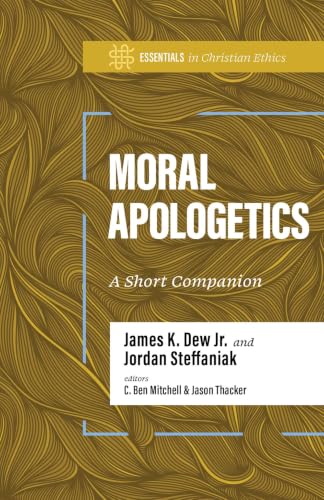
Moral Apologetics: A Short Companion
Written by James K. Dew and Jordan Steffaniak Reviewed By Andrew SlayThe recent shift from evidential to moral apologetics has been drastic. Since the Enlightenment, the main challenges to Christianity have been leveled at its truth claims. Today, however, skeptics are generally not asking if Christianity is true. Instead, they are asking whether it is good. The church, then, must be ready to speak into the moral issues surrounding topics like racism, sex and gender, the family, abortion, euthanasia, and AI. This is a difficult task, particularly as Christian responses are often seen as abusive, hateful, and anti-human. But thankfully, help is at hand. In Moral Apologetics: A Short Companion, James K. Dew and Jordan Steffaniak offer a valuable resource to equip believers to present cogent apologetic arguments in answer to common objections.
The authors’ main contention is that all the moral objections to Christianity stem from a failure to appreciate the significance of the human person—a significance grounded in the eternal existence of the Triune God. Based on a defense of humanity’s hylomorphic constitution and unique status as God’s image (part 1), Dew and Steffaniak pick apart the culture’s critique (part 2), effectively dismantling the moral arguments against the Christian faith. This review will highlight the authors’ two key arguments for the metaphysical reality of human nature in part 1 of their book and then provide an assessment of their application in part 2.
Part 1 explores the foundations of Christian morality as grounded in human metaphysics. For human nature to be an objective concept that is universally true, there must first be such a thing as objective morality that provides moral standards that are binding for all people in all places. Thus, Dew and Steffaniak aver that atheistic moral concepts have no metaphysical room for transcendent morality. So, for example, when assessing the non-natural, non-theistic moral realism of Erik J. Wielenberg, the authors state: “Obligations to do particular actions and avoid others arise from persons, not facts or objects. If morality is merely a brute fact [as Wielenberg claims], we lack obligations altogether” (p. 30). Hence, objective moral obligations cannot be brute facts but must be grounded in the eternal being of a personal God who will hold his creatures accountable.
This brings us to their second key argument: the objective reality of human nature (or the self). They define human nature as “the particular essence that grounds all essential attributes shared by human beings” (p. 36). They then argue that the postmodern attempt to make human nature plastic or “fluid” is what has led to the current confusion concerning identity, sexuality, gender, and personal autonomy. And so, “If we want to respond to the moral debates of our day, we must understand the philosophical backdrop of the changing views on human nature” (p. 38). In landscaping this backdrop, Dew and Steffaniak make two points. First, until postmodernity, every philosopher believed that humans shared a particular nature located in the self; second, even though they shared a belief in the objective reality of human nature, they did not share a unified understanding of the self.
In response to the postmodern assault on the self, the authors offer multiple arguments. First, postmodernists do not offer any compelling arguments for completely removing human nature from reality; they merely offer rhetoric. Second, philosophers who deny the existence of the self “teeter on absurdity,” as they deny the self-evident truth that all people share “ontological similarities,” such as feeling, thinking, planning, and acting. If we are the “kinds of things” that can perform these actions, then we are “kinds of things” that have a fixed nature or essence (p. 51). Third, the postmodern understanding of the self is self-contradictory, because the “self” that is shaped by cultural forces cannot exist in the postmodern worldview. As Dew and Steffaniak state: “How is it that I can be shaped if ‘I’—a particular self—am not there in the first place as the kind of thing capable of being shaped” (p. 51). Fourth, postmodernists have no ground to enforce their ethical codes if their worldview denies that “we are kinds of beings that have moral obligations or duties” (p. 52). Fifth, it is impossible to affirm both Christian doctrine and postmodern anthropological views because the postmodern view of human nature denies the creation of humanity in God’s image and the full humanity of Christ (pp. 52–53).
In part 2, Dew and Steffaniak demonstrate how a right understanding of human nature answers the moral objections to Christianity surrounding racism, sex and gender, abortion, marriage and the family, and transhumanism. For example, only a biblical worldview truly combats racism by affirming the equal dignity of every human being, only biblical doctrine teaches the true meaning and purpose of human sexual dimorphism, and only a biblical anthropology has the resources to prevent us from allowing technology to transform us into machines because “if our bodies are part of what it means to be human, we should not seek to transcend them” (p. 185).
Although Dew and Steffaniak typically offer robust arguments throughout their book, I have one small critique of their chapter on sex and gender. They argue that sex and gender are interchangeable terms. They are aware, of course, that some use gender to refer to social roles, norms, or identity. In fact, they concede that there is “nothing inherently wrong about this when carefully used.” But they continue, “in our view, when ‘gender’ is used for these social outworkings of biology, it is nothing distinct from sex.” And so, they conclude, “we think it’s best to treat them as synonymous and still make clear there is a difference between sex and its social expression” (p. 121).
The problem here is the confusion created by maintaining that “there is a difference between sex and its social expression” and yet also maintaining that “when ‘gender’ is used for these social outworkings of biology, it is nothing distinct from sex.” If the first proposition is true, the second cannot be. Moreover, one problem that often arises from conflating sex and gender is the creation of rigid stereotypes. For example, if seventy per cent of men love hunting and fishing, and we have no other term to describe their preference other than sex (or gender meaning sex) then what about men who do not love hunting and fishing? Are they less male because of that fact? No.
What this highlights is the need to allow some slack in the line between sex and its various outworkings. So, even if we lost the language of gender altogether, we would still need terms to describe the psychosocial dimensions of sex (e.g., “sex roles,” “sex norms,” and “sex identity”) and to express the fact that, when it comes to prevailing norms for masculinity or femininity in a given culture, men and women land at various points on their respective distributional curves. Nevertheless, it is important to acknowledge that both the authors and this reviewer are arguing for the inextricable connection between sex and its expression and against any severing of that connection—as in transgenderism and gender-inclusive feminism.
God’s people stand in need of robust and readable resources to refute ethical objections to the goodness of God and the Christian worldview. Dew and Steffaniak have gone a long way toward meeting that need in Moral Apologetics.
Andrew Slay
New Orleans Baptist Theological Seminary
New Orleans, Louisiana, USA
Other Articles in this Issue
Main-Point-Driven: A Clear Methodology for Implementing the Christ-Centered Hermeneutic
by Dan AllenThis article addresses the need for a clear methodology for implementing the Christ-centered interpretation...
LaMaster considers Elizabeth Castelli’s contention that Paul’s use of imitative language reinforces power in authority relationships...
Cameron Schweitzer argues that Drew Hunter’s earlier work on Jonathan Edwards’s understanding of typology is too narrowly christological...
This essay argues that evangelical retrieval of the Christian tradition finds a particularly fruitful interlocutor in Athanasius of Alexandria, whose “ruled readings” of Scripture and trinitarian exegesis model a canonically-coherent theological hermeneutic...
Wisdom and Folly in Laodicea: Revelation’s Message to the Laodiceans as Wisdom Discourse
by Joel MacInnesThis article examines Christ’s message to Laodicea as “wisdom discourse,” arguing that it employs “wisdom forms,” “allusions to wisdom literature,” and addresses “wisdom concerns...
Other Reviews in this Issue