
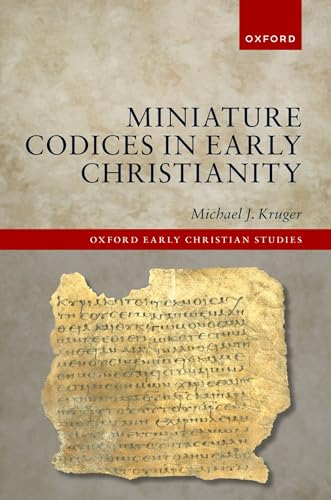
Miniature Codices in Early Christianity
Written by Michael J. Kruger Reviewed By Ched SpellmanIn our digital age, the shift from text to hypertext has introduced new opportunities and complexities to the task of reading. What it means to “read a book” might mean many different things. One of the reasons that this paradigm shift feels so destabilizing is because of the unrivaled dominance of the codex “book form” that has been at the center of how people organize and access information for thousands of years.
An interesting feature about the earliest churches is that they were early adopters of this then innovative publication technology (outpacing the broader Greco-Roman world by several hundred years). In Miniature Codices in Early Christianity, Michael Kruger examines an easily overlooked datapoint in this story of the codex format. As part of the material turn in the study of the ancient world, scholars have noted the meaningful significance of not only the content of biblical manuscripts but also their physical or paratextual features. Kruger’s focus is on “miniature codices” and what they might tell us about the people and communities that read and produced them.
While these tiny religious texts have been analyzed in various ways, Kruger’s monograph is the first full-length treatment of this kind of codex. In demonstrating the rationale for his study, Kruger notes that further work needs to be done on defining the category of a miniature codex, cataloguing the relevant evidence that must be included, and exploring the implications this evidence might have for our understanding of the early Christian community (pp. 1–28). Kruger structures his work in order to address each of these three areas of needed research.
Kruger begins by defining the category of a “miniature codex” with precision, by accounting for both form and content. Drawing on previous studies but also modifying them, he establishes a size criterion (less than 12 cm in width), surveys the extant evidence, and situates these very small codex manuscripts within the broader landscape of ancient book production. His focus is on miniature codices that are produced in the “early” era of the church (which he ranges from the second to eighth centuries), that originate or function within the Christian community, and that are written in Greek on either papyrus or parchment. This foundational work allows the study to distinguish miniature codices from other small-format texts and to clarify their relative frequency among Christian manuscripts compared with non-Christian literary remains.
The argument develops by examining competing explanations for the function and origin of miniature codices. Kruger evaluates proposals that attribute these manuscripts to practical concerns such as portability, personal reading, or economic efficiency, as well as interpretations that emphasize “magical,” symbolic, or performative uses. One of Kruger’s chief contributions to this area of scholarship is his careful delineation of the similarities and differences between miniature codices and religious amulets. Older studies conflated these two categories, but Kruger maintains that many miniature codices did not function like amulets (which were usually understood by users to provide some sort of benefit or protection if they were worn).
For Kruger, several features distinguish a mini-codex from an amulet or mystical token: they are composed with continuous text, they are in the codex format, and they bear the marks of professional or competent scribal production (see pp. 36–46, pp. 102–5). These features lead to an important and interesting conclusion, namely, that these tiny texts were designed to actually be read by their users. Though they could certainly have been used as an amulet by a given person (e.g., a book with excerpts from New Testament texts about healing worn by someone who is sick), these carefully crafted booklets were intended to function as readable texts (e.g., the personal copy of a Gospel for personal study and devotion). Mostly, these texts were probably meant for private use, but Kruger also observes the liturgical-ritual function of some examples that contained elements of an ecclesial service. While the size of the codex prevented easy public reading, “they could have been used by ministers as a handy guide to their liturgical duties” (p. 67). In this scenario, “the minister might have held the little booklet in one hand while reading the communion text, offering a communion prayer, and even leading a final hymn” (p. 67).
Beyond this interpretive issue, a major component of this volume is Kruger’s comprehensive catalogue of manuscripts that fit the criteria he establishes for the category of a miniature codex (see pp. 106–69). Here Kruger provides a unique numbering system for sixty-two manuscripts. Kruger acknowledges that further research will likely uncover more manuscripts in the future, but this catalogue exceeds previous formal studies. Each entry describes the basic content of the manuscript, the reconstructed size of the artifact, the generally accepted date range, a bibliography of the most relevant published studies on a given fragment, and a fresh description of the manuscript that includes aspects like scribal patterns and any notable paleographical features.
The study concludes by integrating the material findings into a broader account of early Christian textual practices, arguing that miniature codices constitute a meaningful subset of Christian manuscripts that illuminate how texts were produced, circulated, and used within early Christian communities. Statements are often made by scholars and pastors that downplay the relevance of physical copies of the Scriptures in the ancient world. However, Kruger’s study at the very least forces a more nuanced vision of how biblical texts functioned for individuals in these eras. As Kruger observes, “the mere existence of such tiny books is a reminder that (some) Christians—perhaps more than we thought—expressed their textual culture, and particularly their commitment to the Christian scriptures, in private/personal ways” (p. 177). This means that “like never before, individual Christians could be united to, and connected with, their books” (p. 177, emphasis original). Indeed, “it is hard to think of something more bookish than always carrying around a book” (pp. 177–78). These kinds of observations have the potential to reshape several commonly stated assumptions about the reading culture of the earliest churches.
In the end, this technical volume about little books yields sizable insight into the social and reading culture of Early Christianity. A literal page-turner about ancient little page-turners.
Ched Spellman
Ched Spellman is assistant professor of biblical and theological studies at Cedarville University in Cedarville, Ohio.
Other Reviews in this Issue