
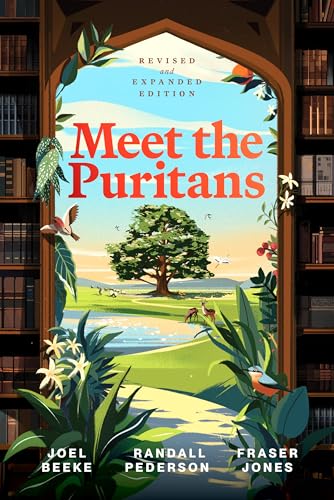
Meet the Puritans: A Guide to Their Lives and Books
Written by Joel R. Beeke, Randall J. Pederson, and Fraser E. Jones Reviewed By James L. A. MorrisonEven those who do not have a particular interest in seventeenth-century Reformed theology are unlikely to have missed the remarkable attention which the Puritans have received over the last eighty years. Often attributed to the founding of The Banner of Truth Trust in 1957, and its close association with Martyn Lloyd-Jones, the second half of the twentieth century saw the republication of numerous theological and devotional works from the early modern period.
This appetite spawned numerous other publishers who sought to meet the growing interest in Puritan literature. One of the most prolific of these is Reformation Heritage Books (RHB), set up under the editorial direction of Joel Beeke in 1995. In the time since, it has published or reprinted over 150 titles, many of which relate to Puritan spirituality. Particularly important were the publication of three introductory volumes to the subject: Meet the Puritans (2006), a catalogue of Puritan republications since 1957 with accompanying biographies; A Puritan Theology (2012), an introduction to fifty key areas of Reformed theology which the Puritans developed and applied to their lives; and Ore from the Puritans’ Mine (2020), a compilation of over 3,000 quotations from more than 250 Puritan authors organised under 400 different headings. I have regularly turned to each of these titles, both in my pastoral ministry and studies of post-Reformation Reformed theology.
So it was with excitement that I heard that RHB had released a new edition of the first of these books. As well as cataloguing the hundreds of reprints that have become available over the last two decades, this expanded version of Meet the Puritans also includes short biographies of an additional forty-five figures from the early modern period. Amongst the additions are accounts of Englishmen such as Oliver Cromwell (1599–1658), Irishmen such as James Ussher (1581–1656), and Scotsmen such as Robert Rollock (1555–1599), as well as those from the Dutch Further Reformation such as Petrus van Mastricht (1630–1706). There are also expanded bibliographies of collected Puritan works and secondary sources on the movement, together with an enlarged glossary of key terms.
This second edition also has a handful of new features. There is a guide for those wanting to read the Puritans for the first time (which originally appeared elsewhere). There are also short chapters from each of the authors with their personal recommendations of particular writers to read. Added to the sections in the previous version providing brief histories of English Puritanism, Scottish Presbyterianism, and the Dutch Further Reformation, there is now included a more general introduction to Puritanism, an essay on the Church of England and the universities of early modern England, and chronologies detailing the births and deaths of the 190 individuals covered in the work. If the first edition was already a treasure trove of information on the Puritans, this new edition is even more so, being forty percent longer than its original size.
With size comes cost. Currently retailing for over $50, the new edition is not cheap. That being said, it will likely prove a valuable investment for those able to buy it. The authors explain that they had three intended audiences in mind, and undoubtedly each will find it beneficial. If you are a church member, it will provide a helpful guide to support your devotional reading. There are lots of books about the Puritans, but there is no replacement for reading them yourself. The authors’ recommendations will give inspiration for what to read, and the bibliographies will help you find it. The various introductory sections will offer helpful background on the historical events and social dynamics of the times, and the short biographies will provide a window on a writer’s particular place within them. Like in all periods of historical theology, the impact of such information can be significant for our appreciation of what someone wrote and why they wrote it.
If you are a pastor, this book is likely to be of help in a number of additional ways. Not only will the accounts of the ministries of a previous generation be of encouragement to you in yours, they will also prove a fertile source of illustrations for your preaching and teaching. And when it comes to deciding what titles to add to your library, the book summaries will encourage you to resist the chronological snobbery of thinking that new is necessarily better by introducing you to some of the best from the seventeenth century.
For students just getting into the period, the introductions and biographies will provide you with valuable orientation before moving on to more advanced secondary sources. The glossary will be of help too, though, as you become more familiar with the area, you will begin to realise that many of the definitions given there are rather more nuanced in the scholarship.
Like the volume’s predecessor, this expanded edition will be a helpful work for specialists to keep close at hand. The chronological list of births and deaths is a neat way of quickly identifying the dates of figures in relation to each other. The biographical sketches also provide a good overview of an individual’s life, though most receive no more than a few pages. This is less a criticism of the authors of this important volume and more a reflection of the scholarship. For whilst so much has been done in the last seventy-five years to increase the contemporary church’s appreciation of the Puritans, there is still more work to be done in our understanding of them. The authors have done an impressive job in giving church members, pastors, and scholars what they need to keep meeting the Puritans.
James L. A. Morrison
Union Theological College
Belfast, Northern Ireland, UK
Other Articles in this Issue
Main-Point-Driven: A Clear Methodology for Implementing the Christ-Centered Hermeneutic
by Dan AllenThis article addresses the need for a clear methodology for implementing the Christ-centered interpretation...
LaMaster considers Elizabeth Castelli’s contention that Paul’s use of imitative language reinforces power in authority relationships...
Cameron Schweitzer argues that Drew Hunter’s earlier work on Jonathan Edwards’s understanding of typology is too narrowly christological...
This essay argues that evangelical retrieval of the Christian tradition finds a particularly fruitful interlocutor in Athanasius of Alexandria, whose “ruled readings” of Scripture and trinitarian exegesis model a canonically-coherent theological hermeneutic...
Wisdom and Folly in Laodicea: Revelation’s Message to the Laodiceans as Wisdom Discourse
by Joel MacInnesThis article examines Christ’s message to Laodicea as “wisdom discourse,” arguing that it employs “wisdom forms,” “allusions to wisdom literature,” and addresses “wisdom concerns...
Other Reviews in this Issue