
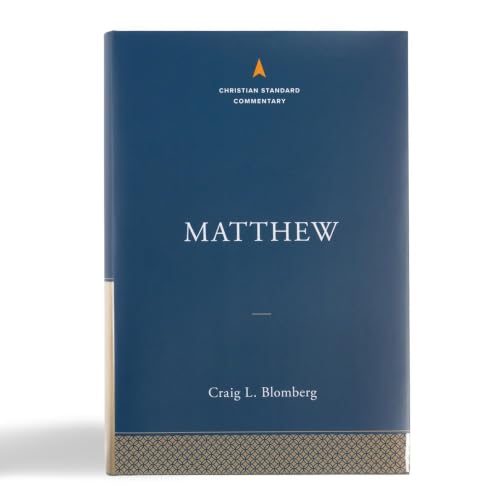
This volume is a revision of Blomberg’s 1992 commentary on Matthew in the New American Commentary (NAC) series. It is also part of a new series, the Christian Standard Commentary (CSC). Blomberg discusses this connection in his author’s preface (pp. xv–xx), noting that the vision behind the CSC series was to revise and update the NAC using the Christian Standard Bible (CSB) as the base text (the NAC used the NIV). A revision was only possible for some of the volumes, however, since a number of original authors had retired, passed away, or were otherwise unable to take on a revision. So the CSC is a combination of new volumes and revised ones. Oddly, the series introduction (pp. xi–xiv), presumably written by the general editors, says nothing about the connection between the NAC and the CSC, nor the use of the CSB as its base text.
Some commentary revisions are small upgrades, correcting minor mistakes and updating bibliography. Blomberg’s is on a much grander scale. He notes that because his NAC commentary stayed within its contracted word count, he was able to expand this one considerably (NAC: 460 pp.; CSC: 752 pp.). The thoroughness of revision is evident in the select bibliography (pp. 689–92). Of the approximately one hundred books listed there, about ninety percent were written after the first edition of the commentary.
Blomberg’s style is clear and accessible, designed especially for students and pastors but with sufficient scholarly depth for academic research. It is a good “go to first” commentary, setting out well the central thrust and key interpretational issues in each passage. Blomberg deals fairly with opposing views and often reaches mediating solutions.
It is of course impossible in a short review to comprehensively survey each passage. Instead, I will summarize Blomberg’s conclusions on various introductory issues and then on a few of Matthew’s controversial passages.
Concerning Matthew’s structure, Blomberg sees legitimacy in both of the two most widely cited outlines. The first is structured around the five main teaching sections (chs. 5–7; 10; 13; 18; 23–25), which all end with a similar formula (“after saying these things…”) and alternate with sections of narrative. The second, proposed by Jack Kingsbury, is structured around the formula, “From that time on Jesus began to…,” which appears at 4:17 and 16:21, dividing Jesus’s ministry into three phases (1:1–4:16; 4:17–16:20; 16:21–28:20). Blomberg integrates both of these into his outline, as some other commentators have, but uniquely reverses the order of discourse and narrative from 16:21 onward.
On Matthew’s theology, Blomberg surveys five main themes: Christology, fulfillment of Scripture, discipleship and the church, Israel and the Gentiles, and eschatology. He is skeptical of Kingsbury’s conclusion that “Son of God” is Matthew’s dominant title for Jesus. While it is certainly an important one, appearing in key passages and containing both messianic and divine connotations, one should not diminish the importance of other titles and themes that contribute significantly to Matthew’s fulfillment motif (e.g., Christ, Son of David, Son of Man, Wisdom, Lord).
Concerning Matthew’s purpose and audience and more specifically the scholarly debate whether Matthew’s community has decisively broken with Judaism, Blomberg agrees with those who see the relationship with the Jewish community as already severed, but he views this break as recent enough that the two are still in vigorous polemical debate (pp. 34–35). This kind of conflict was occurring throughout the Roman empire, which makes the exact location of Matthew’s community uncertain. What little evidence there is from the early church suggests Judea or Palestine, but more popular among contemporary scholars is Antioch in Syria. This conclusion is driven by Antioch’s large Jewish population, thriving Christian church, and proximity to Palestine.
On Matthew’s sources, Blomberg affirms the likelihood of the two-source hypothesis, that Mark’s Gospel was written first and that both Matthew and Luke used Mark as well as a common source or sources (“Q”). On the date of Matthew, Blomberg agrees with D. A. Carson that the paucity of evidence would allow nearly any date between AD 40 and 100, “but perhaps a slight preponderance of weight favors a date in the 60s” (p. 50).
On authorship, Blomberg acknowledges that, strictly speaking, all four Gospels are anonymous. It is church tradition that identifies the author as Matthew (Levi) the tax collector. But nothing in the date, purpose, or content of the Gospel precludes this identification. Blomberg rejects the argument that Matthew could not have been the writer since an apostle would never have used the work of a non-apostle (i.e., Mark). The early tradition associating Mark’s Gospel with Peter would have been sufficient to give it the stamp of apostolic authority. While apostolic authorship is not necessary to ensure the inspiration and authority of the gospel, “Matthew remains the most plausible choice for author” (p. 53).
With reference to historicity and genre, Blomberg takes a similarly measured approach. He concludes that while “none of the gospels is a history or biography of Jesus according to modern standards of precision and reporting … nevertheless, Matthew, like the other three gospels … measures up quite well when compared with ancient Jewish and Greco-Roman histories and biographies” (pp. 54–55).
On various fulfillment quotations, where Matthew has been accused of taking the Old Testament text out of context (e.g., Isa 7:14 at 1:22–23; Hos 11:1 at 2:15; Jer 31:15 at 2:17–18), Blomberg appeals to various kinds of double fulfillment, either partial and proleptic fulfillment in the Old Testament followed by final or complete fulfillment in the New Testament (p. 75), or to various kinds of typology or analogical fulfillment (pp. 85–86; pp. 87–88).
Matthew’s preference for “kingdom of heaven” over “kingdom of God” reflects pious Jewish use of circumlocution to avoid uttering the divine name. In terms of their meaning, the two expressions are largely interchangeable. The distinction is not, as in older dispensational scholarship, an indication of a postponed kingdom (pp. 96–97).
On Matthew’s most famous teaching section, the Sermon on the Mount (chs. 5–7), Βlomberg surveys eight major interpretations, finding the most satisfying one in an “inaugurated” or “already/not yet” eschatology, where the sermon’s ethic remains the ideal for all Christians, but which will never be fully satisfied until the consummation of the kingdom at Christ’s return (pp. 131–32).
Finally, the strange episode in 27:51–53, where “many bodies of the saints who had fallen asleep were raised … and appeared to many,” is most likely not a legendary accretion or apocalyptic symbolism but “a genuine event, just like the resurrection Jesus himself,” with rich theological significance concerning the bodily resurrection of the dead (pp. 665–67).
Those who know Blomberg’s work from other writings will recognize the same clarity, balance, and insight found there. While at times (though surprisingly rarely) I disagreed with Blomberg’s individual conclusions, his thoughtful, humble, and measured scholarship is on display throughout. This volume will no doubt assume its rightful place as one of the most respected and useful commentaries on Matthew’s Gospel.
Mark L. Strauss
Mark Strauss is University Professor of New Testament at Bethel Seminary.
Other Articles in this Issue
I first heard Don Carson speak in 1993 at Cornerstone Church, Nottingham...
A Better Priest and the Problem of Abiathar: Literary and Biblical-Theological Reflections on Mark 2:23–28
by Matthew EmadiI began my NSBT volume, The Royal Priest: Psalm 110 in Biblical Theology, with a quote from a sermon Don Carson preached, called “Getting Excited about Melchizedek...
Christianity brought two startlingly new ideas into the ancient world: the one God is Trinity, and God the Son became incarnate...
Key Questions Concerning the Book of Ecclesiastes: An Explanation of the Negative Views of Qohelet
by Richard P. Belcher Jr.I have two fond memories of meeting Dr. Carson...
Friends, Non-Israelites, and the Surprising Grace of God: A Grateful Retrospective on New Studies in Biblical Theology at 30
by Daniel C. TimmerIt is a joy and an honor to contribute to this special volume of Themelios dedicated to celebrating the thirtieth anniversary of New Studies in Biblical Theology...
Other Reviews in this Issue