
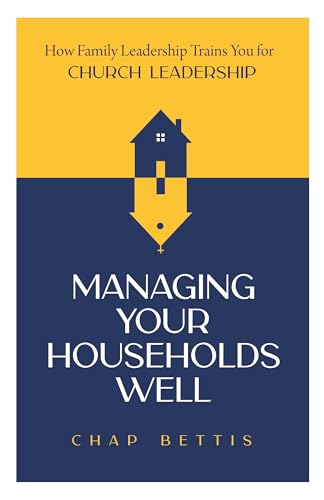
Managing Your Households Well: How Family Leadership Trains You for Church Leadership
Written by Chap Bettis Reviewed By B. J. HilbelinkAt first glance, it might appear that a typo has infiltrated the title of this book (and indeed, it is misprinted in multiple places online). Most churches expect their leaders to have one “household”—not multiple “households”! The plural, however, is not only intentional but fundamental to the book’s message. Chap Bettis contends that there is an organic, God-ordained connection between parenting well and pastoring well: the better a man manages his own household, the more skillfully he will shepherd God’s household—and vice-versa.
Bettis begins by highlighting 1 Timothy 3 and Titus 1, where Paul devotes disproportionate space to the elder’s effective family management (1 Tim 3:4–5; Titus 1:6). This “vital aspect of godly leadership,” Bettis laments, “is being overlooked” in contemporary seminaries and churches (p. xii). Managing Your Households Well aims to address this void—not as a “comprehensive leadership book” or an in-depth parenting manual but to “make clear the connection between leading your family well and leading God’s people well” (p. xiv).
The book divides neatly into two parts. Part 1 establishes the theological foundation by expounding the relevant Pauline passages and clarifying key concepts such as “manage” (pp. 8–10) and “above reproach” (pp. 39–48). Part 2 draws out practical implications in the areas of leadership (ch. 5; Appendix A), communication (ch. 6), conflict resolution (ch. 7), and character formation (ch. 8).
As I read, I was struck by how richly and naturally the leadership lessons of church and home inform one another. As Bettis wryly observes, “A plumber might not make deep connections between his job and his family (other than fixing the pipes!), but a church leader should see profound similarities” (p. 8). On Bettis’s model, the home is not merely the initial testing ground in which leaders display their fitness for ministry, as a cursory reading of Paul might suggest; it is a discipleship laboratory in which leaders continue learning fresh lessons for ministry. Listening carefully to one’s wife, for instance, can help a pastor see things from a woman’s perspective and more effectively care for women in his congregation (pp. 68, 73). Likewise, moving toward difficult conversations at home strengthens a pastor’s resolve to face conflicts within the church (pp. 46–47).
The strengths of Managing Your Households Well are threefold. First, given the relative lack of contemporary emphasis on the “marvelous pipeline” between the home and the church (p. xvii), Bettis’s bookfills a significant gap—one that seminary curricula have been slow to address. Shepherding one’s family may indeed be one of the most important “things they don’t teach you in seminary.”
Second, Bettis writes with the gravitas of a seasoned pastor-father. Each chapter is packed with pithy one-liners that search the soul: “You don’t want to be a public success and a private failure” (p. 25); “Our children … are little sanctification machines that shine a floodlight on ways we need to grow” (p. 59). The same pastoral wisdom informs Bettis’s balanced and nuanced approach to leadership. The model leader, in his view, is characterized by “both rule and care,” “authority and affection” (p. 18), and is “neither permissive nor perfectionistic” (p. 41). Throughout, Bettis addresses problematic contemporary trends in pastoring and parenting (pp. 15, 16, 18, 22) without diminishing the book’s timeless message.
Third, Bettis has a rare gift for posing penetrating questions: “Would your wife and children say you are the same person in public that you are in private?” (p. 26); “Are you a skilled encourager, giving grace with your words? Or are you stingy with your praise?” (p. 65). Such questions are not merely tacked on to each chapter as an afterthought; they invite leaders to evaluate themselves with specificity and honesty. In particular, the final two appendices (pp. 119–34) are well worth the price of the book, for they supply dozens of questions for a pastor and his wife to evaluate his leadership together—an exercise my wife and I found highly illuminating and have already recommended to other church leaders.
One of the book’s most debatable points lies in chapter 3, where Bettis presents five arguments that the phrase echōn pista in Titus 1:6 refers to “faithful” children rather than “believing” children (pp. 30–32). His strongest argument is that belief is a sovereign work of God, whereas a father more directly cultivates faithfulness and other virtues in his children (p. 30). One wonders, however, whether a father bears substantially more influence over his children’s faithfulness than their faith. By God’s grace, might not a father exert as much influence on their faith through proclaiming the gospel as he does on their behavior through discipline? Some readers may find more persuasive the observation that whenever the New Testament pairs pistis (“faith,” cognate to pistos in Titus 1:6) with echō (“to have”), the phrase uniformly refers to possessing faith in God (Matt 17:20; 21:21; Mark 4:40; 11:22; Luke 17:6; Acts 14:9; Rom 14:22; 1 Cor 13:2; 1 Tim 1:19; Phlm 5; Jas 2:1, 14, 18). To his credit, Bettis later qualifies his position and, in a characteristic display of nuance, gestures toward the “believing children” interpretation. He concludes that “when a loving father teaches his children the gospel, and when they trust their father, then we could expect them to embrace his God…. This is a gracious outworking of hearing the sweet news of the gospel from a source they trust” (p. 34).
None of the foregoing detracts from the book’s substantial value. Managing Your Households Well will prove useful to a wide range of readers: emerging elders, pastoral search teams and ordination committees, seminary professors teaching pastoral theology, and especially pastors, young and old, who aspire to be “shepherds after [God’s] own heart” (Jer 3:15).
B. J. Hilbelink
B. J. Hilbelink serves at Litfin Divinity School, Wheaton College, Wheaton, Illinois.
Other Articles in this Issue
Main-Point-Driven: A Clear Methodology for Implementing the Christ-Centered Hermeneutic
by Dan AllenThis article addresses the need for a clear methodology for implementing the Christ-centered interpretation...
LaMaster considers Elizabeth Castelli’s contention that Paul’s use of imitative language reinforces power in authority relationships...
Cameron Schweitzer argues that Drew Hunter’s earlier work on Jonathan Edwards’s understanding of typology is too narrowly christological...
This essay argues that evangelical retrieval of the Christian tradition finds a particularly fruitful interlocutor in Athanasius of Alexandria, whose “ruled readings” of Scripture and trinitarian exegesis model a canonically-coherent theological hermeneutic...
Wisdom and Folly in Laodicea: Revelation’s Message to the Laodiceans as Wisdom Discourse
by Joel MacInnesThis article examines Christ’s message to Laodicea as “wisdom discourse,” arguing that it employs “wisdom forms,” “allusions to wisdom literature,” and addresses “wisdom concerns...
Other Reviews in this Issue